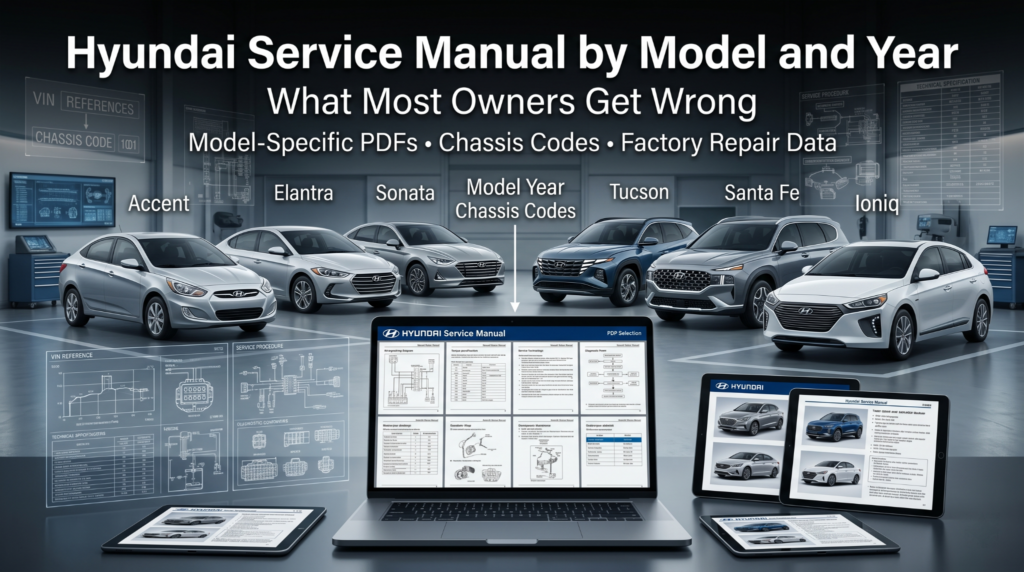
Most Hyundai owners grab a manual that looks close enough and assume it will work. That assumption leads to wrong torque specs, missed procedures, and repairs that fail within weeks. The difference between the right manual and a near-match is not minor.
Pinpoint the required documentation by using your 17-digit Vehicle Identification Number (VIN). This code identifies your engine, model year, and market to ensure a perfect match. For guaranteed accuracy, enter your vehicle's year, model, and trim into the official Hyundai Resources Manuals & Warranties portal.
This post walks through how to decode your VIN for manual selection, how the three main Hyundai manual types differ, where model generation gaps cause the most damage, and how to verify any manual before you rely on it. Every section connects directly to your next repair decision.
Find Correct Hyundai Manual: The Exact Steps Most Drivers Skip

Alter Tag:Comparison of different Hyundai Tucson generations showing why model year specific manuals are necessary for accurate repairs.
Most drivers search for a manual by model name alone. That approach fails because Hyundai uses the same model name across multiple generations, engine variants, and regional specifications. A manual for a 2014 Tucson will not reliably cover a 2019 Tucson. The platform, engine architecture, and electrical systems are fundamentally different between those two years.
Knowing your manual type matters just as much as knowing your year. An owner's manual covers operation and scheduled maintenance. A factory service manual covers teardowns, torque specifications, wiring schematics, and full diagnostic procedures. Grabbing the wrong type for the job produces either a document too thin to help or a technical spec set that does not match your drivetrain.
The fastest path to the correct document combines three inputs: your full 17-digit VIN, your production market (Europe, North America, or other), and your intended repair system (engine, electrical, suspension, or body). Every step below builds toward that verified match.
Hyundai Manual Type vs. Use Case vs. Risk of Wrong Selection
|
Manual Type |
Best Use Case |
What It Covers |
Risk if Wrong Type Used |
|
Owner Manual |
Daily operation, basic maintenance intervals |
Fluid types, warning lights, basic service schedule |
Missing torque specs, no repair procedures |
|
Workshop / Service Manual |
DIY repairs, diagnostics, rebuilds |
Torque specs, wiring diagrams, system procedures |
Incomplete data for complex repairs |
|
Factory Service Manual (OEM) |
Professional-level or safety-critical repairs |
Full OEM specs, ECU pinouts, assembly sequences |
Wrong specs, ECU or structural damage risk |
|
Parts Catalog |
Ordering replacement components |
Part numbers, exploded diagrams |
Correct parts, but no install procedures |
|
Body Repair Manual |
Collision or structural repair |
Panel alignment specs, weld procedures |
Structural integrity compromise |
Your VIN Holds the Answer to the Right Manual
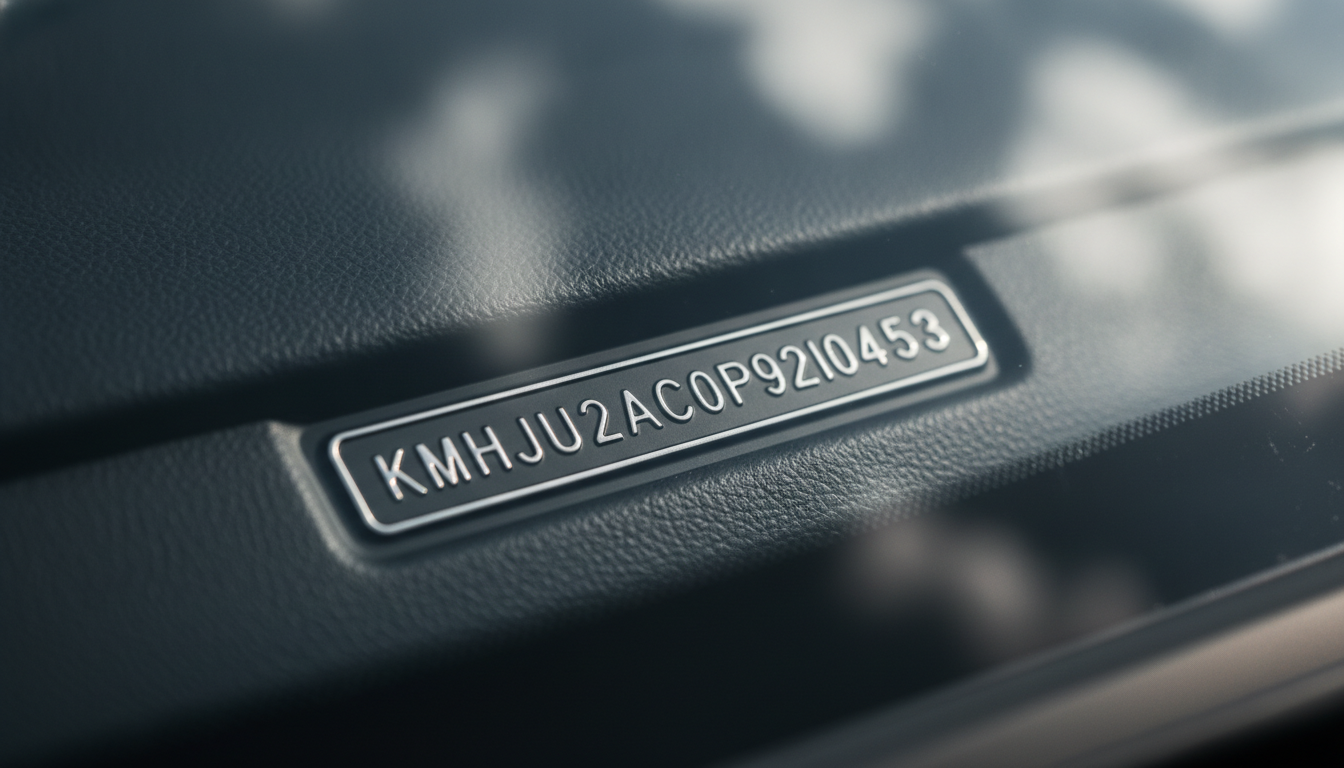
Alter Tag: Close-up of a 17-digit Hyundai Vehicle Identification Number (VIN) on a dashboard used for manual selection.
Your 17-digit VIN is stamped on the driver-side dashboard, visible through the windshield, and on the driver-side door jamb sticker. Both locations carry the same string. Before you open any manual database or download any PDF, you need this number in hand.
The VIN is not just a registration identifier. It is a factory data record that encodes your exact production spec, including engine type, body style, restraint system, and assembly plant. Using the VIN before sourcing a manual eliminates the most common sourcing mistake: selecting by model name alone without confirming the year or variant.
For Hyundai vehicles built after 1981, the VIN follows the standardized 17-character format set by the National Highway Traffic Safety Administration. Older or regionally produced models may use shorter formats, so always confirm the VIN length before decoding.
Reading Digit 10 for Your Model Year
The 10th character of your VIN is the model year code. It does not directly represent the calendar year of manufacture. Instead, it follows a standardized alphanumeric sequence. For example, the character A represents 2010, B represents 2011, C represents 2012, and so on. Numeric characters cover earlier years. Knowing this character confirms the exact model year your manual must cover.
This matters because Hyundai updates specifications between model years, sometimes significantly. A transmission solenoid test procedure written for a 2016 model year may reference a 6-speed DCT. That same procedure written for a 2020 model year may reference an 8-speed unit with different solenoid locations, resistance values, and wiring connectors. The model year code is non-negotiable before manual selection.
Write down your 10th VIN character before you open any manual portal. Cross-check the manual's listed coverage year against that character. If those two do not align, close that document and continue searching.
Digits 4-8 and Your Engine Code
Digits 4 through 8 of the VIN form the Vehicle Descriptor Section. Digit 8 is the engine type code. For Hyundai vehicles, this position identifies the specific displacement and fuel system. For example, the code D identifies a 2.0L DOHC gasoline engine on certain models. This code tells you which engine-specific procedures, torque specs, and fluid capacities apply to your vehicle.
Why does this matter for manual selection? The same Hyundai Sonata, in the same model year, was sold with a 2.0L naturally aspirated engine, a 2.0T turbocharged engine, and a 2.4L naturally aspirated engine depending on trim level and market. A manual covering one engine will carry incompatible torque specifications, oil capacity figures, and timing procedures for the others.
Confirm your engine code before selecting any section inside a service manual. Many factory manuals include all engine variants in one document but separate them by code within each section. Using the wrong subsection produces the same errors as using the wrong manual entirely.
The Three Manual Types and When Each Applies
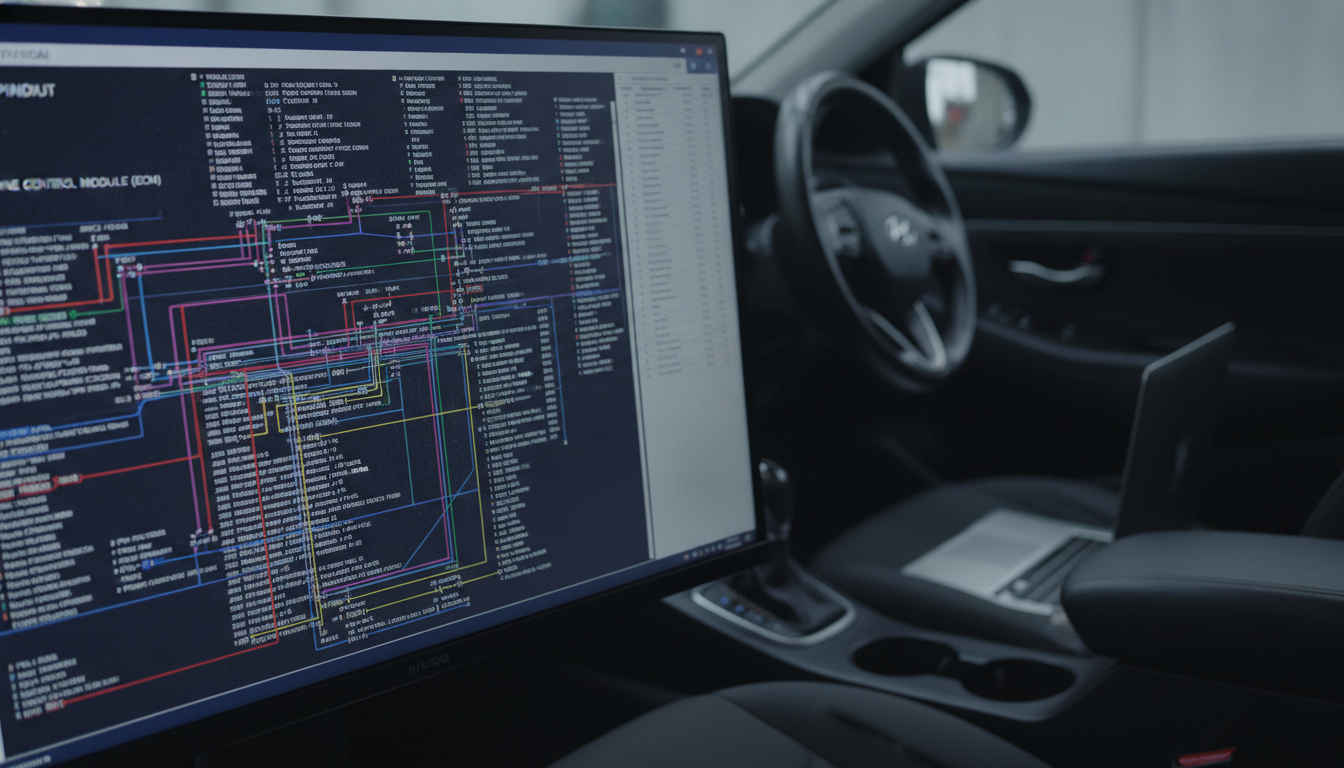
Alter Tag:Hyundai factory service manual displaying complex electrical wiring schematics and ECU pinouts for professional repair.
Not every repair requires a factory service manual. Selecting the right manual type for your task saves both time and money. The owner manual is written for the everyday driver. It covers explanations of warning lights, scheduled maintenance intervals, fluid type recommendations, and basic operational procedures. It is adequate for oil change intervals and tire pressure tables, but it stops well short of repair data.
The workshop or service manual bridges the gap between consumer guidance and professional repair documentation. It includes torque specifications, step-by-step repair procedures, system diagrams, and diagnostic flowcharts.
For most DIY repairs, this is the correct document. The Hyundai Europe vehicle range across models like the H-1 and Grand Santa Fe uses regional service manual editions that account for European emission standards and market-specific electrical configurations.
The factory service manual, or OEM manual, is the most accurate document. It is produced by or directly authorized by Hyundai Motor Company.
It includes the same data set that dealer technicians use, covering ECU pinout charts, full wiring schematics, assembly torque sequences, and hybrid or EV system isolation procedures. For safety-critical repairs, this is the only document that carries the full spec set.
How Model Generation Gaps Lead to Wrong Specs
Hyundai reuses model names across completely different platforms. The Galloper, available on Hyundai Europe's Galloper page, has a very different mechanical architecture from later compact SUVs that share a similar market position. Using a manual from the wrong generation of any nameplate is one of the highest-risk sourcing errors in DIY repair.
Generation gaps affect every major system. The engine codes, transmission types, suspension geometry, ABS architecture, and electrical bus design all change across generations. A manual covering the first generation of any model will include torque specifications, fluid volumes, and diagnostic procedures that are incorrect when applied to a second-generation vehicle.
The safest approach is to confirm the model generation before sourcing any document. You can identify your generation by combining the model year code from your VIN with the body code listed in your registration documents.
The Hyundai Europe Accent 1st Generation is a clear example of a model where generation-specific sourcing is critical. Its X3 platform carries fuel, ignition, and suspension data that is entirely incompatible with later Accent generations.
For any Hyundai with more than two generation cycles, never assume a manual labeled with your model name is correct. Always verify the generation code in the document's coverage table before using any specification.
Verified Sources That Match Manuals to Your VIN

Alter Tag: Digital interface of the official Hyundai Global Service portal for sourcing VIN-matched repair manuals.
The most reliable source for a Hyundai manual matched to your VIN is the Hyundai Global Service portal, which is the same system dealer technicians access. This portal allows lookup by model, model year, and market region. It is subscription-based but provides exact OEM documentation rather than third-party interpretations.
For the full Hyundai Europe vehicle catalog, NXT Motors' Hyundai Europe section aggregates model-specific resources for European-market vehicles, including models for which documentation is difficult to find through generalist databases. This is particularly useful for older European-market Hyundais where documentation availability is limited.
Subscription platforms like ALLDATA and Mitchell1 also carry Hyundai factory documentation matched to VIN. These platforms are widely used by independent repair shops and provide reliable year-specific data.
Helm Inc. publishes printed factory service manuals for select Hyundai models and is another OEM-level source. For the H-1 van platform, which has a distinct European spec, NXT Motors' H-1 page provides a useful starting point for sourcing model-specific documentation.
Avoid downloading PDFs from unverified file-sharing sites. Beyond legal risk, unverified documents frequently carry transcription errors in torque specifications. One documented case in the repair community involved an aftermarket manual listing an incorrect valve cover torque figure, roughly double the correct specification, resulting in broken fasteners. Legitimate sourcing eliminates that risk entirely.
Four Checks Before Trusting Any Hyundai Manual

Alter Tag:Maintenance checklist for verifying a Hyundai service manual against vehicle VIN and engine specs before repair.
Before using any manual for a repair, run four verification steps. Each one filters out the most common sourcing errors before they reach the workbench.
Check 1: Confirm the model year coverage. Open the manual's coverage page or title block. The listed model year must match the 10th character of your VIN. A one-year gap is enough to invalidate critical specifications on updated platforms. This is especially true for Hyundai Europe models where annual updates sometimes precede North American rollouts by a production cycle.
Check 2: Confirm the engine code match. Find the manual's engine coverage section. Cross-reference the listed engine code against digit 8 of your VIN. If the manual covers a different displacement or fuel system, the torque specs and service procedures will not apply accurately to your vehicle.
Check 3: Confirm market applicability. European-market Hyundais frequently differ from North American or Korean-domestic specs in emission system design, electrical architecture, and even suspension tuning. A manual sourced for the wrong market can carry incorrect sensor specs and incorrect fluid grades for your vehicle's operating environment.
Check 4: Verify system coverage in the table of contents. Before starting any repair, confirm the specific system you need to service has a dedicated section in the manual. Some workshop manuals omit advanced electrical sections or hybrid system procedures. If the relevant chapter is absent, source a supplementary document before proceeding.
Running these four checks takes less than ten minutes. They prevent misdiagnosis, incorrect reassembly, and the cost of a secondary repair on a primary mistake.
Common Asked Questions About How to find the correct Hyundai manual
Can I use a North American Hyundai service manual for a European-market vehicle?
North American and European Hyundai manuals cover the same model names but often carry different specifications. European-market vehicles frequently use different emission-control configurations, transmission tuning, and ECU calibrations.
Using a North American manual for a European-spec Hyundai can result in incorrect sensor resistance values, incorrect fluid type recommendations, and mismatched torque specs for market-specific components.
Always source a manual that specifically states European or regional coverage matching your vehicle's country-of-origin code, based on the first digit of your VIN. Sourcing correctly from the start prevents the most common diagnostic errors on European-market Hyundais.
Is the Hyundai owner manual enough to perform brake pad replacement at home?
The owner manual covers the brake system only at the warning light and basic inspection level. It does not include caliper removal sequences, brake pad clearance specifications, caliper bolt torque values, or rotor minimum thickness data.
For a brake pad replacement that requires any caliper work or rotor measurement, you need a workshop or service manual specific to your model year and engine variant.
The owner manual is designed to tell you when to seek service, not how to perform it. Using only the owner manual for brake work creates a significant safety risk by leaving critical assembly specifications undocumented.
What does the 10th digit of my Hyundai VIN actually represent?
The 10th VIN digit represents the model year using a standardized alphanumeric code. It does not always match the calendar year you purchased the vehicle. Hyundai and all other manufacturers build "model year" vehicles during the prior calendar year.
For example, a vehicle produced in late 2019 may carry a 2020 model year code. This distinction matters critically for manual selection because Hyundai often updates specifications at the start of a new model year.
The digit follows a fixed sequence: A equals 2010, B equals 2011, and so on through the alphabet, skipping I, O, Q, U, and Z.
Why do third-party repair guides sometimes carry incorrect Hyundai torque specs?
Third-party guides are produced by publishers that compile data from multiple sources rather than directly from factory documentation. Errors can arise from transcription of physical manuals, from mixing specifications across model years, or from incorrectly applying data from one regional variant to another.
In documented cases, incorrect torque values from third-party sources have been copied between editions of the same publication without correction.
The safest approach for any structural, engine, or safety-critical repair on a Hyundai is to use a factory service manual or a verified subscription platform like ALLDATA or Mitchell1 that sources directly from manufacturer data.
How do I find a service manual for an older or discontinued Hyundai model?
Older, discontinued Hyundai models are often underserved by digital databases that prioritize newer model years. The best approach for discontinued platforms is to search for original factory service manuals in print format from Helm Inc. or from specialized automotive document archives.
For European-market models specifically, regional dealer networks may still have access to older documentation via the Hyundai Global Service portal.
Model-specific pages, such as those covering legacy Hyundai European vehicles, provide a useful starting point for navigation when generalist databases return no results.
Print manuals for older models often carry more accurate specs than digitized third-party compilations built from photocopied sources.