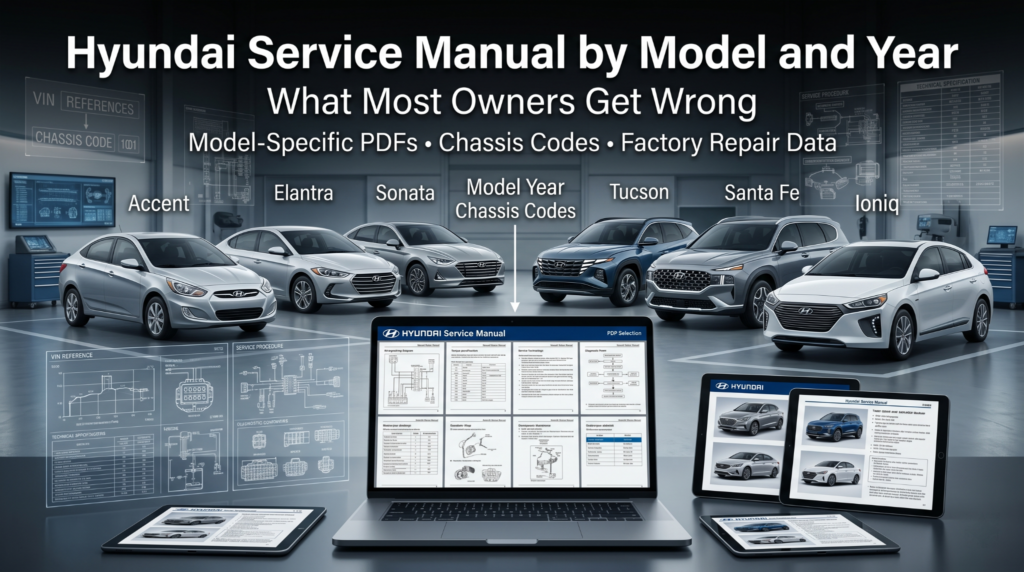
Getting the wrong Hyundai service manual is more common than most technicians admit. A manual labeled for your model and year can still contain torque specs, wiring diagrams, and fuel system data that do not match your actual build. That mismatch does not show up until something goes wrong on the bench.
Accurate maintenance requires using your 17-character VIN to access a Hyundai Electronic Repair Manual. Decoding six specific digits ensures you receive build-specific data, including engine codes and manufacturing details, which eliminates technical guesswork.
This guide walks through every VIN position that affects manual selection for Hyundai vehicles. It covers where to find the correct factory data, how to spot a mismatched manual before it costs you time, and which platforms serve Hyundai's official repair documentation.
Hyundai VIN Service Manual: Why One Wrong Digit Breaks Your Repair
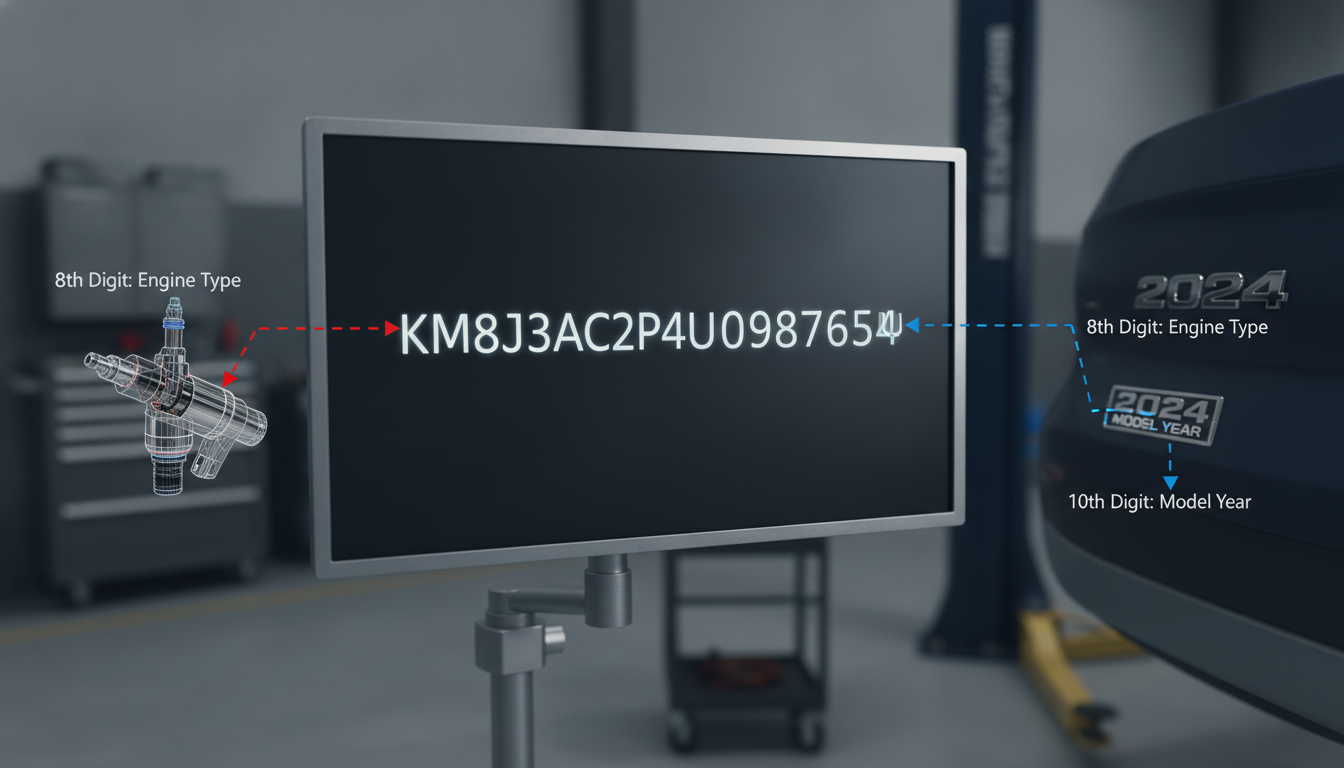
Alter Tag: A detailed technical breakdown of a Hyundai 17-character VIN showing how specific digits map to engine and model year data for repair accuracy.
The Hyundai VIN service manual system is built on a 17-character Vehicle Identification Number that encodes your car's exact build configuration. Every character in that number ties to a specific data field in the factory documentation system.
When you skip the VIN decode and select a manual by model name alone, you are gambling that your exact engine code, transmission type, and production region match the manual's scope, and they often do not.
Hyundai uses the same model nameplate across multiple plants, regional markets, and engine and gearbox variants, sometimes within the same model year. The Tucson, Santa Fe, Elantra, and i30 all share this complexity.
Pulling the correct Hyundai factory service manual means locking in on at least the first 10 positions of the VIN before you touch a download button or a subscription portal.
The table below shows exactly how each VIN section maps to manual selection.
VIN Position to Manual Selection, Quick Reference
|
VIN Position |
Characters |
What It Encodes |
Manual Impact |
|
1-3 |
World Manufacturer Identifier (WMI) |
Country of origin, manufacturer |
Determines regional manual set |
|
4-8 |
Vehicle Descriptor Section (VDS) |
Body type, engine code, restraint system |
Core manual selection, most critical |
|
9 |
Check digit |
Validation only |
No manual impact |
|
10 |
Model year |
Production year |
Selects correct model year manual |
|
11 |
Plant of manufacture |
Assembly plant |
Confirms regional variant |
|
12-17 |
Production sequence |
Build order number |
Used for TSB and recall lookup only |
Decode Positions 1-3: Your Hyundai's Origin Code
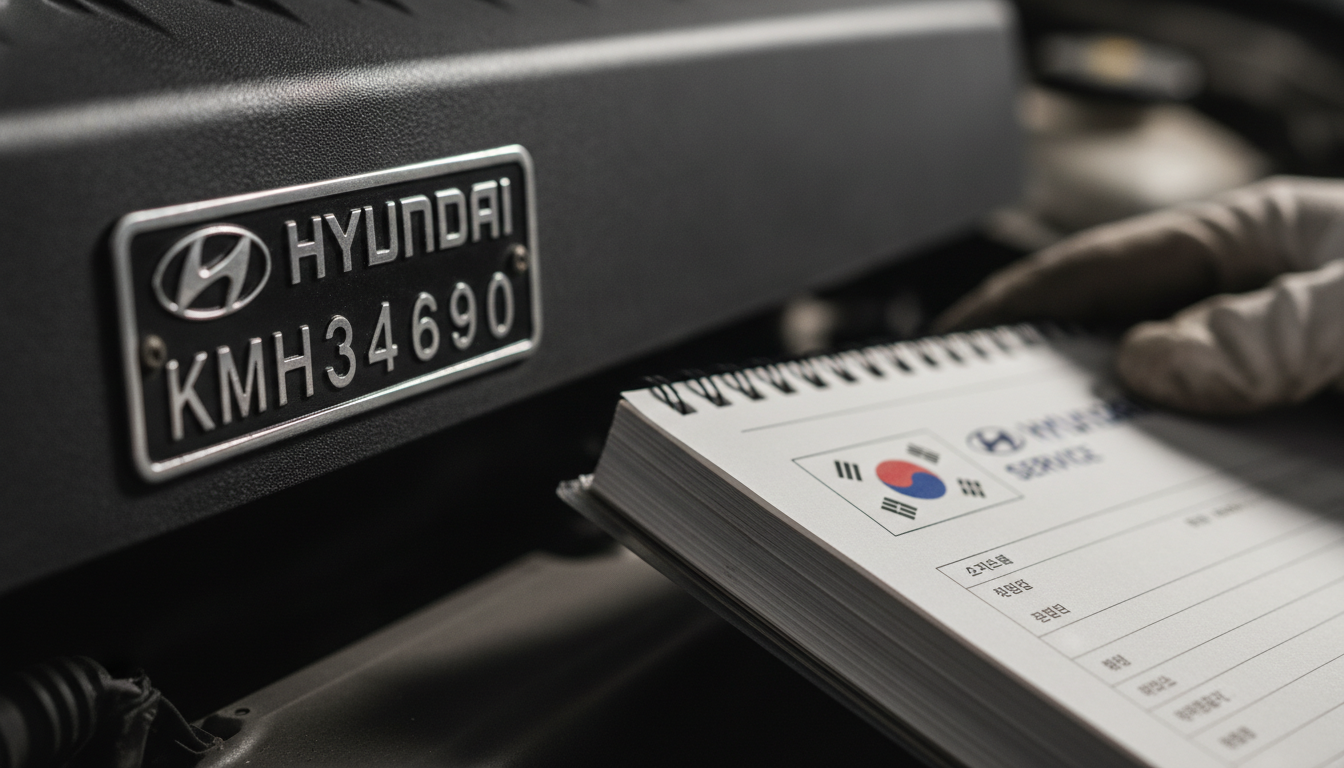
Alter Tag: Close-up of a Hyundai VIN plate focusing on the KMH World Manufacturer Identifier for South Korean built vehicles.
The first three characters of any Hyundai VIN form the World Manufacturer Identifier, or WMI. This group tells you which country assembled your vehicle and confirms the manufacturer.
For Hyundai, the most common WMI codes are KMH (South Korea), KNA (South Korea, Kia-adjacent Hyundai plant), and 5NP (United States, Alabama plant). The WMI directly determines which regional manual library applies.
A Hyundai Sonata built in Alabama has different emissions calibration data, HVAC refrigerant specs, and sometimes wiring harness routing compared to the same Sonata built in Ulsan, South Korea.
The factory documentation for each plant is maintained separately. If your WMI starts with 5NP and you pull a KMH-series manual, your wiring color codes and connector pin counts may not match.
This step takes under 30 seconds, but it sets the entire manual search in the right direction. Write down your WMI before moving to the next VIN section. Cross-reference it with the regional documentation library you plan to use.
Positions 4-8: Engine and Body, Your Manual's DNA
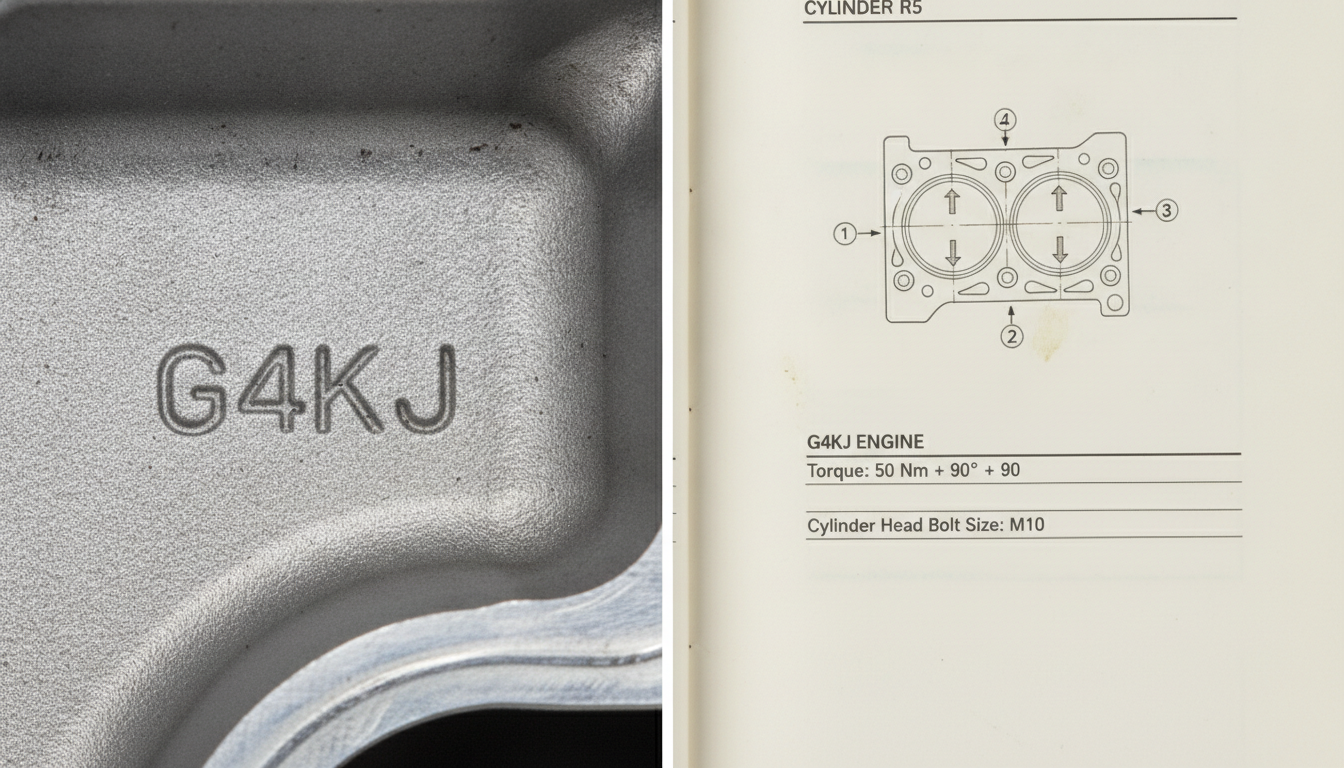
Alter Tag: Comparison of a physical G4KJ Hyundai engine code stamp and the corresponding torque sequence page in a service manual.
Positions 4 through 8 constitute the Vehicle Descriptor Section and are the most critical group for Hyundai workshop manual selection. Position 4 typically encodes the body series or platform code.
Positions 5 and 6 describe the body style and restraint system type. Position 7 usually carries the check-digit partner code. Position 8 is the engine code, and it is the one that causes the most manual mismatches in real-world repairs.
Hyundai uses a letter or number at position 8 to identify the engine family. Common examples include "G"- prefix families such as G4KE (2.4L MPI), G4NA (2.0L GDI), and G4KJ (2.4L GDI).
These engines share displacement but have entirely different fuel-injection systems, timing-chain configurations, and head-torque sequences. A manual written for the G4KE will not give you accurate data for a G4KJ even though both are 2.4-liter four-cylinder engines.
Before downloading any Hyundai repair documentation, confirm the engine code at position 8, then verify it against the manual's engine coverage table in the front section.
Most factory manuals list supported engine codes on the first page of the powertrain chapter. If your code is not listed, you have the wrong manual.
Key engine code examples by VIN position 8:
- G = Gamma engine family (1.4L to 1.6L GDI/MPI variants)
- N = Nu engine family (1.8L to 2.0L GDI)
- T = Theta engine family (2.0L to 2.4L MPI and GDI)
- L = Lambda engine family (3.3L to 3.8L V6 GDI)
For Hyundai Europe models including the Accent, you can verify the exact engine code against the model page at NXT Motors Hyundai Europe Accent, which lists documented engine variants for the X3 series.
Position 9: The Check Digit You Can Skip
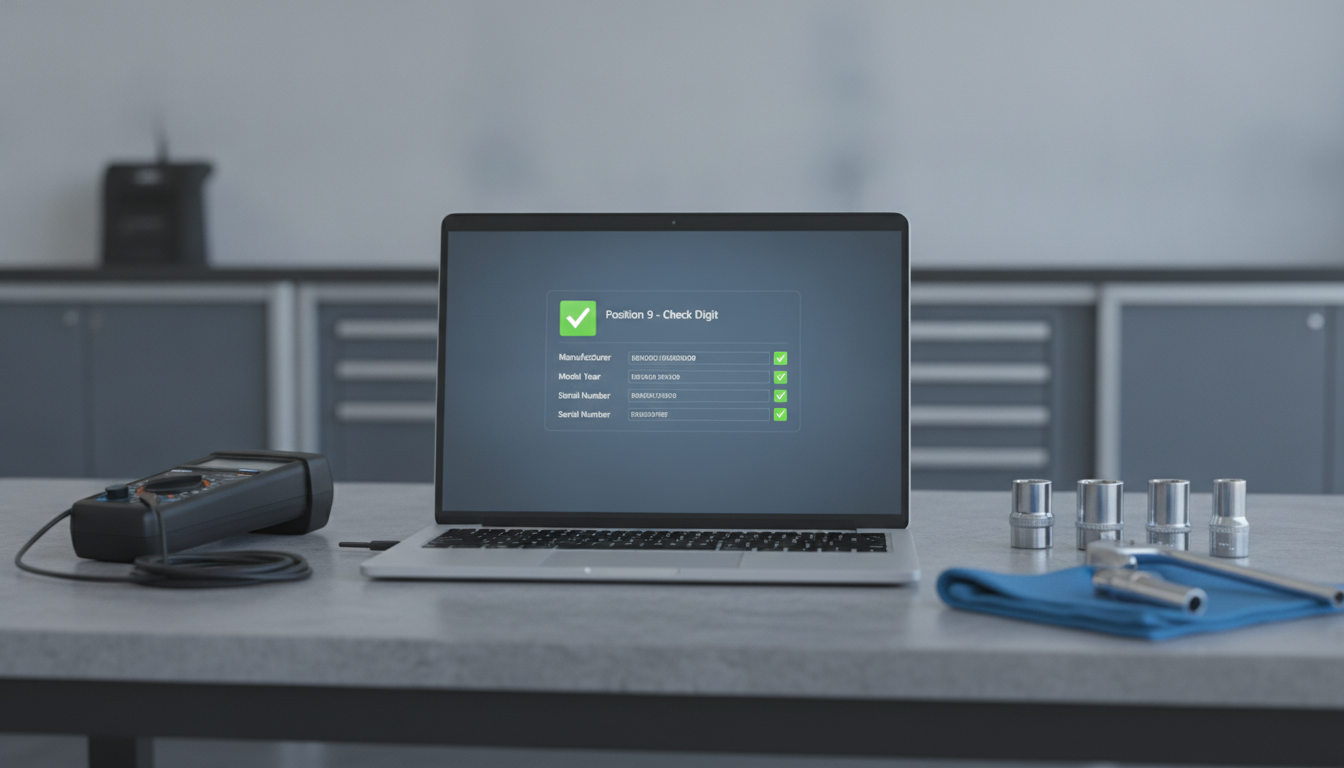
Alter Tag: Digital interface showing a Hyundai VIN check digit validation screen in a professional repair environment.
Position 9 is a mathematically derived validation digit. It is calculated from the other 16 characters using a weighted algorithm defined by the US National Highway Traffic Safety Administration.
This character confirms that the VIN has not been altered. It carries no information about your vehicle's build configuration and has no impact on manual selection. Note it exists, verify that your VIN passes basic format checks, then move on.
Position 10: Model Year Code, Critical for Manual Selection
Position 10 encodes the model year using a single letter or number from a standardized table. This position is the second most important for manual selection after position 8. Hyundai issues revised factory service manuals at the start of each new model year, and mid-cycle facelifts sometimes trigger supplemental manual releases under the same model-year code.
The model year character follows a repeating sequence where letters skip I, O, Q, U, and Z to avoid visual confusion with numbers. The sequence runs: A=1980, B=1981, continuing forward with numbers 1-9 interspersed from 2001 onward.
For example, position 10 showing "C" means 2012 if you are working on a modern Hyundai. Confirming this character against the manual's stated coverage year prevents one of the most common documentation errors.
Hyundai introduced significant changes to the Elantra and Tucson during certain production years that are reflected only in updated factory manuals. A manual covering the early production run of a given model year may omit updated ABS module pinouts or revised fuel injector torque specs introduced partway through that year. Always check the manual's revision date, not just the model year in the title.
Position 11: Plant Code Reveals Regional Manual Set
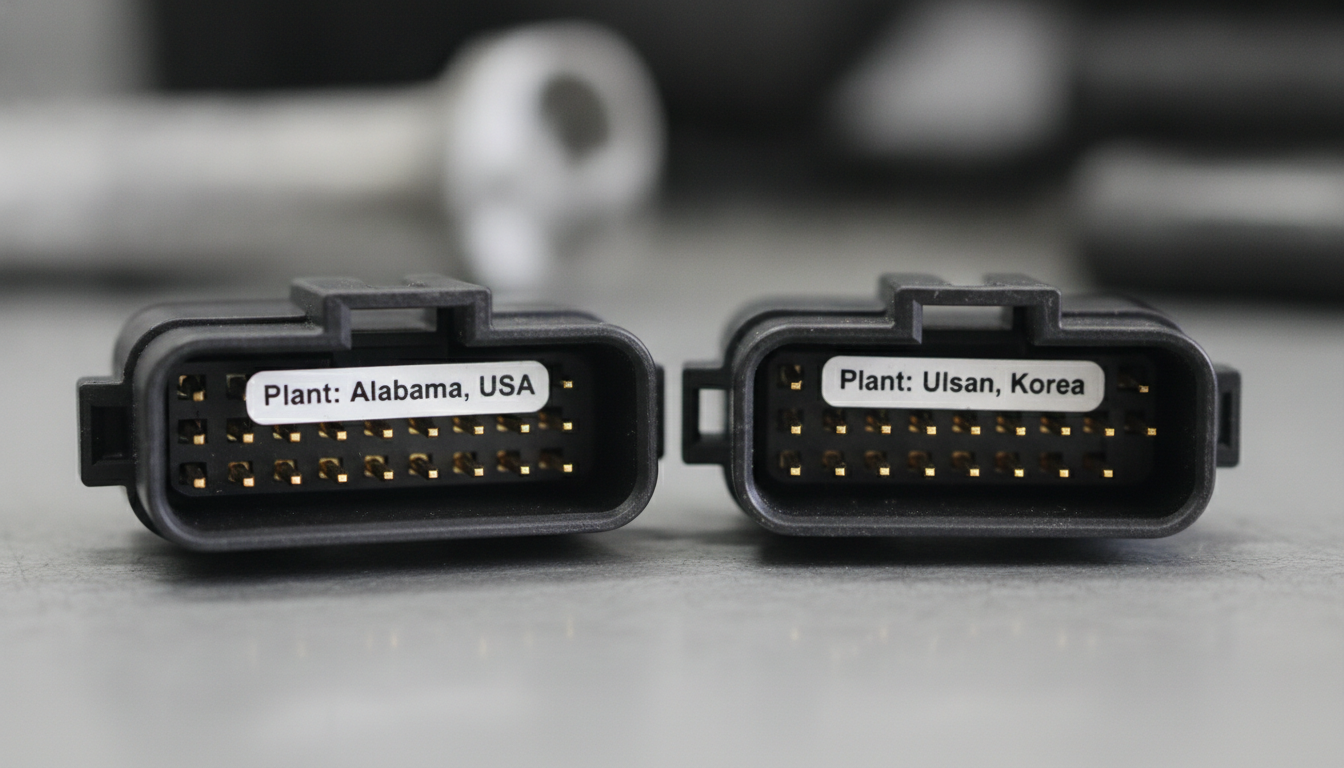 Alter Tag: Detailed comparison of Hyundai ABS connectors showing differences based on manufacturing plant codes from the VIN.
Position 11 identifies the assembly plant where your Hyundai was built. This character directly influences which regional documentation library covers your vehicle. Hyundai operates plants in South Korea (Ulsan, Asan, Jeonju), the United States (Montgomery, Alabama), the Czech Republic (Nosovice), Turkey (Izmit), India (Sriperumbudur), and other locations.
Plant-specific variants often involve differences in supplier components for items such as ABS control modules, infotainment head units, and HVAC blower assemblies. These supplier differences show up in the wiring diagrams as different connector configurations or different control module pinouts.
The Hyundai Europe Galloper documentation reflects how regional plant variants produce distinct documentation needs even within the same brand family.
For the H-1 and other commercial van variants built for specific regional markets, the plant code is especially important. The Hyundai H-1 series includes models that differ significantly between Asian and European builds in engine management and emissions hardware.
Confirming the plant code at position 11 before accessing the manual ensures you are working with the correct regional documentation set.
Positions 12-17: Build Sequence, Less Critical but Useful
Positions 12 through 17 form the production sequence number. This group does not affect the selection of the general service manual. However, it is essential for Technical Service Bulletins (TSBs) and recall lookups.
Hyundai's TSB system often specifies affected VIN ranges by sequence number to identify vehicles built before or after a specific production change.
When a TSB updates a torque specification, wiring routing, or software calibration, it will reference the specific VIN range where that change applies. Keep the full 17-character VIN available when searching TSBs.
Trusted Sources to Pull Your Hyundai Factory Manual
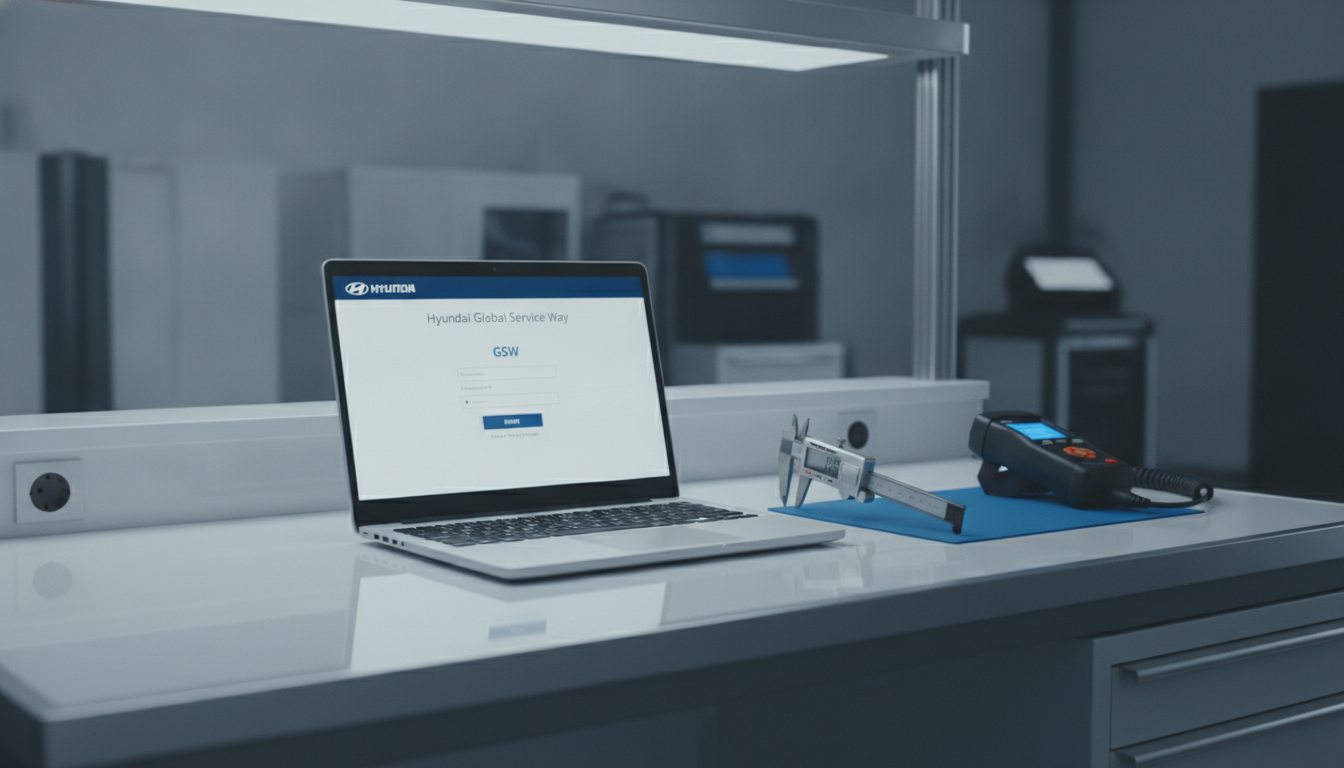
Alter Tag: Technician workstation showing the official Hyundai Global Service Way portal for factory manual access.
Selecting the right manual is only useful if the source is authoritative. Three categories of sources for Hyundai OEM repair manuals exist: the official Hyundai portal, professional subscription platforms, and physical manual publishers.
For Hyundai models across all generations covered by NXT Motors, the Hyundai Europe documentation hub provides a strong starting point for identifying the correct model variant before accessing a repair platform.
Hyundai Global Service Way (GSW)
Hyundai GSW is the manufacturer's own subscription-based workshop information system. It provides VIN-based lookup that automatically filters documentation to your specific vehicle's build data.
After entering your 17-character VIN, GSW returns the applicable service manual sections, wiring diagrams, TSBs, and labor time guides for that exact build.
GSW is region-specific, so a US-market GSW subscription does not provide access to Korean domestic or European documentation. Subscriptions are available for day, month, or year terms, making them practical for both single jobs and ongoing use.
The primary limitation of GSW is that older model years, particularly pre-2000 Hyundai vehicles, have incomplete or absent coverage.
For legacy models like the first-generation Accent X3 or the Galloper, physical documentation or archival PDF sources are more reliable. Our guide to finding your factory service manual PDF by VIN covers the archival-source strategy in detail.
ALLDATA and Mitchell1 for Shop Technicians
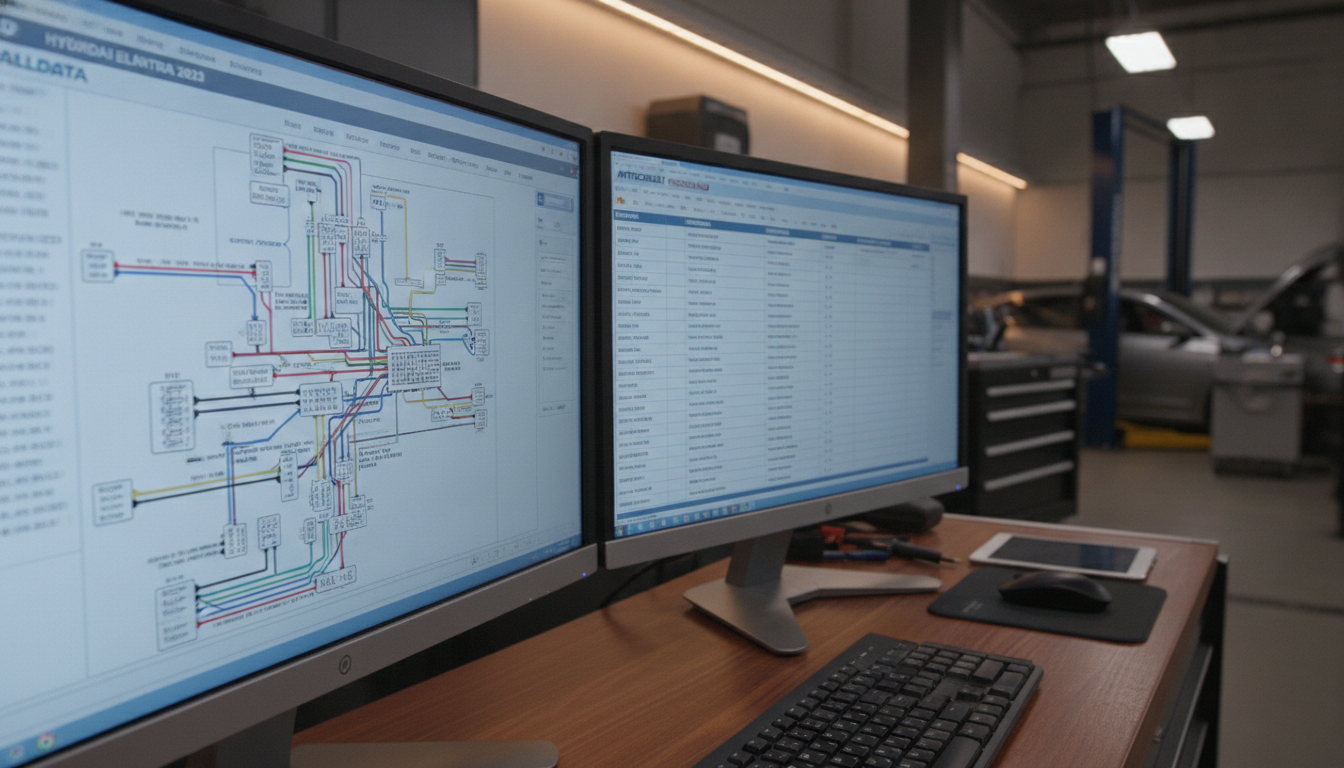
Alter Tag: Professional shop dual-monitor setup showing ALLDATA wiring diagrams and Mitchell1 data for Hyundai repairs.
ALLDATA and Mitchell1 are the two dominant professional shop platforms in North America. Both integrate VIN-based lookup and pull from licensed OEM data. ALLDATA typically mirrors the structure of Hyundai's own documentation, presenting content by system section (engine, transmission, body electrical, etc.) with VIN-filtered applicability notes.
Mitchell1 ProDemand offers similar coverage with stronger integration of labor estimating tools. Both require paid subscriptions and are priced for use in shops. For individual DIY users working on a single vehicle, a one-time GSW access or a model-specific Helm-published manual is more cost-effective. Our post on PDF manuals versus interactive repair software directly compares these formats.
For the Grand Santa Fe and other larger Hyundai SUVs with complex multi-zone electrical systems, ALLDATA's wiring diagram viewer is especially useful. The Grand Santa Fe model page documents the variant specifics that make professional platform access worthwhile for that nameplate.
Three Signs You Have the Wrong Hyundai Manual
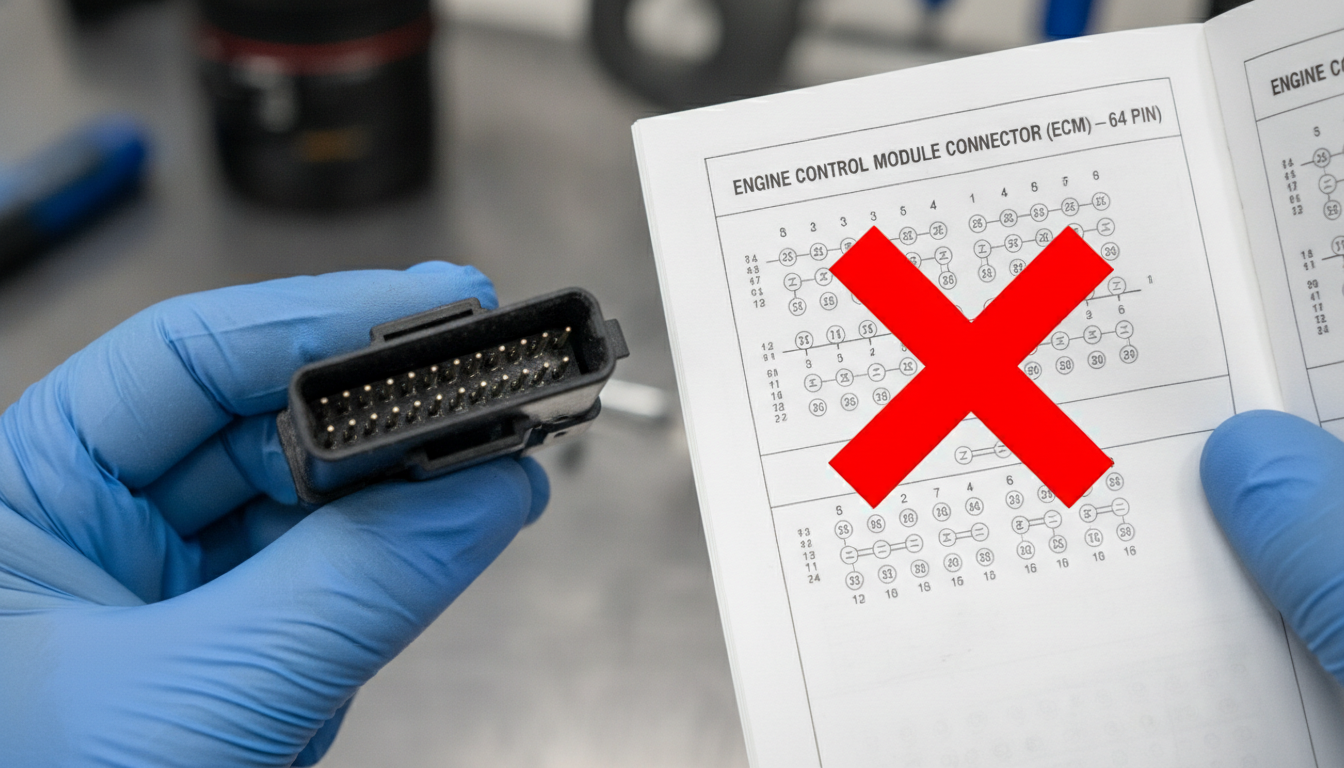
Alter Tag: A technician identifying a mismatched Hyundai manual by comparing a physical 80-pin connector to a 64-pin manual schematic.
Catching a manual mismatch before deep work begins saves hours of troubleshooting. These three indicators appear quickly when you compare your manual to your actual vehicle.
The engine code is not listed in the manual's coverage table. Every legitimate Hyundai factory service manual lists the exact engine codes it covers on the first or second page of the powertrain section. If the engine code at VIN position 8 is missing, close the manual and find the correct one. This takes two minutes and prevents hours of time spent following the wrong specifications.
The wiring diagrams show a different number of pins on a connector you are working on. Hyundai connector configurations vary by trim level and regional variant. If the ECU pinout in the manual shows 64 pins and your physical connector has 80 pins, you have a regional or trim variant mismatch.
This is especially common on Hyundai models sold in Europe, Korea, and North America, which had different infotainment and safety system specifications. Our post on ECU pinout charts for diagnostics explains how to verify pin counts before starting any wiring work.
The torque specifications produce an unusual result during installation. If a cylinder head bolt torque sequence listed in your manual produces clamping force that feels wrong for the gasket type you are using, cross-reference the engine code and model year in a second source before proceeding.
Hyundai updated torque specifications for several engines in TSB releases, which were incorporated into revised manual editions. Our detailed walkthrough on finding engine torque specs for cylinder heads covers this cross-referencing process step by step.
How to Cross-Check Your Manual Against Your Build Sheet
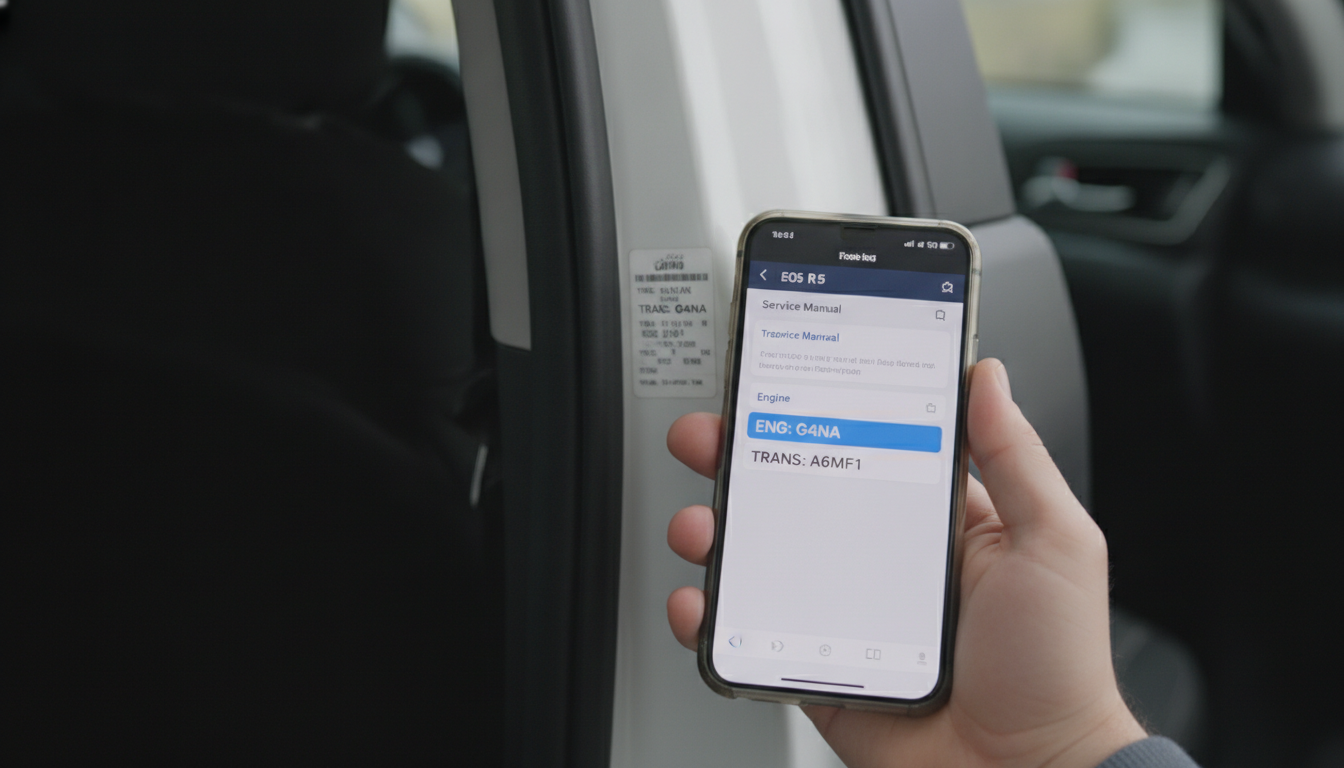
Alter Tag: Cross-checking a Hyundai door jamb build sheet engine code against a digital factory service manual.
A final verification step locks in confidence before major disassembly. The build sheet or vehicle specification label is typically located on the driver's door jamb, inside the engine bay firewall, or on the spare tire cover. It lists the engine code, transmission code, trim level, and paint code as assembled at the factory.
Compare the engine code on the build sheet against the engine code shown at position 8 of the VIN. They must match. Then open the service manual's coverage page and confirm that the exact code appears in the applicable engine list.
If all three sources agree, you have the right manual. This three-point check takes under five minutes and eliminates the risk of working from mismatched documentation.
For vehicles sourced from markets outside your region, particularly grey-import Hyundai models, the build sheet comparison is especially important. Factory specifications for emissions systems, fuel octane requirements, and electronic control module calibration can differ significantly between markets even on identical-looking vehicles.
The NXT Motors Hyundai Europe resource page helps identify which European-market Hyundai variants have distinct documentation requirements from their global counterparts.
Our guide on navigating interactive PDF workshop manuals shows how to use the manual's index to quickly confirm the scope of coverage once you have identified the correct document.
Common Asked Questions About the Hyundai VIN Service Manual Guide
Can I get a free Hyundai service manual using just my VIN?
Free access to a complete, VIN-matched Hyundai factory service manual is not realistically available through legitimate channels. Hyundai's official GSW portal requires a paid subscription, and professional platforms like ALLDATA and Mitchell1 are subscription-based.
Some archival PDF sources exist for older Hyundai models, but these are typically not VIN-filtered, meaning you still need to confirm the engine code and production year match your vehicle before trusting any specification in the document.
For current models, a short-term GSW day pass is the most cost-effective legitimate option if you need accurate, VIN-specific data for a single repair job.
What is the difference between a Hyundai owner's manual and a factory service manual?
The owner's manual is a consumer-facing document covering basic operation, maintenance intervals, and minor adjustments. It does not contain torque specifications, wiring diagrams, component replacement procedures, or diagnostic flowcharts.
The factory service manual, also called the workshop manual, is written for trained technicians and contains full repair procedures, electrical schematics, special tool lists, and measured specifications for every system.
If you are performing any repair beyond an oil change or an air filter replacement, the owner's manual will not provide the data you need. Always use the factory service manual for technical repair work on any Hyundai model.
Why does my Hyundai manual show different torque specs for the same engine?
Hyundai revises torque specifications via Technical Service Bulletins (TSBs) and incorporates those changes into updated editions of the manual. If you are comparing two manuals that both claim to cover your engine, the one with the later revision date reflects any TSB-driven updates.
Additionally, the same engine family (for example, the Theta II 2.4L) was built in slightly different configurations for different markets, and those configurations sometimes carry different specification tables.
Always check the manual's revision date and confirm that the engine code matches your VIN at position 8 before trusting any torque value for critical fasteners such as cylinder head bolts, main bearing caps, or connecting rod bolts.
Does Hyundai GSW cover European market vehicles?
Hyundai GSW is structured by region, and the European version of GSW (accessed via Hyundai Europe's dealer and independent repairer network) covers European-market vehicles, including right-hand-drive UK models, continental left-hand-drive models, and models assembled at the Nosovice plant in the Czech Republic. Access is separate from the North American GSW portal.
Independent repairers in Europe can access GSW through the Hyundai Europe technical portal under regulations that require manufacturers to provide third-party access to repair data. The subscription tiers and access interface differ slightly from the North American version, but the VIN-based lookup function operates the same way.
How do I know if my Hyundai has a mid-cycle facelift that needs a different manual?
Hyundai mid-cycle facelifts, often called LCI (Life Cycle Impulse) updates internally, typically introduce changes to the front fascia, interior trim, and sometimes the infotainment and safety systems.
The clearest indication of a facelift variant is to check the build date on the door jamb label and compare it with known facelift introduction dates for your model. Hyundai typically issues a supplemental service manual or a revised edition of the manual to cover facelift-specific changes.
If your build date falls after the known facelift introduction, confirm that your manual edition was issued on or after that date. Hyundai GSW and ALLDATA both flag facelift production breaks in their coverage notes when you perform a VIN lookup.