When deciding between OEM and Aftermarket manuals for your next DIY repair, it’s critical. Picking the wrong guide leads to inaccurate specs and incomplete diagrams, potentially costing you more time and money.
Aftermarket manuals handle most routine maintenance confidently, but OEM factory data becomes essential for complex electrical diagnostics, safety systems, or advanced engine work where factory-exact precision is non-negotiable.
This guide analyzes accuracy, costs, and skill-level matching to provide a clear decision framework for selecting the right manual for your specific vehicle and job.
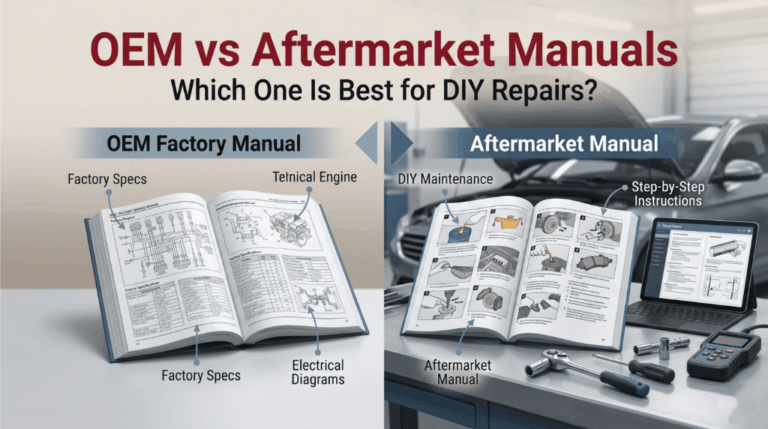
OEM vs Aftermarket Manuals: Best for DIY: Real Difference
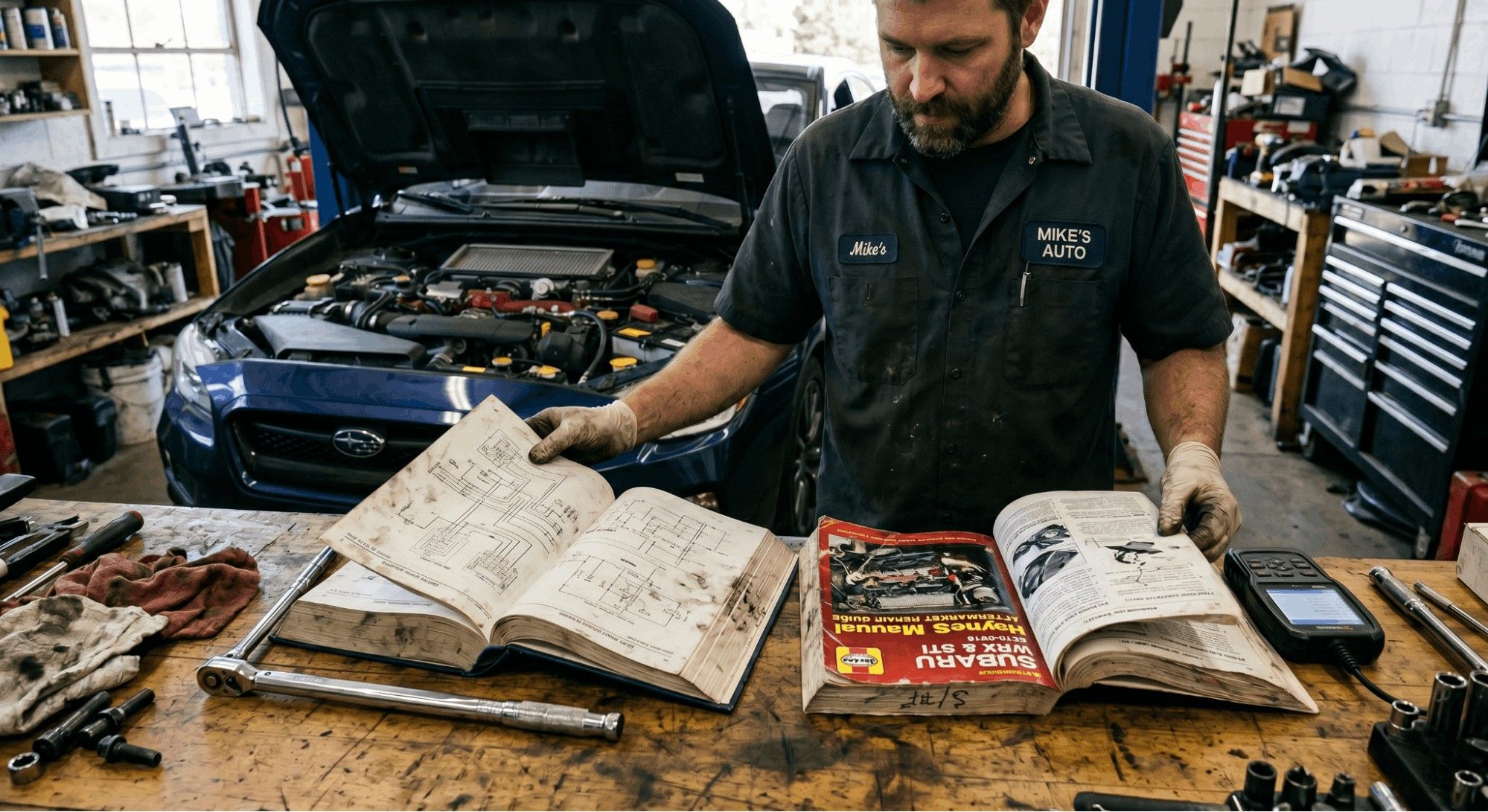
Most people choose a manual based on price or brand name. The deeper issue is where the data comes from, and that single factor determines repair accuracy more than publisher reputation, page count, or printing quality ever will.
What OEM Manuals Actually Contain?
OEM factory service manuals are issued directly by the manufacturer’s engineering team. They contain dealer-level repair data that no third-party publisher can fully replicate. Understanding their scope changes how seriously you approach your next repair.
OEM manuals typically include:
- Exact torque specifications for every fastener on the vehicle, not just the common ones
- Full proprietary wiring schematics, built from confidential electrical data
- Technical Service Bulletins (TSBs) are incorporated as the manufacturer releases them
- Diagnostic trouble codes with factory-level troubleshooting trees
- Calibration procedures for sensors, drive-by-wire systems, and safety modules
OEM manuals assume the user has professional training, hydraulic lifts, and manufacturer-specific scan tools, creating a usability gap for DIYers. Full sets cost $200 to $800+, often with additional subscription fees.
Availability is a major hurdle; OEM manuals are significantly harder to find for older or discontinued vehicle models. While strong for newer cars, sourcing print inventory for pre-2000 vehicles requires hunting specialty resellers at high prices.
However, for modern vehicles using CAN bus wiring and processor-controlled components, an OEM factory service manual is the only precise source for these complex interactions.
Why Aftermarket Manuals Handle Most DIY Jobs
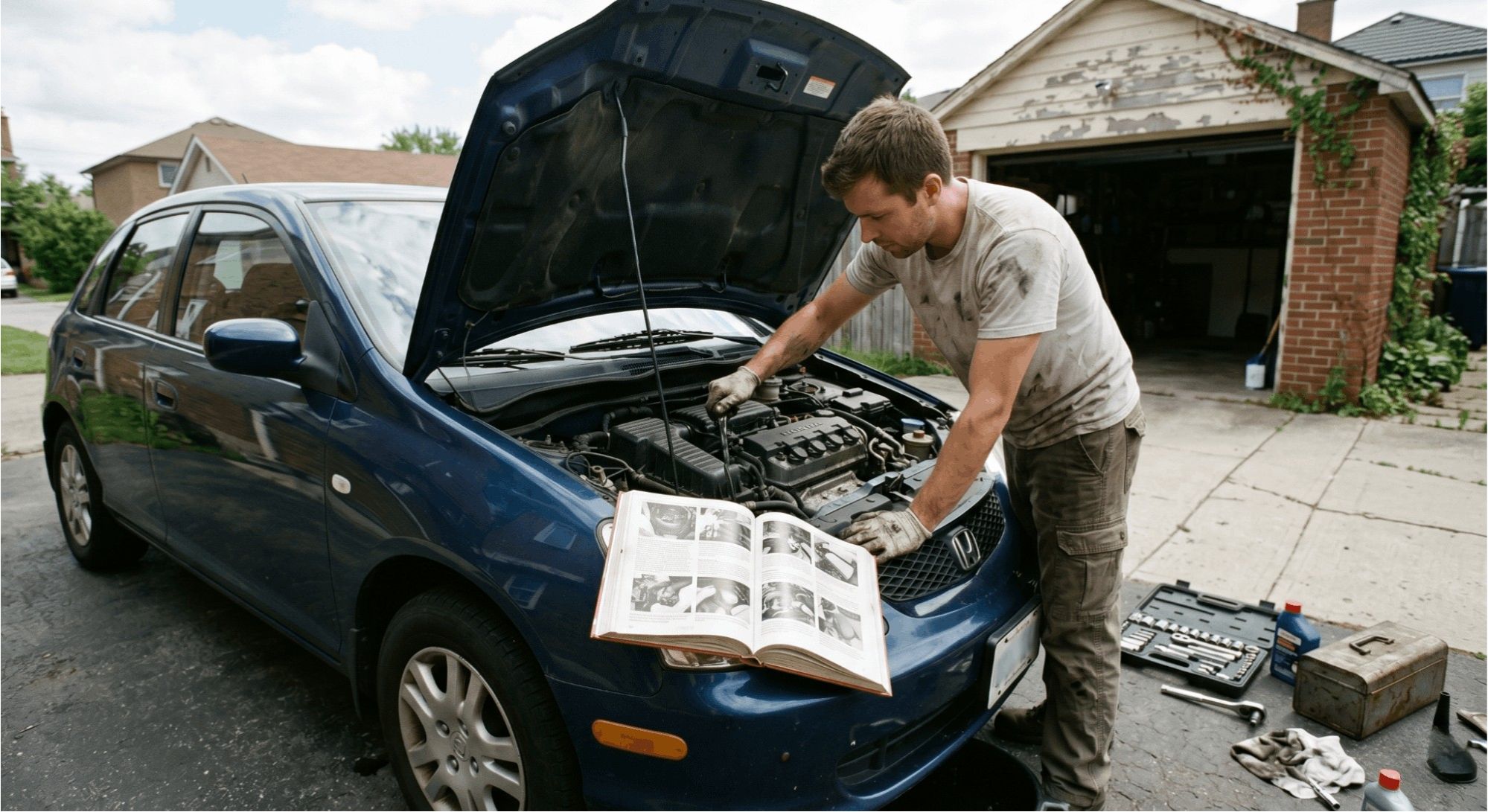
Aftermarket manuals like Haynes, Chilton, and Clymer were written from the ground up for the home mechanic. They don’t assume a dealership workshop, they assume a driveway, a standard tool set, and a determination to get the job done right.
Key strengths of aftermarket guides:
- Step-by-step photo sequences that break each procedure into clearly visible stages
- Accessible language that removes factory-level jargon without losing key details
- Price range of $30–$150 for full vehicle coverage
- Coverage spanning multiple model years in a single volume
- Real-world repair tips and time-saving notes not found in factory manuals
While aftermarket manuals deliberately simplify or omit procedures for complex internal components, such as deep engine internals or advanced electronics, this intentional design suits most DIY needs. However, repairs beyond the routine scope require an OEM source.
Haynes users save roughly $3,993 per year by developing skills. Though covering multiple trims can lead to generalized model-specific details, this rarely affects routine tasks like oil changes, brake pad replacement, belt inspection, and fluid services.
Cost vs Accuracy: The Trade-Off Decoded
Price is a factor, but it’s not the whole story. The right question isn’t which manual costs less, it’s whether the accuracy gap between OEM and aftermarket actually matters for your specific repair.
For standard DIY tasks like brakes or cooling systems, aftermarket manuals offer affordable, sufficient guidance. However, complex engine rebuilds or diagnostics on vehicles under ten years old require the precision of OEM manuals.
ALLDATA DIY provides a middle ground, offering searchable, factory-equivalent data and proprietary wiring diagrams via subscription. It grants home mechanics OEM depth without requiring dealership-level resources.
Step-by-Step: Picking the Right Manual for Your Job
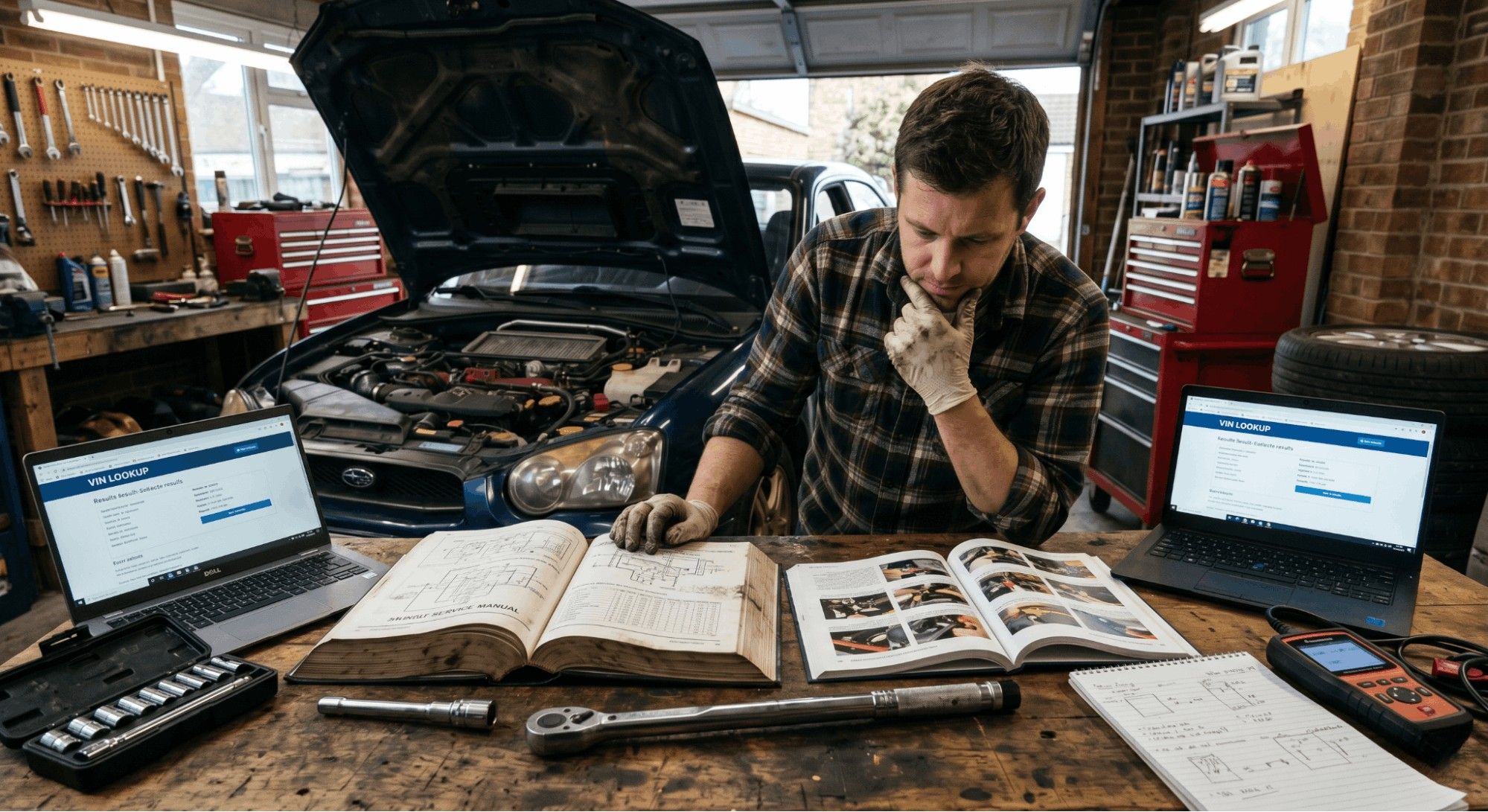
Certain repairs leave no room for generalized instructions. Use this five-step process before purchasing any manual to make sure you’re getting the right data for the actual job.
Step 1: Identify the exact system you’re repairing. Electrical, transmission, fuel injection, and advanced diagnostic work all demand OEM-level accuracy.
Step 2: Check the age and complexity of your vehicle. Vehicles newer than 10 years typically use drive-by-wire throttles, solenoid EVAP systems,and CAN bus wiring, which require factory schematics to trace safely.
Step 3: Evaluate how torque-sensitive the job is. Engine head bolts, wheel bearing hubs, and suspension control arms have zero tolerance for approximate specifications — this is where OEM torque specs are worth every cent.
Step 4: Audit your tools honestly. OEM manuals reference manufacturer-specific scan tools and specialty pullers that most home garages don’t have. If those tools aren’t available, many OEM procedures can’t be safely followed as written.
Step 5: Consider your experience level. First-time DIY mechanics benefit significantly from the step-by-step photography and plain-language instructions in Haynes or Chilton manuals. Move up to an OEM source once the repair complexity genuinely demands it.
Top Aftermarket Brands Ranked for DIY Fit
Not all aftermarket manuals perform equally across skill levels and vehicle types. Knowing which brand fits your repair goals prevents mismatched expectations and mid-job frustration.
Haynes vs Chilton vs Clymer: What Changes
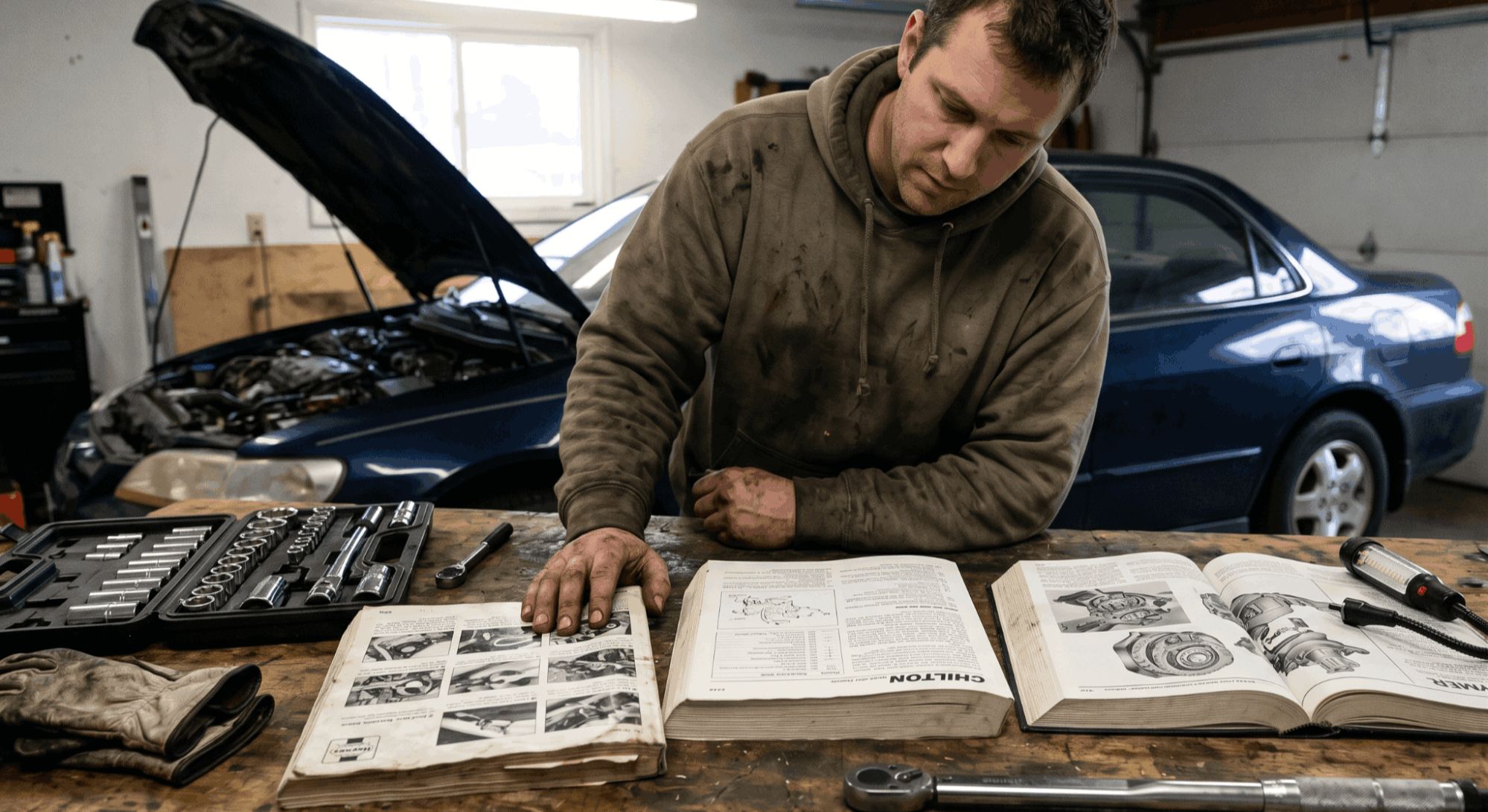
Though now under the same parent company, Haynes and Chilton retain distinct editorial styles. Haynes is the premier beginner-friendly choice for standard repairs, utilizing step-by-step photography, color wiring diagrams, and fault-code guidance. This visual-heavy approach builds confidence and reduces errors for DIYers performing routine tasks such as cooling system flushes or brake work.
Chilton leans toward text and technical depth. It includes more complete engine torque specifications and is comfortable for intermediate mechanics with more detailed procedural language. The gap between the two brands has narrowed since the 2001 acquisition, but Chilton still rewards mechanics with a bit more experience.
Clymer stands apart with a unique production method: every machine is physically disassembled and reassembled during the writing process. This produces more precise, real-world DIY repair instructions specifically for motorcycles, ATVs, snowmobiles, and powersport vehicles than any generic guide delivers.
Final Word
The OEM vs aftermarket manuals decision isn’t about which manual is objectively better it’s about matching data source, depth, and usability to the actual job in front of you. Aftermarket manuals from Haynes, Chilton, and Clymer confidently handle the vast majority of DIY repairs at prices that make sense.
OEM factory service manuals are the right call when precision is truly non-negotiable, such as advanced electrical diagnostics, engine rebuilds, or any modern vehicle where generalized specs carry real risk.
Start with an aftermarket guide for routine maintenance and common fixes. Step up to an OEM manual or a platform like ALLDATA DIY when the job demands factory-level accuracy. That two-step approach covers most mechanics across most situations without overpaying or underequipping.
Frequently Asked Questions
In specific cases, yes. Aftermarket manuals cover multiple model years and trim levels in a single volume, so certain torque values or wiring configurations may be generalized or omitted. Always cross-reference critical specifications on complex jobs, especially on post-2015 vehicles.
Most major manufacturers offer digital access to their factory service data. ALLDATA DIY provides manufacturer-sourced information via an affordable single-vehicle annual subscription, making it a practical alternative to purchasing full physical OEM sets.
Coverage is limited. Hybrid and EV systems involve high-voltage safety protocols and system-specific diagnostics that most aftermarket guides don’t fully address. For these vehicles, OEM service data or a specialized EV repair platform is strongly recommended before starting any work.
No, using an aftermarket DIY manual is completely legal and does not automatically void a warranty. Only improper repairs, regardless of which manual guided them, can affect warranty coverage. Keep detailed records of all work completed.
Older vehicles often have limited OEM manuals available, and those that are available can be costly to source. For pre-2000 vehicles, aftermarket options from Haynes, Chilton, or Clymer typically provide strong coverage and used factory service manuals are frequently available at lower cost through specialty resale platforms.