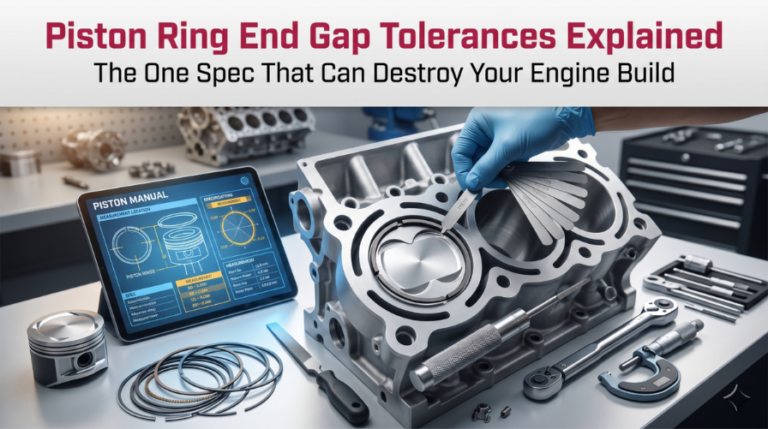
Getting piston ring end gap tolerances wrong is one of the most common reasons freshly rebuilt engines fail within hours of startup. The gap is small, the stakes are enormous, and most builders either over-tighten or ignore it entirely, both of which lead to serious damage.
A standard minimum top ring gap is 0.004 inches per inch of bore diameter. This clearance, measured with a feeler gauge, prevents ring butting from thermal expansion while ensuring proper heat transfer. Requirements vary by boost level and material, with high-performance builds needing larger gaps.
This article breaks down how ring end gap tolerances work, what the correct numbers look like across different applications, how to measure and file rings properly, and what happens when you get it wrong. By the end, you’ll have a clear, practical framework to use at your next engine build.
Piston Ring End Gap Tolerances Explained: Why This Tiny Gap Controls Engine Life

Understanding piston ring end gap tolerances is non-negotiable for any engine builder, from weekend mechanics to seasoned professionals. This spec is small in size but enormous in consequence.
The end gap is the space between the two ends of a piston ring when it is seated in the cylinder bore. Rings expand with heat, and without enough gap, the ends collide, causing ring seizure, cylinder wall damage, and sometimes a total engine loss.
Too much gap, and you lose compression, burn oil, and run weak. There’s a narrow band where everything works, and this article lives within it.
What Is Piston Ring End Gap and Why Does It Exist?
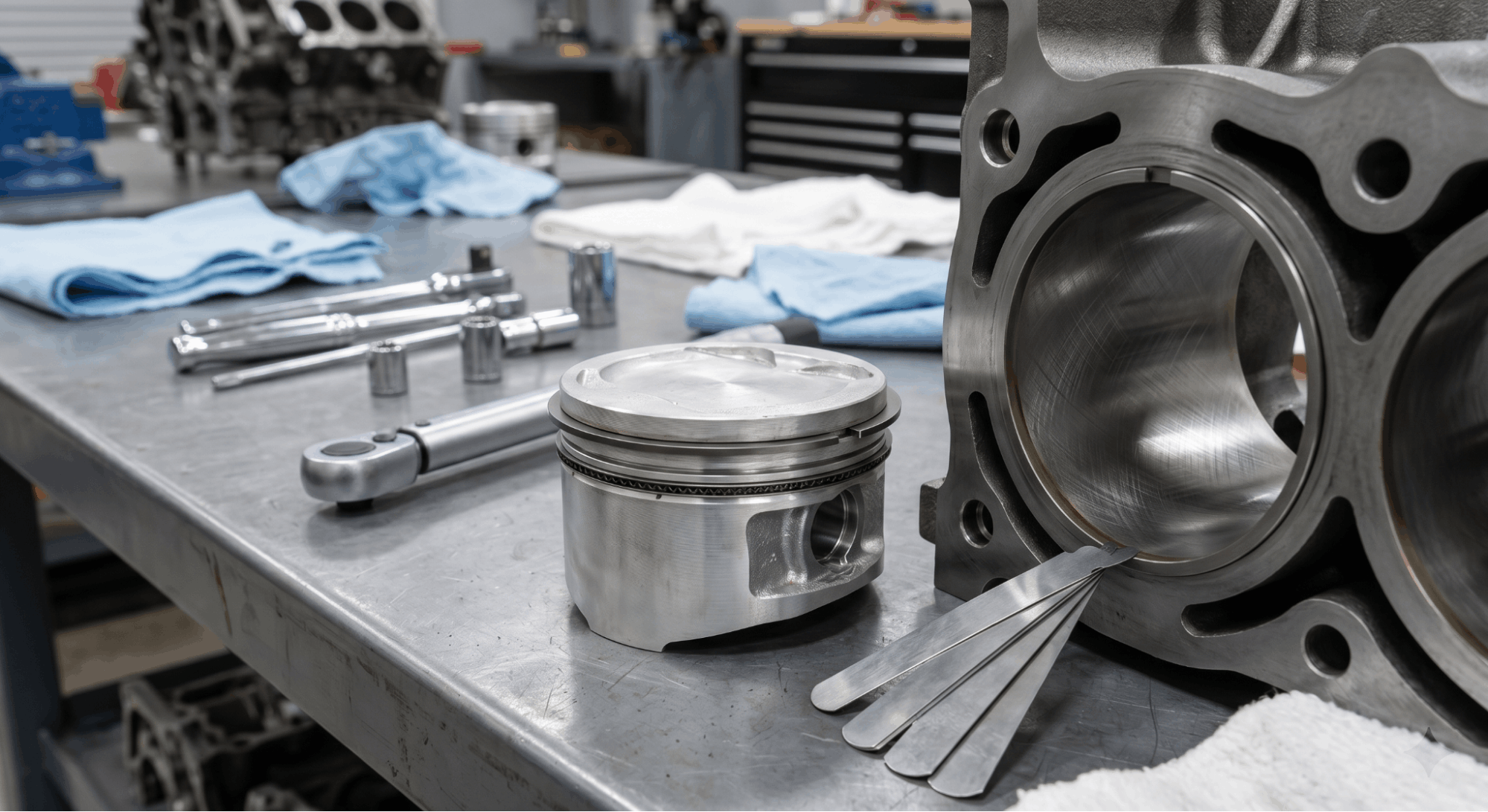
Most people building engines for the first time assume rings just need to fit. That thinking is what causes rebuilds to fail.
Piston rings are split for two reasons: they need to expand over the piston during installation, and they need room to grow when the engine reaches operating temperature. The end gap accommodates thermal expansion. Without it, the ring ends would collide under heat, lock the ring to the cylinder wall, and begin a rapid chain of destruction.
The top compression ring carries the most heat because it sits closest to the combustion event. It also has the primary job of sealing combustion pressure and transferring heat from the piston to the cylinder wall and into the coolant. This is why the top-ring end-gap tolerance is the most critical measurement in the ring set.
Key facts to understand:
- Varying thermal expansion rates mean that mean rings and cylinder bores do not grow at the same rate.
- Aluminum pistons in iron blocks expand significantly faster, which directly affects how much gap the ring needs
- Forged pistons (2618 alloy) require more clearance than cast or hypereutectic pistons due to higher thermal expansion
Standard End Gap Tolerances by Application Type
This is where builders make most of their mistakes, applying a street spec to a boosted engine or a race spec to a daily driver.
The ring end gap is calculated as the bore diameter (in inches) multiplied by the multiplier factor. The multiplier varies by application. Below is a reference table based on industry-standard guidelines from manufacturers, including Hastings, Wiseco, and CP-Carrillo.
|
Application |
Top Ring Factor |
Second Ring Factor |
|
Stock / OEM Street |
0.004 |
0.005 |
|
Hi-Performance Street / NA |
0.0050 |
0.0060 |
|
Drag Race / NA |
0.0055 |
0.0065 |
|
Track / NA |
0.0060 |
0.0070 |
|
Turbo / Supercharged (Low Boost) |
0.0055 |
0.0065 |
|
Turbo / Supercharged (Mid Boost) |
0.0063 |
0.0073 |
|
Turbo / Supercharged (High Boost) |
0.0070 |
0.0090 |
Example: A naturally aspirated street engine with a 4.000″ bore would need a minimum top ring end gap of 4.000 × 0.004 = 0.016″ and a second ring gap of 4.000 × 0.005 = 0.020″.
Oil rings are less critical but should always maintain a minimum end gap of 0.015″, regardless of application.
Why the Second Ring Gap Often Needs to Be Larger Than the Top Ring
This surprises many builders, especially those who learned under the old-school “tighter second ring” rule.
In OEM applications, the second ring runs tighter than the top ring because it sees less heat and primarily controls oil. But in performance builds, a second ring gap that’s tighter than the top ring can actually hurt sealing.
If combustion gases slip past the top ring and hit a second ring with a smaller gap, they have nowhere to go except back up, pushing against the underside of the top ring, lifting it off its seat, and creating more blowby, not less.
For performance engines, the second ring end gap should be 0.001 to 0.002 inches larger than the top ring gap. This allows trapped gases to vent downward instead of destabilizing the top ring.
Key points:
- OEM engines run tighter second ring gaps designed for exact power levels, low emissions, and controlled heat
- Performance and forced induction engines need the second ring gapped slightly wider than the top ring
- Ring flutter at high RPM (above 5,000–6,000 RPM) is reduced when the second ring gap is opened 10% beyond spec
How to Measure Piston Ring End Gap Correctly
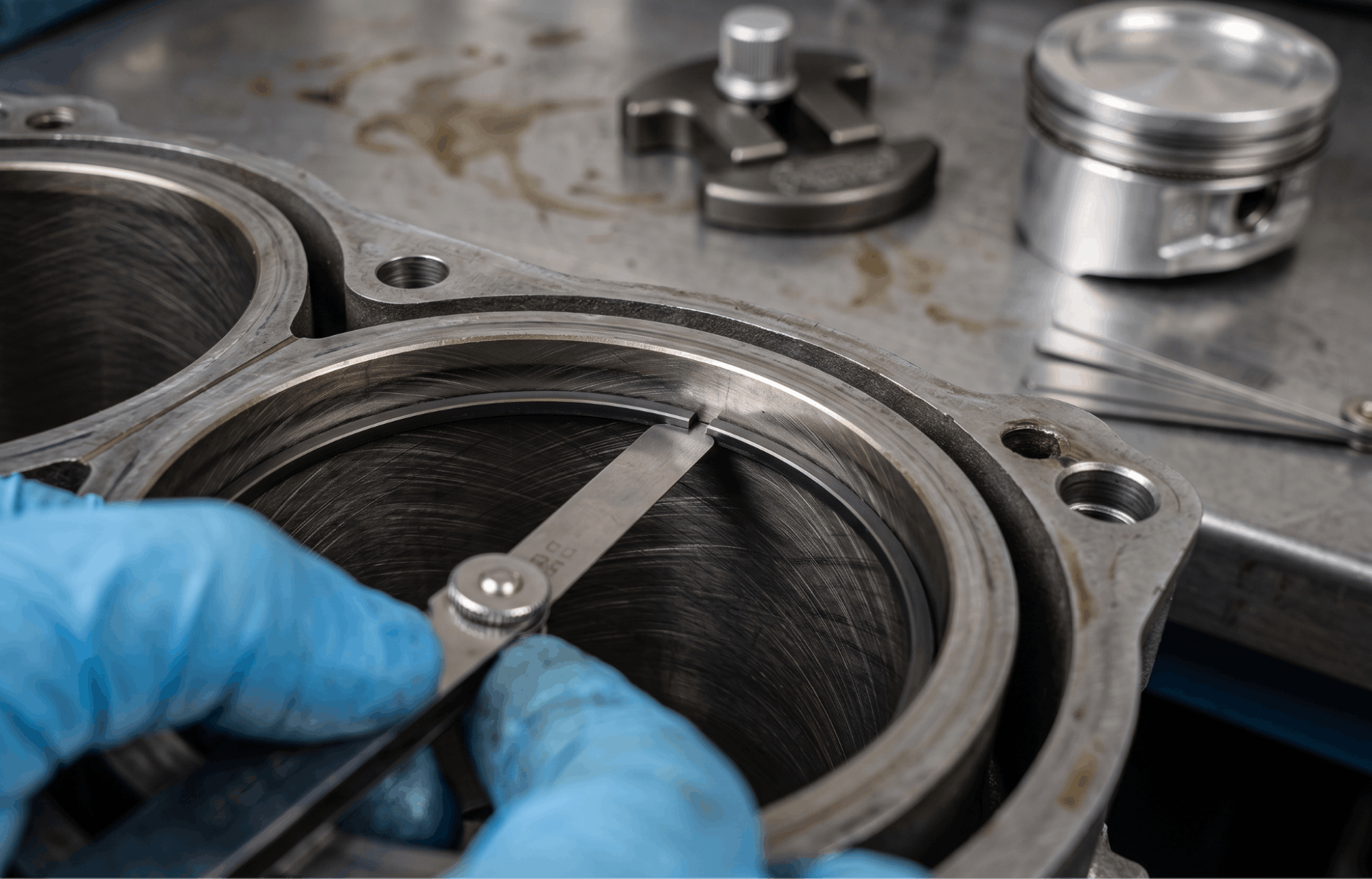
Measuring the ring end gap sounds simple, but a few common errors can lead to incorrect readings and poor outcomes.
Step 1: Place the ring squarely inside the cylinder bore. Use a piston ring squaring tool or turn a flat-top piston upside down to push the ring down evenly, approximately 0.500″ (13mm) from the top of the bore.
Step 2: Slide a feeler gauge between the ring ends. Choose the thickest blade that fits with light resistance.
Step 3: Record the measurement and compare it to your target spec using the bore × factor formula above.
Step 4: For worn cylinders, verify the gap at both the top and bottom of the bore. Upper-bore taper can inflate readings; therefore, always use the unworn lower portion to set your gap. Filing based on the worn top section creates a gap that is dangerously tight at the bottom.
Important notes:
- Avoid setting the gap based on measurements from a worn upper bore; this results in an excessively tight clearance at the bottom of the cylinder.
- If cylinders show more than 0.003″–0.005″ of taper wear, they need to be bored or honed before ring installation
- Each additional 0.001″ of bore diameter increases the ring gap by approximately 0.00315″ (a factor of pi)
Also note: a gap that’s over-spec by up to 30% above the maximum has minimal impact on ring sealing. A gap that falls below the minimum spec is far more dangerous and must be corrected. When in doubt, slightly over is always safer than slightly under.
How to File Rings to Correct End Gap
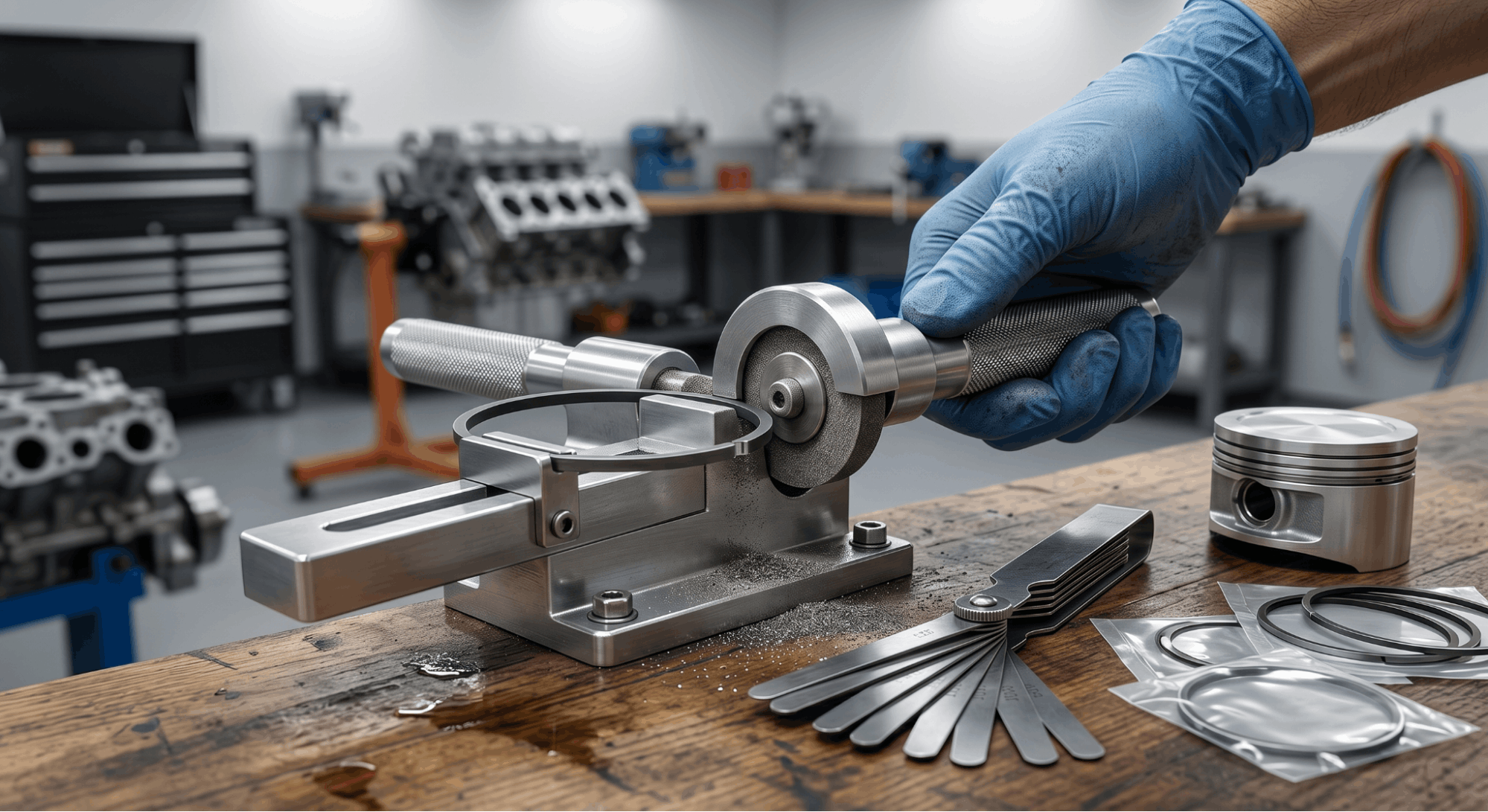
Filing piston rings is straightforward when done carefully, but sloppy filing can create burrs that damage cylinder walls.
Use a piston ring file, either a manual model ($40–$80) or an electric ring filer ($300+), for high-volume builds. The key requirement is that both ends of the ring remain perfectly parallel after filing. An angled or uneven end creates a point contact that scores the bore.
Step-by-step filing process:
- Remove material from one end of the ring using controlled strokes in a single direction
- Check the gap frequently, and remove small amounts at a time to avoid over-filling
- Once at the target gap, use a fine stone or deburring tool to smooth all sharp edges
- Re-measure the gap inside the bore with the ring squared before moving to the next ring
Avoid aggressive grinding wheels and never assume ring gaps are identical. Manually verify every component, including oil rails and second rings.
For hypereutectic pistons, add approximately 0.003″ to the standard street spec. These pistons are excellent thermal insulators, which means the top ring retains far more heat than it would in a standard cast piston build. Many hypereutectic failures happen at the top ring land when gaps are set too tight.
Ring Gap Orientation After Installation
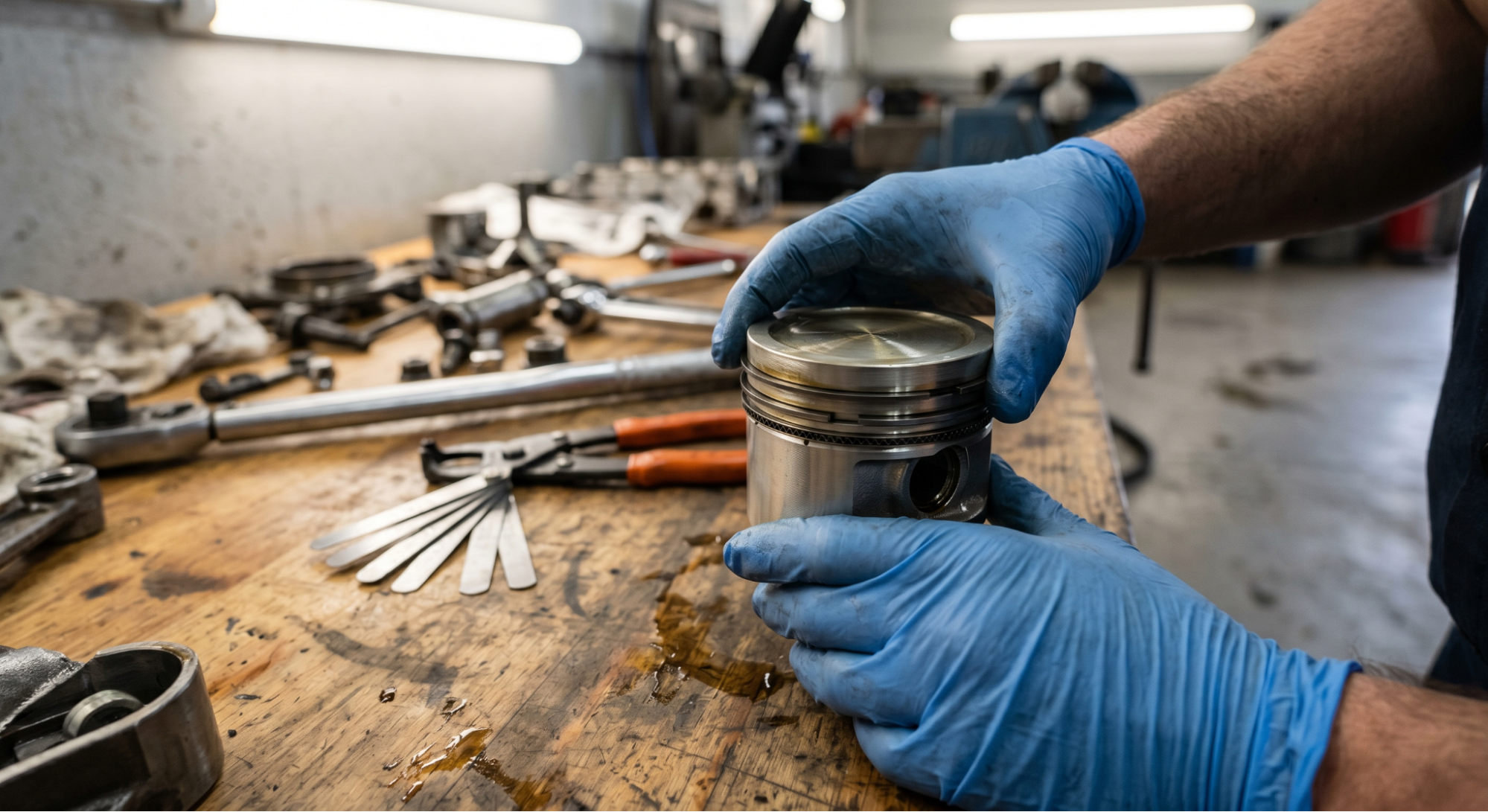
Once every ring is gapped correctly, placement inside the bore matters too.
End gap positions should be staggered when installed, with the gaps approximately 120° apart. This prevents all the gap openings from aligning at any single moment, which would create a straight path for combustion gases to escape into the crankcase.
During engine operation, rings rotate. This means gaps will occasionally align temporarily, which is normal and expected. The staggered starting position simply minimizes the frequency of this during the most critical operating phases.
What Happens When You Get End Gap Wrong
The consequences of wrong piston ring end gap tolerances are not subtle.
Too tight:
- Ring ends collide as the engine heats up
- Outward pressure on the cylinder wall increases rapidly
- Piston material begins to soften from the added heat and friction
- The ring land blows out catastrophically and is usually not recoverable
- In severe cases, the wrist pin exits the piston and penetrates the block
Too loose:
- Compression gases blow past the rings (blowby)
- Oil consumption increases as oil enters the combustion chamber
- Crankcase pressure rises
- Horsepower drops noticeably
- The engine runs rough, especially under load
A slightly loose gap is always the safer failure mode. A slightly tight gap can destroy an engine within minutes of operating at temperature. If you’re rebuilding a used cylinder without re-honing, confirming the cylinder bore diameter before selecting your ring gap spec is essential.
Specs from your factory service manual are a starting point, but the actual bore measurement determines the correct tolerance.
For those referencing factory documentation, understanding how to read valve clearance tolerances in factory manuals follows a very similar principle both specs are bore- and application-dependent, and both must be read in context of the full engine assembly, not treated as universal values.
Reading Manufacturer Specs Without Getting Confused
One area that trips up even experienced builders is misreading how end-gap tolerances are specified in service manuals.
Most specs appear in one of two formats:
- Nominal ± tolerance, Example: 0.0236″ ± 0.005″ (meaning min 0.0186″, max 0.0286″)
- Min/Max range, Example: Min 0.013″ / Max 0.021.”
Both formats require the same awareness: the liner or bore diameter tolerance affects the final gap. A bore spec of 5.401″ ± 0.001″ means your actual bore could be anywhere from 5.400″ to 5.402″.
Each 0.001″ increase in bore diameter increases the acceptable ring end gap by approximately 0.003″. This is why cross-referencing your actual measured bore against the spec sheet matters more than reading the nominal value alone.
If you’re looking for the right specifications for your engine, knowing how to find your factory service manual PDF by VIN is the most reliable way to access the exact piston and ring tolerances published by the OEM for your vehicle. It removes any guesswork about which spec applies to which engine variant.
Conclusion
Piston ring end gap tolerances are not a “set it and forget it” spec. The correct gap depends on bore size, ring material, piston type, and how hard the engine will be driven. Get it right, and your engine seals well, stays cool, and makes power. Get it wrong, and the consequences range from oil burning to catastrophic failure within an afternoon of driving.
The rule is simple: measure everything, file carefully, confirm the gap at the unworn portion of the bore, and always favor slightly more gap over slightly less. Use the manufacturer’s recommended multiplier for your specific application and cross-reference it against the actual bore measurement, not just the nominal spec.
Every ring, in every bore, deserves its own measurement.
Frequently Asked Questions
Even if rings are sold as pre-gapped or “drop-in,” they should still be checked before installation. Ring sets are manufactured to tolerances that may not perfectly match your specific bore diameter, especially if the cylinder has been bored or honed to an oversize.
A ring gap that is too tight is far more dangerous than one that is slightly loose. The few minutes spent measuring with a feeler gauge can prevent total engine failure.
Always square the ring properly in the bore before measuring and compare the reading against the manufacturer’s specification for your bore size and application type.
Taper wear is one of the most common sources of inaccurate gap readings. Cylinders typically wear most at the top of the ring travel, making the bore slightly larger there than at the bottom.
If you measure the ring gap at the worn top section and set it based on that reading, the gap will be dangerously tight when the piston descends to the unworn lower portion. Always measure the gap at approximately 13mm (0.500″) down from the bottom of the ring travel.
If taper wear exceeds 0.003″–0.005″ across the bore, the cylinder should be re-honed or bored to oversize before rings are installed.
Yes, significantly larger. Forced induction engines generate substantially more combustion heat than naturally aspirated setups, particularly at the top ring.
More heat means greater thermal expansion of the ring, so the gap needs to accommodate that additional growth. A street naturally aspirated engine might run a top ring gap factor of 0.004, while a high-boost turbocharged engine may need 0.007 or more.
Using NA specs on a boosted engine is a common and costly mistake. Always match the gap multiplier to your intended use case, not just the engine’s displacement or bore size.
Hypereutectic pistons are excellent thermal insulators, which is part of what makes them efficient. But that insulating property means the top ring retains heat rather than transferring it through the piston.
As a result, the top ring on a hypereutectic piston runs considerably hotter than it would on a standard cast piston in the same application. Most experienced builders add approximately 0.003″ to the standard street specification when using hypereutectic pistons.
Failing to do this is the primary reason hypereutectic piston builds fail the ring land blows out when the over-expanded top ring seizes against the cylinder wall.
For performance and racing applications, yes, the second ring gap should be 0.001″–0.002″ larger than the top ring gap. This is the opposite of OEM practice, where the second ring runs tighter.
The reason is pressure management: if combustion gases slip past the top ring and hit a tighter second ring gap, the trapped pressure pushes back up against the underside of the top ring, reducing its seal.
Opening the second ring gap slightly allows that pressure to vent downward instead. In stock street engines running at fixed power levels, this is less critical. But in performance builds with variable heat cycles, it’s an important detail to get right.