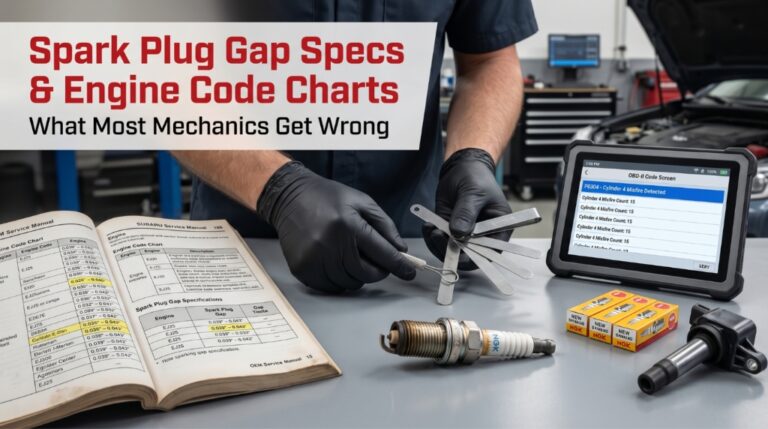
Using the wrong spark plug gap specs for your engine code can trigger misfires, fail emissions tests, and quietly erode power output. A gap error as small as 0.010 inches can destabilize combustion across every cycle.
Prevent issues by matching the gap to your vehicle’s specific factory engine code chart. Gaps typically range from 0.024″ to 0.060″ (0.6–1.5 mm). High-performance or forced-induction engines usually require tighter gaps (0.016″–0.032″) to avoid blowout. Always prioritize OEM manual or emissions label specs over generic data.
This article covers how to read engine code charts, apply precise gap specs, decode related OBD fault codes, and choose the right data source every time.
Spark Plug Gap Specs & Engine Code Charts: The Data You Need

Every engine code carries a unique ignition tolerance. The factory charts exist to capture those tolerances with precision. Understanding how to read, apply, and cross-reference them with OBD data is the foundation of a proper spark plug installation.
Why Engine Code Decides Your Gap Spec
Every engine code corresponds to a specific compression ratio, fuel type, and ignition design. These variables set the upper and lower bounds for a functional spark plug gap.
A turbocharged engine running high boost pressure demands a tighter gap, typically 0.024 to 0.028 inches, to prevent spark blowout under load. Naturally aspirated engines run wider, often 0.040 to 0.060 inches, for stronger flame kernel ignition.
Key factors that define a gap spec by engine code:
- Compression ratio — higher compression needs a tighter gap
- Ignition system type — coil-on-plug vs. distributor-based setups
- Fuel type — gasoline, E85, and flex-fuel each affect combustion timing
- Forced induction — turbocharged and supercharged engines require tighter tolerances
- Engine management generation — OBD-I vs. OBD-II systems fire differently
Common Spark Plug Gap Specs by Engine Code:
|
Engine Type |
Engine Code |
Gap (inches) |
Ignition System |
|
Naturally Aspirated 4-Cyl |
2ZR-FE |
0.043 |
Coil-on-Plug |
|
Turbocharged 4-Cyl |
EJ255 |
0.028 |
Distributorless |
|
V6 Naturally Aspirated |
VQ35DE |
0.044 |
Coil-on-Plug |
|
V8 Performance |
LS3 |
0.040 |
Coil-on-Plug |
|
High-Compression NA |
B18C1 |
0.028 |
Distributor |
|
Flex-Fuel 4-Cyl |
LUK |
0.040 |
Coil-on-Plug |
Note: Always verify against your OEM factory documentation. Values above are general references.
Reading Spark Plug Gap Charts Without Confusion

Gap charts from factory manuals list multiple values across trim levels and model years. Aftermarket plug boxes often display a generic “recommended” range, not your specific engine code spec.
The most reliable source is always the OEM factory service manual. If you need help locating the right document for your vehicle,
If you need the right documentation for your vehicle, Find Your Factory Service Manual PDF by VIN provides a straightforward way to source accurate OEM files.
How to read a gap chart correctly:
- Locate your engine code. It’s usually stamped on the block or the emissions label under the hood
- Cross-reference the code against the manufacturer’s official gap table
- Confirm which ignition system column applies to your setup
- Check the model year, mid-cycle production revisions sometimes alter gap specs
- Note that the electrode material, iridium and platinum plugs, may have narrower recommended ranges
How to Gap a Spark Plug to Exact Spec

Gapping a plug correctly is a hands-on skill, not just a number lookup. On modern engines with iridium- or platinum-tipped electrodes, aggressive bending can crack the fine-wire tip.
Use a quality feeler gauge set and work slowly. Coin-type gappers create uneven pressure and often leave the gap slightly off from where you intended.
Step-by-step gapping process:
- Check the manufacturer’s spec first before removing the plug from the packaging
- Use a blade-style feeler gauge, not a coin gapper, for accuracy to 0.001 inches
- Slide the gauge through the gap until you feel light, consistent resistance
- Adjust by bending only the ground electrode never apply force to the center electrode
- Re-check the gap after adjustment, as bending can shift the measurement slightly
- Cross-reference with the engine code chart one final time before installation
Engine Code Charts and OBD Misfire Codes: The Link
There is a direct relationship between gap spec errors and engine fault codes. A gap that’s too wide forces the ignition coil to produce excess voltage to bridge it.
Under high-RPM or heavy-load conditions, that coil voltage ceiling gets hit, and the spark fails. The result is a misfire code on the OBD scanner that appears to indicate a coil or injector problem.
Gap errors commonly trigger these OBD codes:
|
OBD Code |
Description |
Common Cause |
|
P0300 |
Random/Multiple Cylinder Misfire |
Gap too wide or too narrow |
|
P0301-P0308 |
Cylinder-Specific Misfire |
Incorrect gap for engine code |
|
P0316 |
Misfire on Engine Startup |
Cold-start gap failure |
|
P0171 |
System Too Lean (Bank 1) |
Incomplete combustion from a weak spark |
|
P0172 |
System Too Rich (Bank 1) |
Erratic combustion, unburned fuel |
For engines with tight valve tolerances, combining this check with a review of Valve Clearance Tolerances in Factory Manuals can help isolate whether the misfire is ignition- or mechanical-related.
OEM vs. Aftermarket Gap Specs: Which Source Wins
Aftermarket plug makers like NGK, Denso, and Champion sometimes suggest gap specs that differ from factory values. These differences exist because their electrode materials may perform optimally at a slightly different gap.
For any unmodified engine, the OEM factory value takes precedence. Aftermarket gaps are calibrated for a broad vehicle population, not your exact engine code.
|
Spec Source |
Gap Range |
Reliability |
|
OEM Factory Manual |
Exact by engine code |
Highest |
|
Aftermarket Plug Box |
Generic range |
Moderate |
|
Online Forums |
Community estimates |
Low |
|
Tuner Recommendations |
Modified engine only |
Application-Specific |
For accurate OEM documentation, Where to Download Genuine OEM Workshop Manuals is the most reliable starting point for sourcing the correct files.
Cylinder Head Torque and Plug Spec: Why Both Matter
Installing a plug to the correct gap spec but with the wrong torque compromises the seal between the plug and the cylinder head. That leak alters combustion pressure, skewing your entire performance baseline.
Thread size, plug reach, and seat design all affect the torque requirement. These values are listed in the same factory documentation as your gap specs never guess at them.
For a detailed breakdown of how torque sequencing affects engine sealing, Finding Engine Torque Specs for Cylinder Heads covers the factory torque logic in precise detail.
Typical spark plug torque specs by thread size:
|
Thread Size |
Torque (ft-lbs) |
Seat Type |
|
10mm |
7 – 11 |
Gasket |
|
12mm |
11 – 15 |
Taper |
|
14mm |
18 – 26 |
Gasket |
|
18mm |
25 – 30 |
Gasket |
Final Takeaway: Match the Gap, Trust the Chart
Getting your spark plug gap specs right is a matter of matching your engine code to verified factory charts, then executing with precision.
Every misfire code, rough idle, and failed emissions test has a root cause. An incorrect plug gap is one of the most common and most overlooked sources of all three.
Use OEM documentation, verify your specific engine code, and double-check every gap with a calibrated feeler gauge. That’s how experienced mechanics work — and it’s the standard you should hold yourself to.
Frequently Asked Questions
No, and this mistake is more common than most mechanics admit. Even within the same model line, different engine codes, such as a base 2.0L vs. a performance 2.0T, carry different compression ratios and ignition systems.
Each of those variables directly affects the ideal spark plug gap. Using a single gap value across multiple codes can cause misfires, a rough idle, and increased fuel consumption. Always verify the gap spec individually for each engine code, even if the plugs are physically identical between trims.
The factory chart is the only source that accounts for all build-specific variables. Internet forums and generic charts are not a substitute for the OEM value.
Yes, it does, and the effect is larger than most drivers realize. A plug gapped too wide struggles to fire consistently under load, causing incomplete combustion. That unburned fuel exits through the exhaust, lowering efficiency and increasing emissions.
A gap that’s too tight produces a weak spark that fails to ignite the full air-fuel charge. Studies on combustion efficiency suggest incorrect plug gaps can reduce fuel economy by 4 to 10 percent, depending on the engine type and load conditions.
Matching the gap to the manufacturer’s engine code spec is one of the lowest-cost ways to restore efficiency. No part replacements, no labor-heavy repairs, just precision measurement.
Most factory schedules recommend inspecting the plug gap at every tune-up interval, typically 30,000 to 60,000 miles for copper plugs. Iridium and platinum types generally run 60,000 to 100,000 miles between inspections.
High-performance engines running boost, aggressive timing, or flex-fuel blends experience faster electrode wear. For those setups, gap checks every 15,000 to 20,000 miles are more appropriate. The engine code chart in the factory service manual usually specifies the inspection interval alongside the gap value.
Never assume a plug is within spec just because it hasn’t hit its replacement mileage. Electrode wear doesn’t follow a linear schedule heat cycles, oil quality, and fuel type all accelerate it.
On a stock engine, widening the gap beyond the factory spec usually hurts performance, not helps it. The reasoning is that a wider gap demands more coil voltage to bridge it.
Stock ignition systems are calibrated to deliver a specific voltage range. Exceeding that ceiling causes misfires under high-RPM or high-load conditions exactly when you need power most. Aftermarket ignition coils and CDI units can sometimes support wider gaps, but only with matching supporting modifications.
Tuned engines are a different conversation, but even then, any gap change should follow the tuner’s tested spec, not general internet advice. Chasing power through gap widening on an unmodified engine is a net loss almost every time.
Traditional feeler gauge sets are still the industry standard for plug gapping. A quality stainless steel feeler set gives accurate readings down to 0.001 inches, sufficient for even tight-tolerance engine codes.
Digital gauges exist, but they vary significantly in quality and can misread the curved gap profile of a spark plug electrode. For professional and DIY mechanics alike, a premium blade-type feeler gauge set, used with a consistent pressure technique, remains more reliable.
The key technique is to check the gap at two or three positions across the electrode, not just at the center point. Electrode wear is rarely uniform, and a single measurement can miss a low spot that affects spark performance under load.