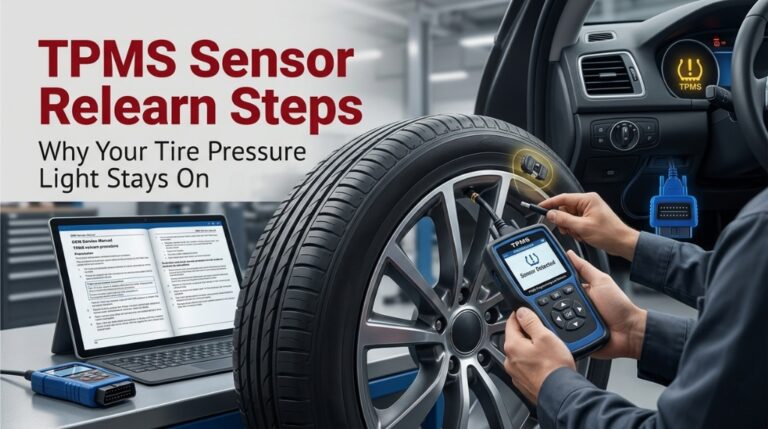
Neglecting the TPMS relearn steps in OEM manuals after a tire rotation or sensor replacement often leaves the warning light active. Using the wrong procedure for your vehicle is a common error in professional shops and DIY settings alike.
To reset the light, identify if your vehicle uses a stationary, OBD, or automatic relearn, then follow the OEM manual precisely. Methods are specific to make and model.
This guide details the three TPMS relearn types, provides instructions for finding them in your OEM manual, and explains how to troubleshoot sensor ID confirmation failures.
TPMS Sensor Relearn Steps from OEM Manuals: Why Manufacturer Procedure Matters

Standard TPMS guides often fail because each manufacturer uses a unique ECU architecture. Only the OEM service manual provides the exact relearn procedure required for your vehicle.
AMRA data shows that 38% of vehicles use automatic, 35% stationary, and 27% OBD relearns. Using the incorrect method causes the ECU to ignore or misstore sensor IDs, leading to persistent fault codes.
Consulting the OEM manual to identify and follow the specific relearn type is essential for a successful, efficient repair.
Step 1: Determine Your TPMS Relearn Type Before Starting
The single most critical step happens before any tool touches the vehicle. Your OEM service manual will specify the exact relearn type under the Tire Pressure Monitoring System section, typically in the Chassis or Body Electrical chapter, depending on the manufacturer.
The three relearn types and what defines them:
|
Relearn Type |
Tool Required |
Drive Required |
Common Vehicle Brands |
|
Automatic |
Optional TPMS tool to trigger |
Yes — specific speed/duration |
Dodge, Chrysler (pre-2012), and some GM |
|
Stationary |
TPMS activation tool + sometimes OBD connection |
No |
GM, Ford, and some Nissan |
|
OBD |
TPMS scan tool with OBD connection required |
Sometimes post-relearn |
Toyota, Honda, Subaru, Jaguar, Land Rover |
If an OEM manual is unavailable, owner’s manuals often detail automatic and stationary relearn procedures. However, OBD relearners require a factory service manual for specific scan tool commands.
For universal TPMS sensors, you must program the sensor to the vehicle’s specifications and then perform the vehicle relearn; both steps are essential to extinguish the light.
If you need to locate the correct factory documentation before proceeding, this guide, “Where to Download Genuine OEM Workshop Manuals,” covers the most reliable sources currently available for year-specific service documentation.
Step 2: Execute the Stationary Relearn — No Drive Needed

The stationary relearn is the most common procedure for GM and Ford vehicles. It transfers new sensor IDs to the vehicle’s ECU while parked, using a TPMS activation tool to trigger each sensor in a manufacturer-specified sequence.
Standard stationary relearn sequence (general format — always confirm against your OEM manual):
- Inflate all four tires to the pressure listed on the door placard — not the tire sidewall
- Turn the ignition to the ON position without starting the engine
- Enter relearn mode using the vehicle’s DIC menu, trip odometer stem, or brake pedal sequence as specified in the OEM manual — the horn will chirp once, or the TPMS light will blink to confirm learn mode is active
- Starting with the left front wheel, hold the TPMS activation tool against the sidewall near the valve stem and trigger the sensor — the horn chirps once to confirm ID receipt
- Move clockwise: right front, then right rear, then left rear — trigger each sensor in sequence, waiting for the horn confirmation between each
- After the left rear sensor is confirmed, the horn will chirp twice — this signals that all four IDs have been successfully relearned
- Turn the ignition off to exit learn mode
Common failure points: missing the correct DIC menu path, using the wrong ignition sequence, or triggering sensors out of the clockwise order. Your OEM manual will specify the exact entry sequence for your model on GM push-button start vehicles, the procedure differs from the key-start version.
Step 3: Execute the OBD Relearn for Asian and European Vehicles
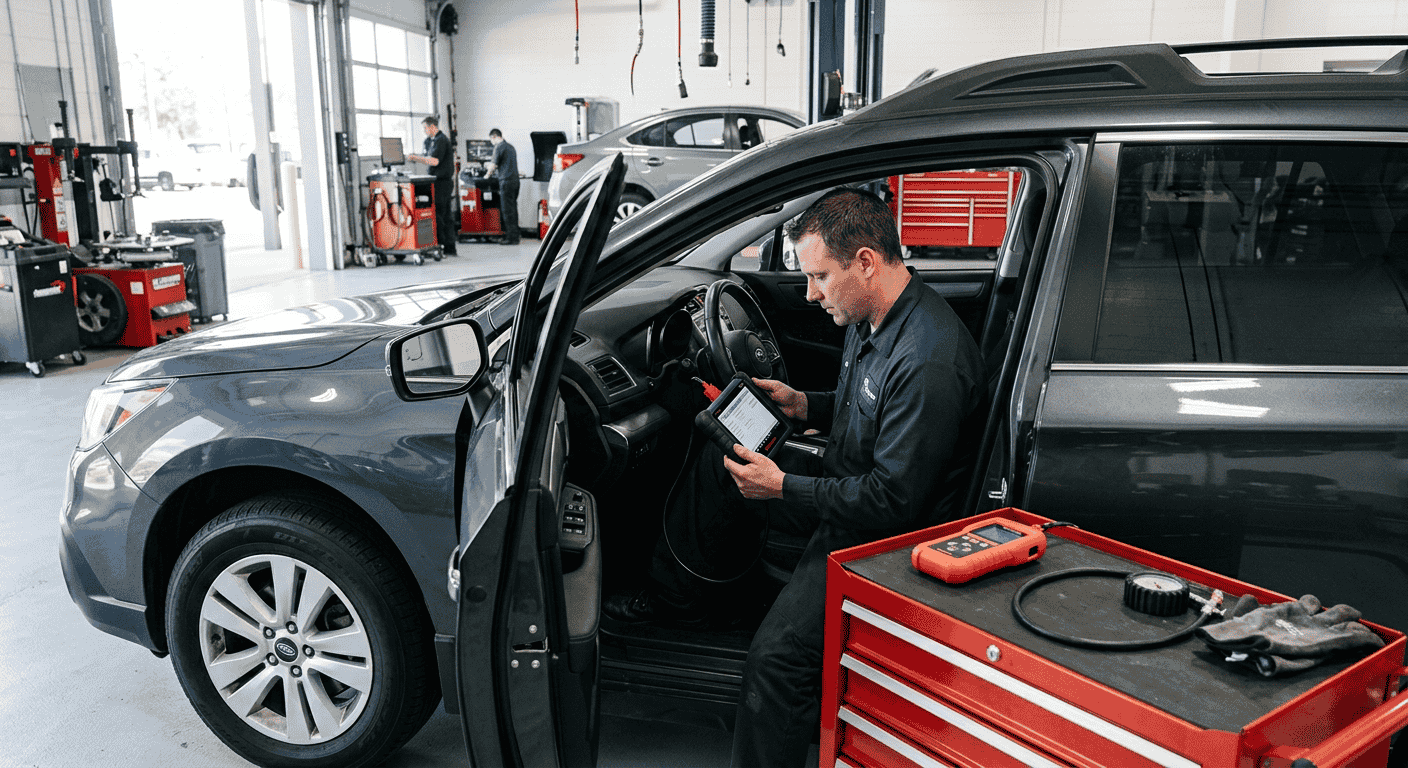
The OBD relearn is the standard for most Toyota, Honda, Subaru, Lexus, Jaguar, and Land Rover models. It uses a TPMS scan tool connected to the OBD port to write new sensor IDs directly to the ECU. The ECU does not automatically pick up these IDs.
OBD relearn sequence:
- Inflate all tires to door placard specification
- Trigger each TPMS sensor using the activation tool — record that each sensor responds. Any non-responding sensor must be addressed before proceeding
- Connect the TPMS scan tool to the vehicle’s OBD port under the dashboard
- Navigate to the TPMS or Tire Pressure section in the scan tool menu
- Select “Relearn” or “Write Sensor IDs to ECU” — the scan tool transfers the triggered sensor IDs to the vehicle’s ECU directly
- Confirm on the scan tool that all four sensor IDs were accepted
- Turn the ignition off, disconnect the OBD tool
- Some vehicles — notably Subaru and certain Toyota models — require a post-OBD drive of 10 to 20 minutes at 15 mph or higher before the TPMS light clears. Your OEM manual will specify if this drive cycle is needed
The choice between OEM and aftermarket TPMS sensors is critical during OBD relearns. Aftermarket units require precise MMY programming before triggering to ensure the ECU accepts the ID write. For a deeper look at compatibility, see this comparison of OEM vs Aftermarket Manuals: Best for DIY.
Step 4: Execute the Automatic Relearn — Drive-Based Confirmation

The automatic relearn requires no specialized tool for the relearn itself, but a TPMS tool is recommended to verify each sensor is transmitting before starting the drive. A sensor that appears to function at the start of a rotation may have a low battery or a damaged antenna — only a trigger test can confirm this.
Automatic relearn process:
- Verify all tires are inflated to the placard pressure
- Optionally trigger each sensor with a TPMS tool to confirm all four are transmitting before the drive
- Drive the vehicle at a sustained speed above 15 mph — most automatic relearn procedures require 10 to 20 minutes of uninterrupted driving at speeds between 20 and 60 mph
- Avoid stop-and-go traffic during this drive — the ECU needs continuous sensor transmissions at wheel speed to map and confirm each position
- The TPMS warning light will extinguish during or shortly after the drive when the ECU has confirmed all four sensor IDs and positions
Automatic relearn vehicles include most pre-2012 Chrysler and Dodge models, some Ford variants, and select GM trucks. Your OEM manual will state the exact minimum speed and duration for your specific model. A 2008 Dodge Charger, for example, specifies a minimum drive of 10 minutes at 15 mph or higher, with no stops exceeding 3 minutes.
For vehicles where the decision between full factory service documentation and aftermarket guides directly affects repair outcomes, this breakdown of Digital Car Manuals vs. Mechanic Advice covers the practical differences.
Step 5: Troubleshoot a Relearn That Won’t Confirm
Even with the correct procedure, some TPMS relearners fail to complete. The most common causes are interference, incorrect sequence, or a faulty sensor, and each has a different resolution.
Troubleshooting checklist when the relearn won’t confirm:
- Horn doesn’t chirp during stationary relearn: Lower all windows, open doors, and turn off the radio — RF interference from electronics can block the 315 MHz or 433 MHz signal between the TPMS tool and the ECU
- OBD relearn shows sensor ID write failed: Confirm the sensor was triggered after the OBD connection was established, not before — some ECUs only accept IDs that are written in the same session as the trigger
- Automatic relearn light stays on after 20-minute drive: Check if any sensor battery is below threshold using a TPMS scan tool — a low-battery sensor transmits intermittently and may not complete enough cycles for ECU confirmation
- Relearn completes but light returns within one drive: The OEM manual may specify a post-relearn initialization drive that was skipped — some Toyota and Honda models require the TPMS monitor to complete a full drive cycle before clearing permanently
For those building a reliable workshop documentation library specifically for safety and monitoring system service, this practical overview of How to Choose the Right Workshop Repair Manual for Your Vehicle is worth reviewing before starting the next job.
If a TPMS relearn failure is appearing alongside other warning lights, including SRS system alerts it is worth checking whether both systems share a BCM or body electronics fault. This guide on SRS Airbag Light Reset Steps via OEM Manuals covers the OEM-documented reset procedure for related body system faults.
Conclusion
TPMS sensor relearn is a manufacturer-specific process, and the OEM manual is the only document that contains the exact procedure for your vehicle. Identifying the correct relearn type first, following each step in the specified sequence, and verifying post-relearn with a scan tool that processes resolves the vast majority of persistent TPMS warning lights without replacing any additional hardware.
Get the type right. Follow the sequence. Confirm the result. That’s the complete job.
Frequently Asked Questions
It depends on the vehicle. For vehicles using a stationary or OBD relearn, rotating tires changes the physical position of each sensor ID relative to the wheel position the ECU has stored.
If the ECU monitors position-specific data, which most direct TPMS systems do, a rotation without relearn causes the system to report incorrect wheel positions when a low-pressure alert occurs.
Some automatic-relearn vehicles self-correct during the next extended drive, but stationary and OBD systems require a deliberate relearn after each rotation. Your OEM manual will specify whether a rotation triggers a relearn requirement for your specific system.
A blinking TPMS light for approximately 60 to 90 seconds, followed by a steady-on condition, is a specific diagnostic signal. The blinking indicates the TPMS system performed a self-test and detected a fault, usually a sensor that did not respond, a sensor with a critically low battery, or a system module fault.
The steady light after the blink sequence means the fault has been logged and is active. This behavior is distinct from a steady-on light that appears after a low-pressure alert, which simply means tire pressure is below the 25% threshold.
A blinking-then-steady pattern always warrants a TPMS scan tool read before proceeding with any relearn attempt.
Yes, and this is one of the most common reasons a relearn procedure fails to produce the confirming horn chirp during a stationary relearn or fails to write the sensor ID during an OBD relearn.
The TPMS sensor battery has an average service life of 5 to 10 years, depending on the transmission frequency and ambient temperatures. A sensor with a battery below the operating threshold transmits intermittently or not at all when triggered by the activation tool. A TPMS scan tool will display the battery status for each sensor, typically shown as “Low,” “OK,” or a voltage percentage.
Any sensor showing a low battery should be replaced before attempting the relearn procedure, as the ECU will not accept intermittent IDs into memory.
Mixing OEM and aftermarket sensors on the same vehicle is technically possible in most cases, but it introduces compatibility risk depending on the relearn type. For automatic relearn vehicles, the ECU simply reads the transmitted frequency. Aftermarket sensors operating on the correct frequency will be accepted.
For OBD relearn vehicles, the ECU writes the specific sensor ID to its memory. Aftermarket sensors must be pre-programmed to the correct vehicle MMY before triggering, or the ID format will not match the ECU’s expectations.
Most reputable aftermarket TPMS sensor manufacturers support programming to OEM ID formats, but the programming step must be completed before installation, not after.
Yes, without exception. The BCM (Body Control Module) or dedicated TPMS module stores the unique ID number and wheel position for every sensor fitted to the vehicle. When the module is replaced, the stored data is lost entirely.
The replacement module starts with no sensor IDs registered, meaning the TPMS warning light will illuminate immediately after the module is installed. A full relearn using the procedure from the OEM service manual is required to register all four sensor IDs to the new module.
On GM vehicles, this is particularly important because the BCM communicates with the sensors via the keyless entry receiver, so a BCM replacement may also require key fob reprogramming as part of the same service visit.