Ignoring valve clearance tolerances listed in your factory manuals is one of the most overlooked causes of premature engine wear. Most drivers have no idea there’s even a number to check until something goes wrong.
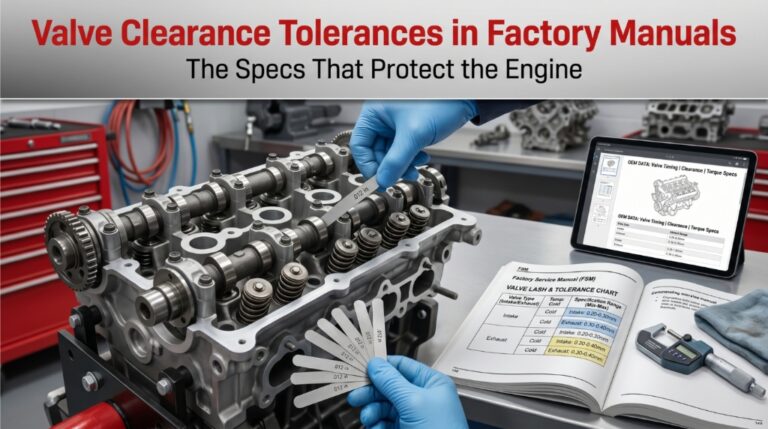
Factory service manuals provide critical valve lash specs to account for thermal expansion. Misinterpretation can lead to noise or burnt valves. For accuracy, measure the gap between the camshaft lobe and lifter or rocker arm with a feeler gauge while the engine is cold.
This guide covers exactly how to read, interpret, and apply valve clearance tolerances from factory manuals, with nothing left out.
Valve Clearance Tolerances in Factory Manuals: What Every Spec Really Means

Factory manuals hold the most accurate valve clearance data available for any engine. Not a forum post, not a mechanic’s memory from 10 years ago. The manual.
This section breaks down how those specs are structured, what the numbers represent, and why even a 0.02mm variance from factory tolerances can push your engine into trouble.
Why Factory Tolerances Exist and Why They Vary by Engine
Every engine is built around specific thermal expansion rates. The gap between the cam and valve (the valve clearance) allows the metal to expand as the engine heats up without the valve remaining partially open.
Factory manuals account for this through a defined tolerance range. A typical example from a Nissan QR25DE lists cold intake clearance at 0.24–0.32 mm and cold exhaust at 0.26–0.34 mm. Those aren’t random numbers. They reflect the expansion behavior of that specific engine’s aluminum block, steel camshaft, and valve material combination.
Key reasons why tolerances differ engine to engine:
- Material combinations, aluminum heads expand more than iron; factory engineers compensate by widening the cold tolerance range
- Valve function exhaust valves run hotter than intakes and require more clearance to prevent heat-related valve stay
- Valve train type shim-over-bucket, shim-under-bucket, and rocker arm setups all respond differently to thermal load
Always treat the factory manual spec as the baseline. Third-party guides often reference middle-range values without noting the full tolerance window.
Reading Intake vs. Exhaust Tolerances the Right Way
One of the most common mistakes during a valve adjustment is treating intake and exhaust specs as interchangeable. They’re not.
Exhaust valves run significantly hotter than intake valves during combustion. To compensate, factory manuals consistently assign exhaust clearances a slightly wider range. A Honda small engine spec, for example, lists intake at 0.15 mm ± 0.02 mm and exhaust at 0.20 mm ± 0.02 mm. That 0.05 mm difference is deliberate.
Here’s a simplified comparison table of common factory tolerance values across popular engines:
|
Engine |
Intake (Cold) |
Exhaust (Cold) |
|
Toyota 2AZ-FE |
0.15–0.25 mm |
0.25–0.35 mm |
|
Nissan QR25DE |
0.24–0.32 mm |
0.26–0.34 mm |
|
Honda 1.5L (Civic) |
0.15–0.19 mm |
0.26–0.30 mm |
|
Kawasaki ZX-14 |
0.10–0.20 mm |
0.15–0.25 mm |
|
Toyota 1C Diesel |
0.20–0.30 mm |
0.25–0.35 mm |
Never assume one engine’s factory spec applies to another, even within the same manufacturer’s lineup.
Cold vs. Hot Valve Clearance Specs in Factory Manuals
Some factory manuals list two sets of valve clearance tolerances, one for cold and one for hot. This catches many people off guard. If you’ve ever found that the hot spec in your manual is larger than the cold spec, you’re not reading it wrong.
Some aluminum-heavy engines, like the Nissan QR series, expand, widening the measured gap at operating temperature. The factory manual for those engines lists a hot intake clearance of0.32–0.40 mm, versus the cold spec of 0.24–0.32 mm. Metal expansion in aluminum cam supports elevates the measurement, making the hot number appear larger.
Standard practice across most factory manuals:
- Measure and adjust cold (stone cold, not just warm)
- If the factory manual calls for a hot verification, do it after a full warm-up cycle
- Always re-check cold specs after any hot measurement to confirm you’re still within factory tolerance
Skipping a re-check is how minor adjustment errors compound into long-term valve damage.
What Happens When Valve Clearance Falls Outside Factory Tolerances
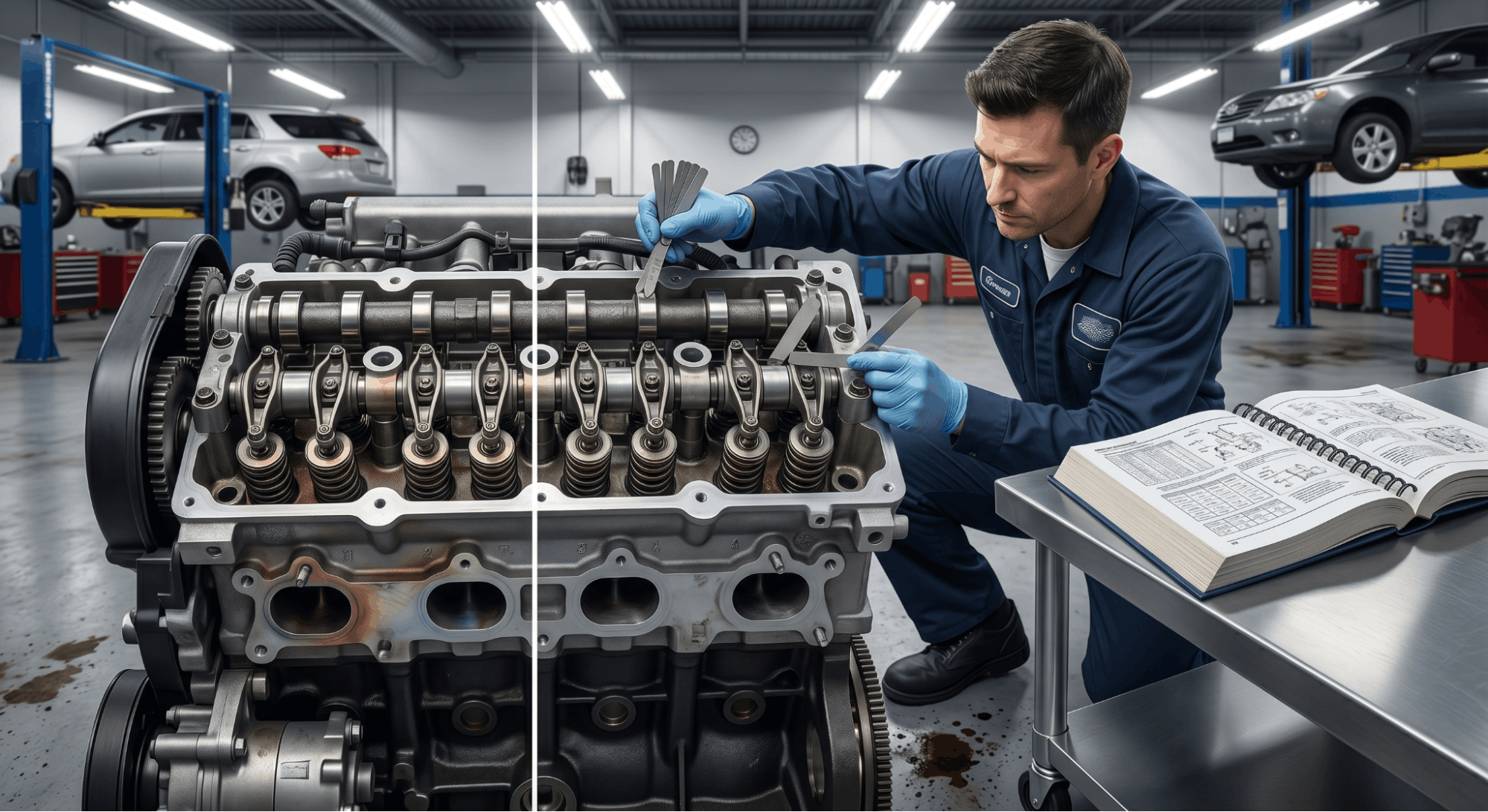
Going out of spec in either direction creates problems. The direction matters as much as the distance.
Too tight (below minimum tolerance): When clearance drops below the minimum spec listed in the factory manual, the valve stem expands under heat and may not fully seat. A valve that won’t fully close can’t shed heat to the seat effectively. This leads to burned valves, compression loss, hard cold starts, and rough idle. It’s the more dangerous direction to err.
Too loose (above maximum tolerance): Excessive clearance causes valve train noise, slightly reduced efficiency, and in extreme cases, cam lobe wear. It’s annoying and shortens component life, but rarely catastrophic on short notice. You’ll typically hear clatter from the top end before any real damage sets in.
Staying within the factory tolerance window, ideally near the midpoint, is the safest approach. Some experienced mechanics aim for the upper half of the exhaust valve range, giving thermal expansion more room to work without risking tight conditions at operating temperature.
If you need the original factory service manual PDF for your vehicle to check the correct valve clearance tolerances, you can find it by VIN, which is the most reliable starting point.
Feeler Gauges, Shim Selection, and Staying True to Factory Specs
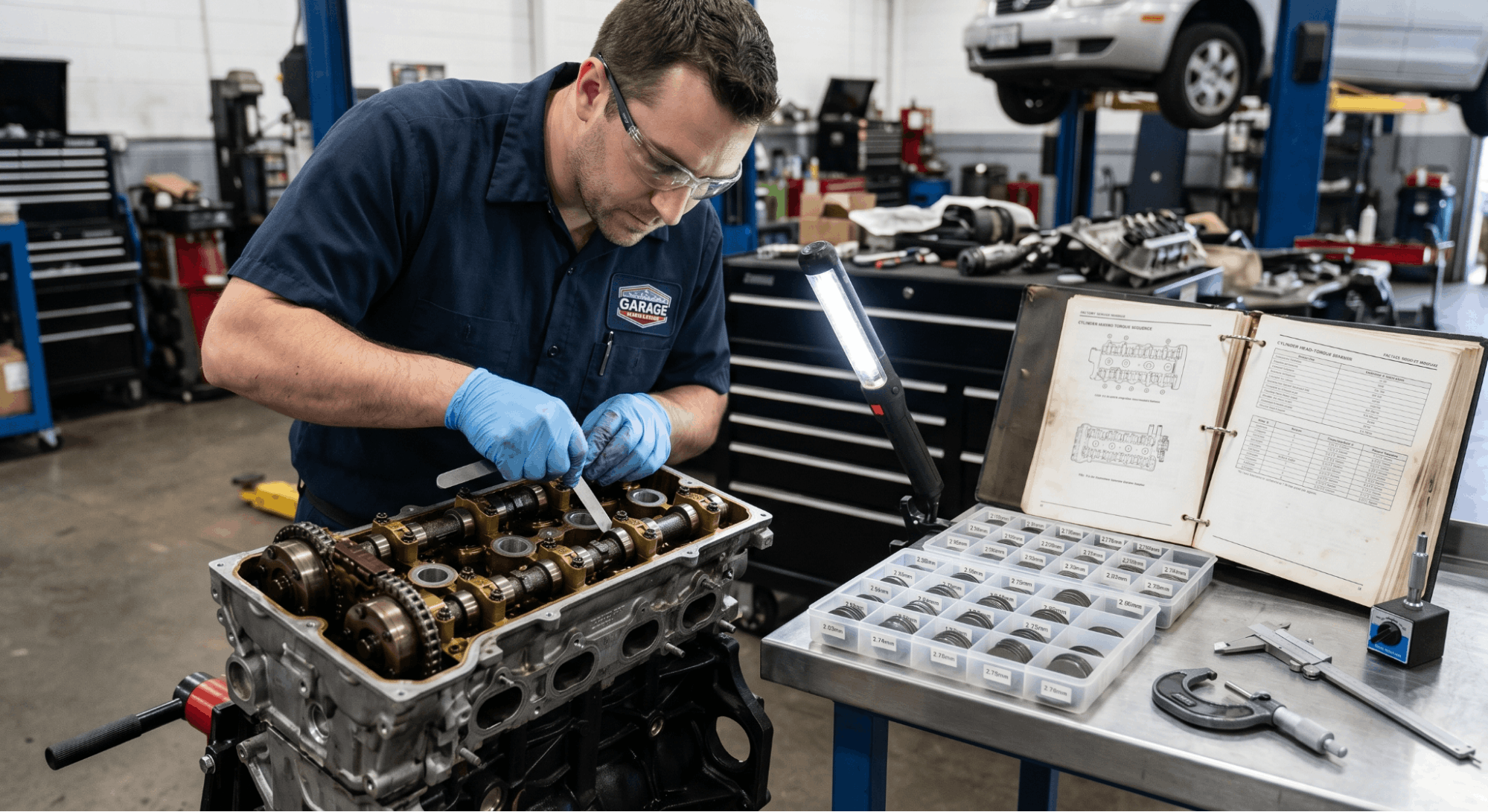
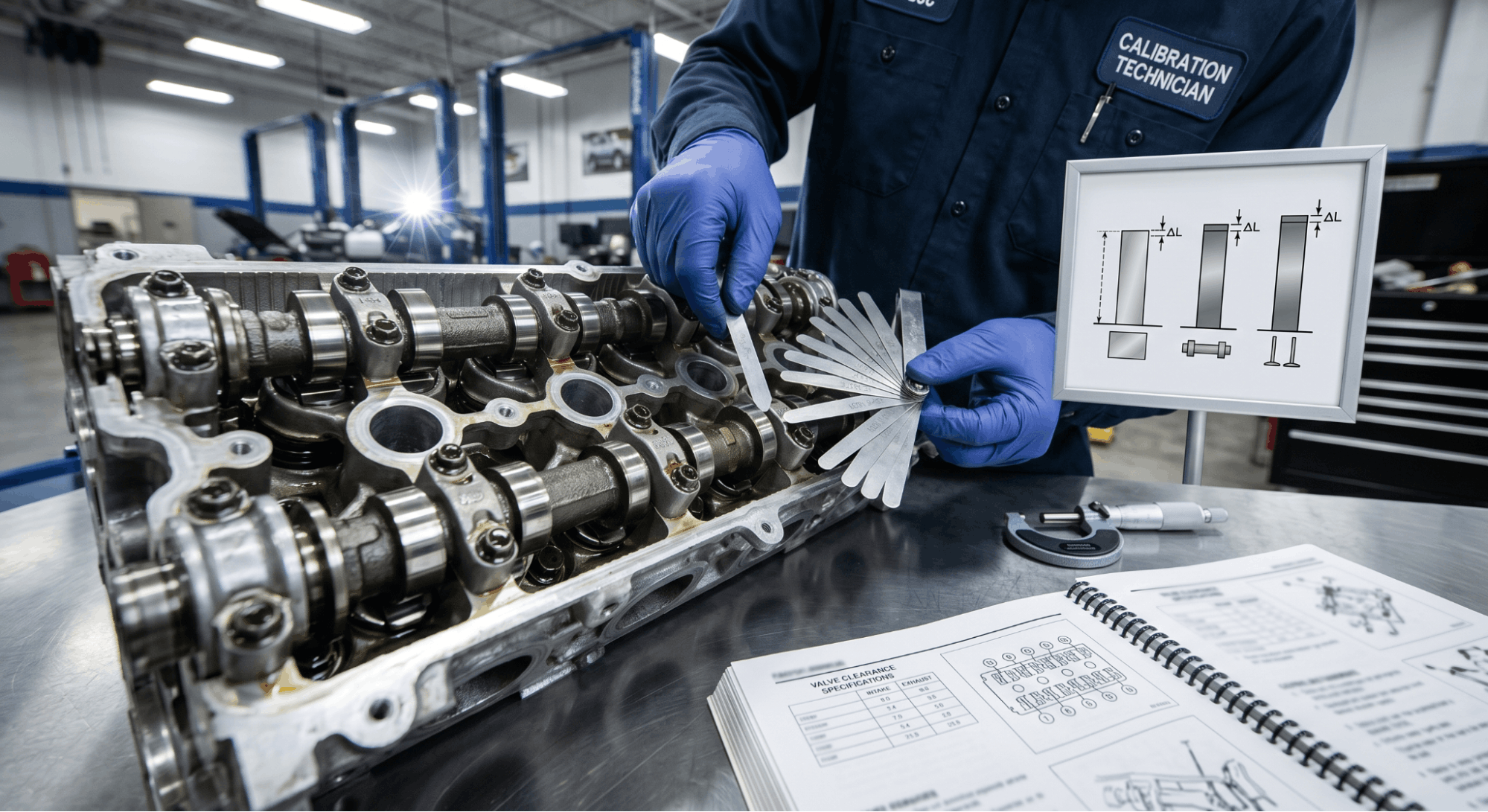
Once you’ve read your factory manual tolerances, the next step is accurate measurement. A feeler gauge inserted between the cam lobe and the valve lifter shows your current clearance. If it’s outside the factory tolerance range, a shim change is required.
Shim selection process (shim-over or shim-under bucket systems):
- Measure current clearance with the correct feeler gauge thickness
- Compare the measured gap against your factory manual tolerance range
- Calculate the difference to determine the required shim thickness
- Install the new shim and re-verify the measurement
Most factory manuals include a shim selection chart. The Toyota 2AZ-FE manual, for instance, provides a full lifter selection table paired with measured clearance values. Using OEM shims is especially recommended when adjusting clearances near the edge of tolerance. Aftermarket shims can vary slightly and tip you out of spec.
For navigating complex shim charts and multi-step procedures in your factory manual, knowing how to use interactive PDF workshop manuals can save a lot of time.
Where to Source Accurate Factory Manual Specs
Not every online source lists the correct valve clearance tolerances for your engine. Aftermarket repair manuals sometimes round or simplify ranges. Online forums often cite a single value from within the range without noting it’s not a fixed spec.
The safest sources, in order of reliability:
- OEM factory service manuals (dealer-issued or downloadable originals like NXT Motors)
- OEM workshop manuals distributed through official channels
- Manufacturer-specific databases (Toyota TIS, Honda eService, etc.)
If you’re concerned about whether a free source is providing accurate data, it’s worth reviewing whether free online car repair manuals are reliable. And when sourcing manuals for less common engines, checking where to download genuine OEM workshop manuals ensures you’re working with the real published factory tolerances.
Conclusion
Valve clearance tolerances in factory manuals aren’t a suggestion. They’re the result of precision-engineering testing tailored to each engine’s materials, temperatures, and valve-train design. Reading them incorrectly or ignoring them entirely puts the engine at real risk at both ends of the range.
The practical takeaway is simple: always reference the original factory manual for your exact engine. Use the correct feeler gauge, measure cold unless the manual says otherwise, and aim for the midpoint of the tolerance range when possible. It’s a straightforward job when you have the right spec in front of you.
Frequently Asked Questions
No. Even within a manufacturer’s lineup, valve clearance tolerances vary by engine displacement, cam profile, head material, and valve train design. A Toyota 1C diesel has different specs than a 2AZ-FE gasoline engine despite both being Toyota products.
The factory manual for your specific engine is the only reliable reference. Cross-referencing specs between models, even similar ones, risks incorrect adjustment and potential engine damage over time.
.It depends on the engine and the manufacturer’s recommendation in your factory manual. Most modern engines call for an inspection every 30,000 to 60,000 miles or every few years.
High-performance engines or those with bucket-and-shim systems tend to maintain clearances longer than those with rocker-arm designs.
Air-cooled and diesel engines typically require more frequent checks. Always follow the factory maintenance schedule rather than a generic interval, as different materials wear at different rates.
Yes, significantly. Installing aftermarket camshafts usually changes the lift and lobe profile, which directly affects the required valve clearance.
In those cases, the original factory tolerance no longer applies. You’d need the specs from the camshaft manufacturer, not the OEM factory manual.
Running factory tolerances on a modified valve train can result in valves being either dangerously tight or excessively loose under operating load.
A range gives the technician realistic flexibility, accounting for minor variations in shim availability and measurement conditions.
A fixed single value is common in older or simpler engines, where the valve train design leaves less room for adjustment. Both formats are valid, but a range is more practical.
If your factory manual lists a range, aim for the center. If it gives a fixed value, hit it to the nearest increment allowed by your shim.
Indirectly, yes. Extreme cold means metal contracts more before startup, which can temporarily widen clearances beyond the factory manual’s measurements at standard conditions.
At high altitude, air-cooled engines may run hotter due to thinner air, pushing clearances tighter faster.
Neither condition changes the published factory tolerance, but it does affect how quickly your clearances drift out of spec over time.
In extreme climates, more frequent checks are worth adding to your maintenance routine.