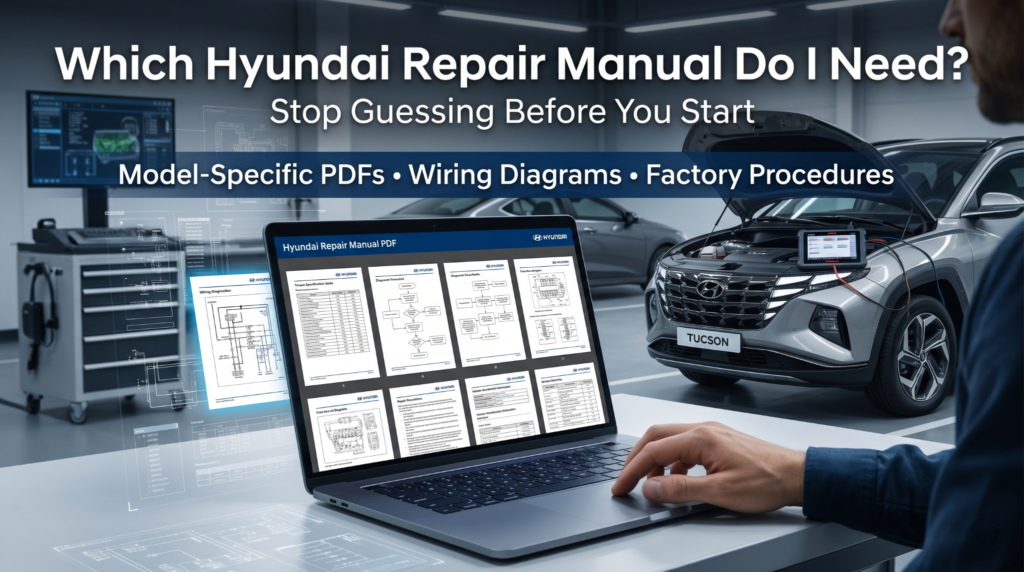
Using the wrong Hyundai repair manual is more costly than having none at all. One wrong torque spec or missing wiring diagram can turn a simple repair into a dealer-level problem fast.
Select your manual based on model, year, and repair type. Obtain the correct documentation from the official Hyundai Service Website or trusted sources such as NXT Motors.
This guide breaks down every manual type, how to match it to your job, and what to avoid when choosing. You will know exactly what you need before spending a single dollar.
Which Hyundai Repair Manual Do I Need: The Answer Most Owners Get Wrong

Not every Hyundai owner needs the same manual, and that is exactly where most people go wrong. Choosing a generic guide for a model-specific repair can lead to missed specs, incorrect procedures, and real damage.
This section covers the right manual types, how to match them to your repair needs, and why model year accuracy is non-negotiable for any serious Hyundai job.
4 Manual Types and Which Repair Each One Covers
Knowing what type of manual exists is the first step before choosing one. Each type is built for a specific level of repair, and mixing them up wastes time and creates errors.
Here are the four main types every Hyundai owner should know:
- OEM Factory Service Manual (FSM): Direct from Hyundai. Covers every system with factory-level specs, torque values, wiring diagrams, and diagnostic trouble codes. Best for engine rebuilds, transmission work, and electrical repairs.
- Workshop Repair Manual: A step-by-step technical document used by professional mechanics. Covers most models in detail, with system-specific chapters and real part numbers.
- Haynes / Chilton Aftermarket Manual: Great for general maintenance on older Hyundai models. Covers oil changes, brakes, belts, and common fixes. Not ideal for newer or hybrid models.
- Owner’s Manual: Covers basic operation, warning lights, and routine checks. Does not include repair procedures or torque specifications.
Picking the wrong type is the single most common mistake Hyundai owners make when starting a DIY repair.
If you want a deeper breakdown of how to approach the selection process before buying, this guide on choosing the right workshop repair manual explains the key decision factors step by step.
OEM Factory Manual vs. Aftermarket: Real Differences
Many owners assume any repair manual works the same way. That assumption gets expensive quickly when working on a modern Hyundai with complex electronics or hybrid systems.
| Feature | OEM Factory Manual | Aftermarket (Haynes/Chilton) |
|---|---|---|
| Accuracy | Exact manufacturer specs | General estimates |
| Wiring Diagrams | Full, model-specific | Simplified or partial |
| Hybrid/EV Coverage | Yes | Limited or none |
| Model Year Precision | Exact | Grouped by range |
| Best For | All repairs | Basic maintenance only |
| Format | PDF, digital, print | Print, some digital |
OEM manuals always carry the highest level of accuracy because they are built directly from Hyundai’s own engineering data. For any repair that goes beyond routine maintenance, they are the only safe choice.
For a detailed comparison of the two manual categories and their specific use cases, this breakdown of OEM vs. aftermarket manuals is worth reading before you decide.
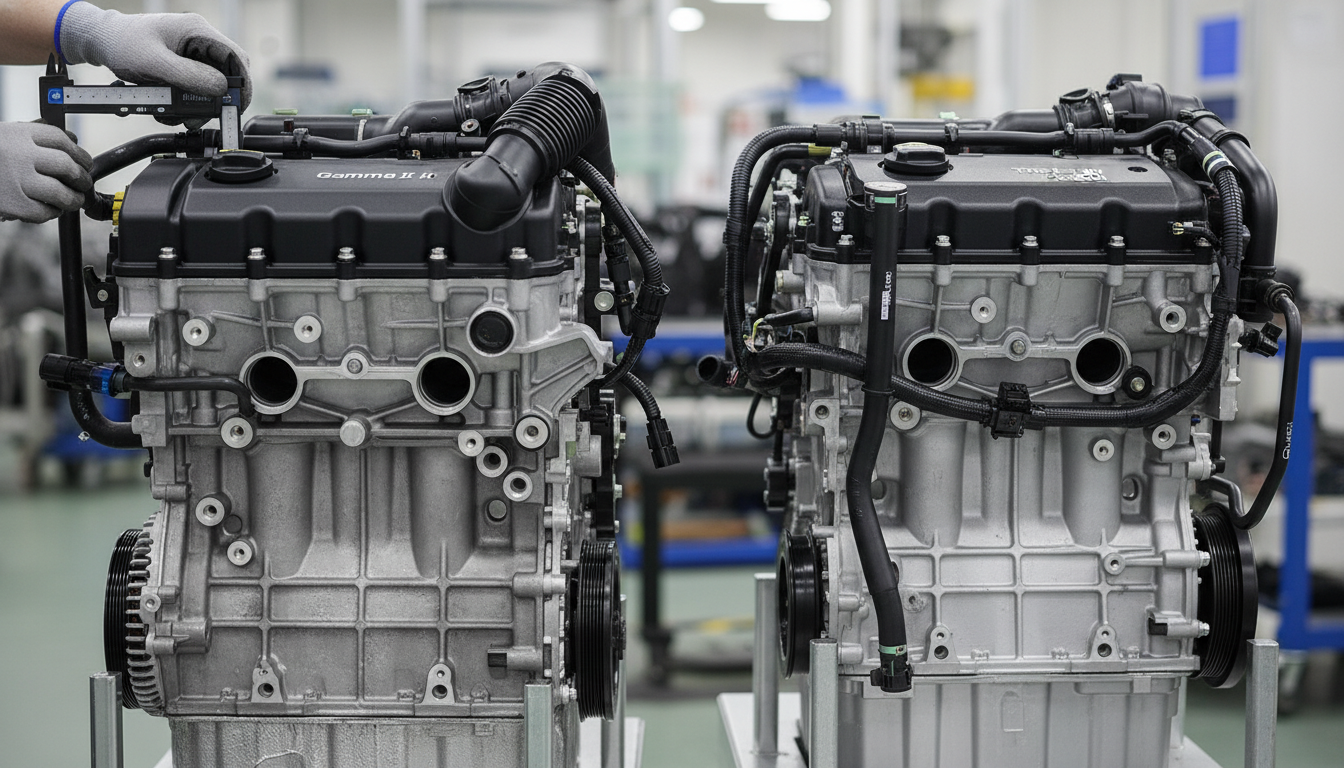
Why Your Hyundai Model Year Changes Everything
A repair manual written for a 2018 Tucson will not work correctly on a 2021 Tucson. Hyundai regularly updates engine variants, transmission systems, and electrical architecture between model years.
Key areas where year-specific accuracy is critical:
- Engine codes: The same model can carry different engines across years. Specs and procedures are not interchangeable.
- Transmission type: A manual covering the older 6-speed DCT will not address the newer 8-speed unit correctly.
- Electrical systems: Each generation update brings revised wiring layouts, new sensors, and updated ECU configurations.
- Hybrid and EV variants: Battery management, inverter cooling, and regenerative braking systems require exact model-year data to service safely.
Always confirm the manual covers your exact year, not just your model name. Even a single model generation gap poses a risk when performing structural or electronic repairs.
You can identify your exact factory spec set by using your VIN, which is the most reliable method covered in this resource on finding a factory service manual PDF by VIN.
Digital vs. Print Manual: What Works Better for Hyundai Repairs
Both formats have genuine advantages, and the right choice depends on where and how you work on your car.
Digital Manual Advantages:
- Instant download, no wait time
- Searchable by keyword, system, or fault code
- Zoomable wiring diagrams and high-resolution photos
- Accessible on phone, tablet, or laptop while under the car
- No risk of pages tearing or grease damage
Print Manual Advantages:
- No screen glare in bright outdoor light
- No battery or internet dependency
- Easy to annotate with notes in the margins
- Better for users who prefer linear step-by-step reading
For most modern Hyundai models, a digital OEM manual is the smarter investment. The ability to search by fault code alone saves hours during electrical diagnostics.
If you want guaranteed access to legitimate, manufacturer-approved files, this collection of genuine OEM workshop manuals is a verified starting point.
For i10 owners specifically, the right Hyundai service manual can directly impact performance outcomes, not just repair quality.

How to Confirm You Have the Right Manual Before Starting

Many owners only discover they have the wrong manual mid-repair. That is not the point to find out. Check these factors before you begin any job:
- VIN verification: Cross-check the vehicle coverage in the manual against your 17-digit VIN. This confirms engine code, transmission type, and production market.
- Model generation match: Identify whether your vehicle is the first, second, or third generation of that nameplate. Each has distinct repair procedures.
- System coverage check: Review the table of contents before purchasing. Confirm it includes the exact system you need to repair, whether that is the engine, suspension, ABS, or HVAC.
- Format suitability: If you are working alone without an assistant, a digital format on a tablet holder beats a print manual on a greasy floor.
A Hyundai repair manual that passes all four checks above is the right one. Anything that falls short by even one point is a risk not worth taking on a vehicle you depend on daily.
Conclusion
Choosing the right Hyundai repair manual is not complicated once you know the four variables: manual type, OEM vs. aftermarket, your model year, and your preferred format. The biggest mistake is treating all manuals as equal, they are not.
A factory service manual matched to your exact Hyundai model and year will always outperform a generic guide when it matters most. Get the right one first, and the repair becomes far more manageable from the start.
Common Asked Questions About Which Hyundai repair manual do I need
Can I use a single Hyundai repair manual across multiple model years?
Technically possible for minor jobs, but not recommended for anything beyond basic checks. Hyundai updates engine calibrations, torque specs, and electrical layouts between model years, sometimes dramatically.
A manual for a 2017 Elantra may share 70% of its content with the 2019 model, but the remaining 30% may cover critical systems such as fuel injection mapping or transmission control modules.
For any job involving drivetrain, electronics, or safety systems, always use a manual matched to the exact year. Cross-year use on complex repairs introduces genuine risk of incorrect procedures and potential component damage.
Does Hyundai publish its own official repair manuals for public access?
Hyundai does provide access to official factory service information, though it is typically accessed through subscription platforms or authorized dealer systems rather than a free public download.
Their technical information system, known as HMG TIS, offers model-specific data including wiring diagrams and service bulletins. Some older model manuals have been made available through third-party sources.
For current models, purchasing an authorized OEM digital manual from a verified provider is the most reliable way to access legitimate factory data without a dealer-level subscription.
What is the difference between a service manual and a workshop manual for Hyundai?
These terms are often used interchangeably, but there is a meaningful distinction. A service manual typically refers to the OEM document created directly by Hyundai, covering factory procedures, torque values, diagnostic codes, and complete system specifications.
A workshop manual is often a more practical guide, sometimes produced by third parties like Haynes, designed for hands-on DIY use.
Workshop manuals simplify procedures and prioritize usability over completeness. For complex or safety-critical repairs, the OEM service manual is the preferred source. For routine maintenance, a workshop manual is generally sufficient.
Do Hyundai hybrid and electric models need a different repair manual?
Yes, and this is an important point many owners overlook. Hyundai hybrid and EV models, such as the Ioniq, Kona Electric, and Tucson Hybrid, have powertrain systems that are not covered in standard combustion-engine manuals.
High-voltage battery management, inverter servicing, regenerative braking calibration, and hybrid ECU diagnostics all require model-specific documentation.
Using a standard petrol or diesel Hyundai manual on a hybrid is not only ineffective but also dangerous. Always source a manual that explicitly states hybrid or EV coverage and confirms compatibility with your specific drivetrain variant.
Is a Hyundai repair manual useful for diagnosing warning lights and fault codes?
Absolutely, and this is one of the strongest reasons to own one. A quality OEM Hyundai repair manual includes a full diagnostic trouble code section that maps each fault code to the affected system, likely cause, and recommended test procedure.
This goes far beyond what a basic OBD2 scanner app tells you. When a warning light appears, the manual allows you to systematically trace the fault to its source rather than guessing.
For recurring or intermittent faults, the wiring diagrams and sensor location charts in a factory manual are genuinely invaluable tools that no generic scan tool can replace.