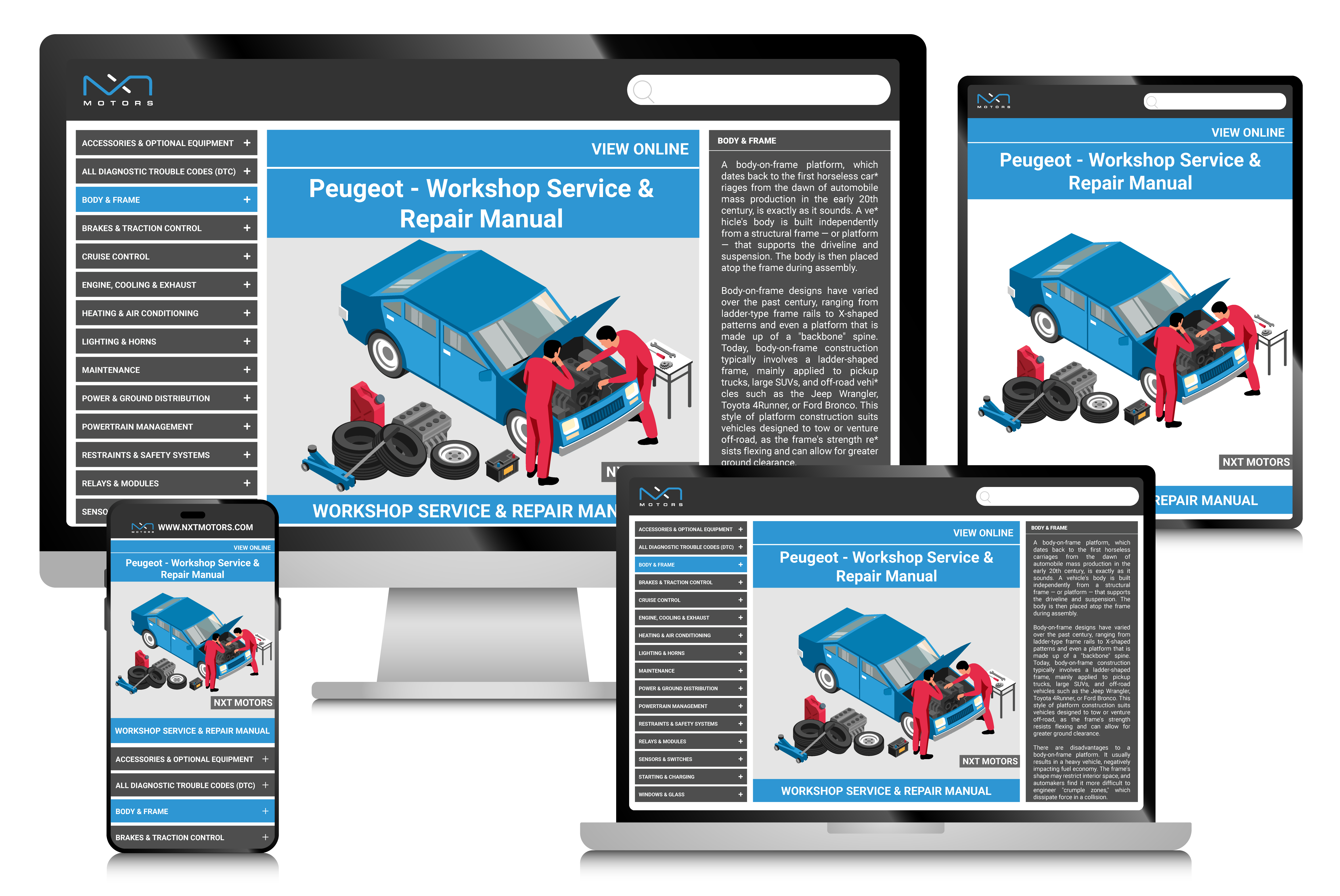
Peugeot 806 Workshop Manual, Repair Guide and Wiring Diagrams

A Peugeot 806 workshop manual gives owners and technicians the model-specific information needed to service and repair this practical MPV correctly. Produced from 1994 to 2002, the 806 used petrol and diesel engines from about 1.8 to 2.1 liters, including the 1.9 TD, 2.1 TD, later 2.0 HDi, and several 2.0 petrol versions.
Because fuel systems, engine management and wiring vary across the range, the manual should match the vehicle’s year, engine and body classification.
Finding the Right Peugeot 806 Manual
Start with the model year, then confirm the engine size, fuel type, power output, and engine code where available. A 1998 1.9 TD needs different injection and electrical information from a 2002 2.0 HDi, while the 2.0 petrol range includes both 8-valve and 16-valve versions.
| Peugeot 806 version |
Category years |
Best manual focus |
| 1.8 i 8v 103 petrol |
1994–2002 |
Ignition, injection, cooling, and servicing |
| 1.9 TD / 1905 cc |
1994–2002 |
Mechanical diesel injection, glow plugs, and turbo |
| 2.0 i / 2.0 i 8v TE |
1994–2002 |
Petrol management, timing, and idle control |
| 2.0 i 16v 135 or 138 |
1994–2002 |
16-valve repairs, sensors, and transmission data |
| 2.1 TD / 2088 cc |
1994–2000 |
Diesel pump, timing, and cooling system work |
| 2.0 HDi / HDi 110 |
2000–2002 |
Common-rail injection, fuel pressure, and ECU systems |
For an earlier diesel family model, the 1998 Peugeot 806 1.9 TD family repair manual is more relevant than a generic Peugeot book. The larger indirect-injection diesel is covered by year-specific products such as the 2000 Peugeot 806 2.1 TD workshop manual.
Later common-rail vehicles require dedicated HDi data, such as the 2002 2.0 HDi 110 DW10ATED family service manual. The category includes separate year, engine, and family/commercial applications.
What Is Included in a Peugeot 806 Workshop or Repair Manual?

A proper Peugeot 806 repair manual supports practical fault-finding and step-by-step workshop work. Depending on the selected product, coverage commonly includes:
- Scheduled maintenance, fluids, filters, and inspection points
- Engine dismantling, measurement, reassembly, and tightening data
- Timing belt, auxiliary drive, water pump, and cooling procedures
- Petrol injection, diesel injection, turbocharger, and exhaust diagnosis
- Clutch, gearbox, driveshaft, and final-drive repairs
- Brakes, ABS, steering, and front suspension
- Heating, air conditioning, sliding doors, and interior trim
- Connector locations, test values, torque settings, and wiring diagrams
This structured information helps users test a fault before replacing parts and follow the correct removal and installation sequence.
Common Peugeot 806 Repairs and Problems Covered

Most surviving 806 models are older vehicles, so condition and service history are important. Used-car guidance and owner reports highlight electrical gremlins, central-locking or immobilizer trouble, air-conditioning faults, worn sliding-door runners, cabin wear, and uneven front-tire wear as useful inspection points.
A model-specific manual can guide:
- Cooling-system repairs: coolant leaks, thermostat, radiator, hoses, fans, water pump, and bleeding.
- 1.9 TD and 2.1 TD faults: glow-plug tests, fuel supply, injection-pump controls, turbo checks, and air ingress.
- HDi diagnosis: hard starting, non-starting, limited engine speed, or power loss involving the filter, rail-pressure sensor, or regulator. Similar concerns regularly appear in discussions among 806 HDi owners.
- Petrol engine repairs: rough idle, misfires, ignition faults, sensors and fuel injection on 1.8 and 2.0 models.
- Driveline work: clutch replacement, gear selection, driveshafts, CV joints, and oil seals.
- Brakes, suspension and bodywork: pads, discs, ABS, ball joints, bushes, bearings, steering, locks and sliding-door adjustment.
Petrol owners should also match the valve configuration. The 2002 Peugeot 806 2.0i 16v 138 workshop manual prevents 8-valve and 16-valve procedures from being confused.
Peugeot 806 Wiring Diagrams and Electrical Troubleshooting

A Peugeot 806 wiring diagram helps identify a failed component from a poor earth, a damaged connector, a faulty relay, or a broken wire. Useful diagrams identify wire colors, connector pins, fuse boxes, control units, and harness routes.
Available XUD9 diesel diagrams identify the battery, passenger and engine-compartment fuse boxes, diagnostic connectors, glow-plug controller, injection pump, engine ECU, central locking, air conditioning and coded anti-start system. Harness and installation layouts also show where components and wiring run through the vehicle.
These details support the diagnosis of no-start conditions, charging faults, warning lamps, cooling fans, glow plugs, central locking, immobilizer, ABS, and air-conditioning controls. Always use a diagram for the correct year and engine.
Peugeot 806 Manuals and Model Variants in This Category

Selecting the correct manual ensures you have accurate technical data, wiring schematics, and service procedures tailored to your vehicle’s specific production year and engine configuration.
Reviewing the categories below will help you identify the precise document needed for your repair or maintenance task, ensuring compatibility with your 806 model.
Manual Types
- Workshop service and repair manuals: Mechanical, maintenance, diagnostic, and electrical procedures.
- Year-specific manuals: Coverage matched to an individual year between 1994 and 2002.
- Engine-specific manuals: Focused data for one engine, output, or code.
- Family Saloon manuals: Passenger-model coverage, including seating, cabin equipment, doors, and heating.
- Commercial Saloon manuals: Information for commercial-use versions where trim or equipment may differ.
Engine and Trim Coverage
- 1.8 i 8v 103 Family Saloon: Petrol servicing, ignition, injection, cooling and 8-valve repairs for 1994–2002.
- 1.9 TD Family and Commercial Saloon: 1905 cc diesel coverage for glow plugs, mechanical injection, turbo, timing, and cooling.
- 2.0 i Family and Commercial Saloon: Core 1998 cc petrol engine-management, maintenance and drivetrain procedures.
- 2.0 i 8v TE Family Saloon: Correct 8-valve TE sensor, intake, ignition, and cylinder-head information.
- 2.0 i 16v 135 Family Saloon: Specific coverage for the 135-output engine and its electronics.
- 2.0 i 16v 138 Family and Commercial Saloon: Higher-output 16-valve engine controls, servicing and transmission procedures.
- 2.1 TD Family and Commercial Saloon: 2088 cc turbo-diesel timing, injection, and cooling coverage through 2000.
- 2.0 HDi DW10BTED Family Saloon: Later direct-injection diesel and electronically controlled common-rail systems.
- 2.0 HDi 110 Family and Commercial Saloon: Fuel delivery, sensors, turbo operation, and routine service work.
- 2.0 HDi 110 DW10ATED Family and Commercial Saloon: The precise choice when the DW10ATED code is confirmed.
- 1762, 1905, 1997, 1998, and 2088 cc listings: Displacement-based options for matching vehicle records when a trim name is unclear.
Commonly Asked Questions About the Peugeot 806 Workshop Manual
Is a Peugeot 806 workshop manual the same as an owner’s manual?
No. An owner’s handbook explains controls and basic checks; a workshop manual provides repair procedures, technical data, locations and diagnostic information.
Which manual do I need for a 2.0 HDi 110?
Match the year, then confirm whether the engine is listed as HDi 110 or by a code such as DW10ATED or DW10BTED.
Do the manuals include wiring diagrams?
Many products include schematics, connector information, and component locations, but coverage varies. Check the selected listing to see which systems are included.
Can I use a 2.0 petrol manual for a 2.0 HDi?
No. Petrol and common-rail diesel engines use different fuel, ignition, turbocharging, and engine management systems.
Are Family Saloon and Commercial Saloon versions covered?
Yes, where listed. Select the application shown in your vehicle details and the product title.
Choose the Peugeot 806 service manual PDF that matches the year, engine size, output, engine code, and family or commercial specification. The closest match gives clearer procedures, more relevant wiring information, and a safer starting point for maintenance, troubleshooting, or repair.