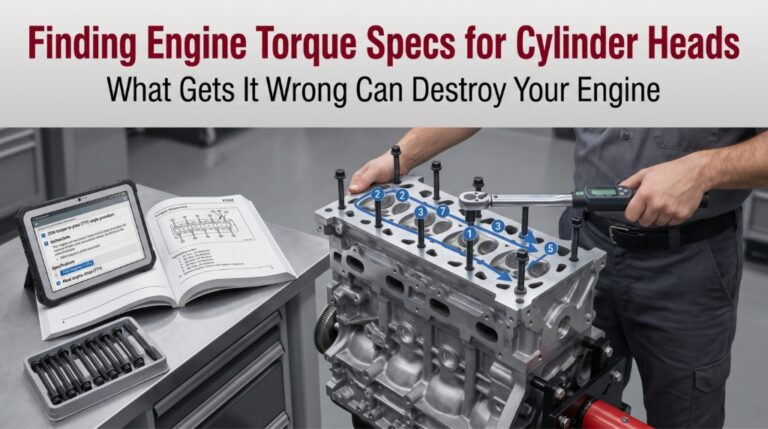
Incorrect engine torque specifications for cylinder heads can cause catastrophic failures, such as blown head gaskets or snapped bolts.
Always use the Factory Service Manual (FSM) or OEM workshop manual for accurate specs. Avoid generic charts. These procedures usually involve multi-stage tightening in a specific sequence.
Modern engines often require torque-to-yield (TTY) bolts, which involve specific degrees of rotation after an initial torque.
This guide walks you through exactly where to find accurate engine torque specs, how to read them correctly, what bolt types change the procedure, and how to apply them step by step without damaging a freshly rebuilt engine.
Finding Engine Torque Specs for Cylinder Heads: Why the Source Matters More Than the Number

Experienced mechanics understand the importance, but the source of your data is equally critical. Discrepancies between generic manuals and factory documents are not errors; they represent precise calculations for bolt preload.
No single torque value exists for cylinder head bolts. Required values vary based on engine design, material, gasket type, and fastener grade, especially regarding torque-to-yield (TTY) bolts. Identifying the correct source is the essential first step.
Why Generic Torque Charts Are Dangerous for Cylinder Heads
Generic bolt torque charts work fine for basic fasteners. They fail completely on cylinder heads.
Most people do not realize that a generic bolt chart only accounts for bolt size and grade. It completely ignores lubrication effects, multi-stage tightening sequences, torque-to-yield bolt behavior, and whether angle torquing is required. For a head bolt holding a combustion chamber at 1,500 psi or less, that missing context is critical.
Here is what changes between engines and why generic values cannot cover them:
- Bolt material and grade: Aftermarket studs like ARP hardware use different friction coefficients than stock bolts, which shifts the required torque value by 10–20%
- Lubrication type: Dry threads, engine oil, and moly-based lubricant all produce different clamping loads at the same torque reading. ARP explicitly states that using their moly lubricant changes the friction enough to require lower torque numbers
- Bolt length variation: On many engines (LS-series GM blocks, for example), bolts vary in length per hole position, and the final angle rotation for shorter bolts differs from longer ones
- Head material: Aluminum heads need hardened steel washers to prevent galling, and clamping load tolerances are tighter than on cast iron
Using a generic chart is not a shortcut it is a gamble on a part that costs hundreds of dollars to replace.
Where to Actually Find Your Engine Torque Specs

There are a few legitimate sources, ranked here from most to least authoritative.
1. Factory Service Manual (FSM)
This is the gold standard. The FSM is produced by the vehicle manufacturer and contains OEM torque values, multi-step sequences, bolt reuse policies, and angle specifications. If you are doing a head rebuild on anything built after 1990, the FSM is the source for the procedure.
You can find original FSMs in OEM workshop manuals or purchase them from manufacturer dealerships and authorized documentation archives. If you already know when to upgrade to a factory service manual, you also know that for anything engine-internal, there is no substitute.
2. Professional Repair Databases
AllData and Mitchell1 are the two major subscription platforms used by professional repair shops. Both pull specs directly from OEM documentation and update regularly. They include torque sequences, not just values. Short-term subscriptions are available for DIY access.
3. Haynes and Chilton Manuals
These are secondary sources. They compile specs from OEM data, but they are not always up to date, and minor discrepancies exist on less common fasteners. They work for lower-stakes fasteners but should be cross-checked against a second source for cylinder head bolts. The OEM manuals always win in a conflict.
For a clear comparison of how different manual types serve different purposes, the breakdown between OEM vs. aftermarket manuals for DIY work is worth reviewing before you decide which documentation to rely on.
4. VIN-Based Lookup
Some spec databases and FSM services let you pull the exact procedure for your VIN. This eliminates trim-level or production-year ambiguity. If your vehicle had a mid-year engine change or a production variant not clearly labeled on the engine bay sticker, a factory service manual PDF found by VIN will provide the correct document for your specific build.
5. Automotive Forums
Forums are the last resort, not the first stop. When using the forum specs, cross-reference with at least 2 independent sources before touching the torque wrench.
There are valuable threads out there, but community specs have no editorial oversight, and a single well-intentioned but incorrect post can circulate for years as “confirmed.”
Torque-to-Yield Bolts Change Everything
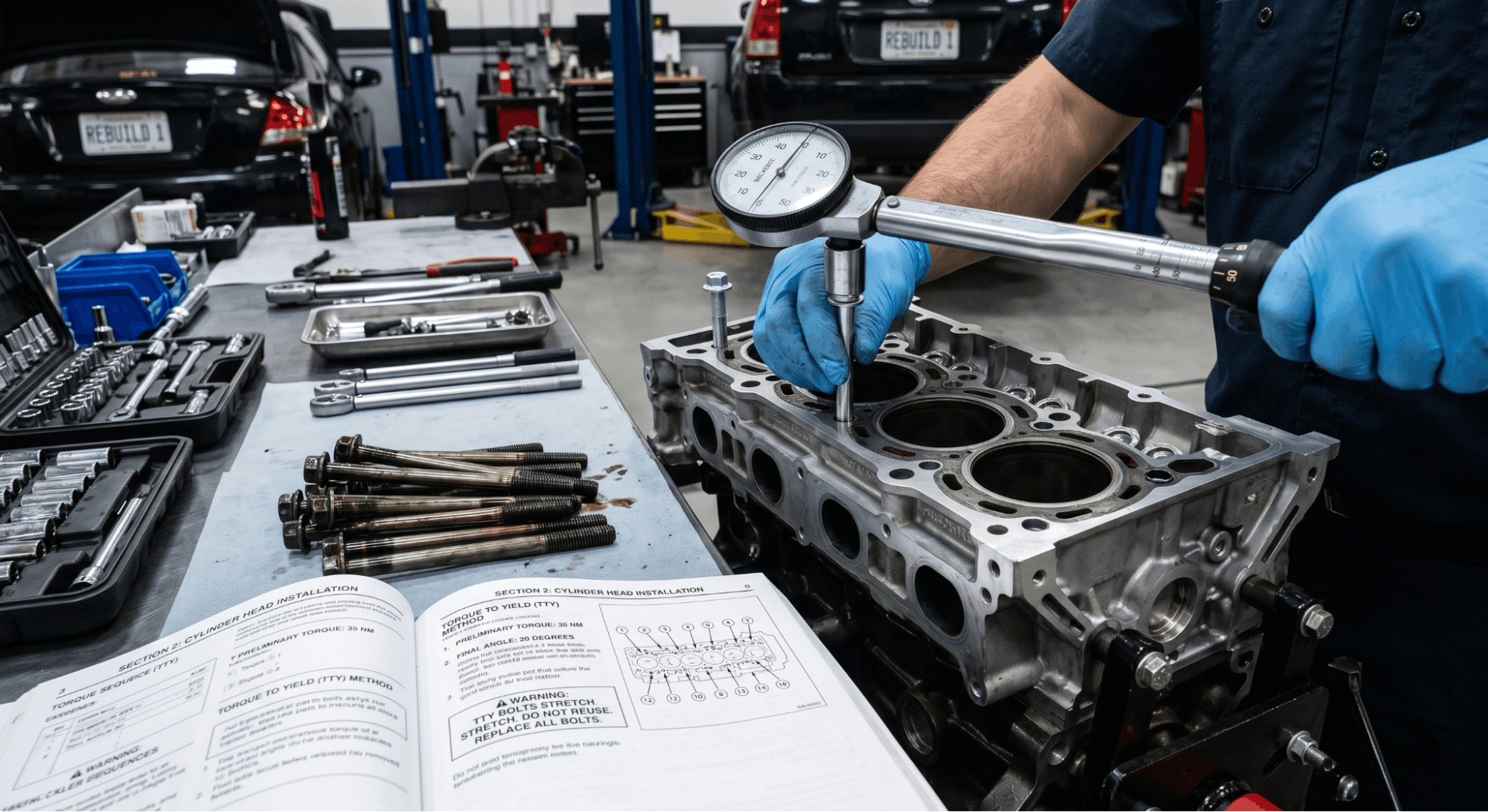
This is where many DIY engine rebuilds go wrong. Torque-to-yield (TTY) bolts are designed to stretch past their elastic limit during installation.
That controlled stretch creates a very precise and consistent clamping load, superior to standard torque-only methods.
The catch: once stretched, they cannot be reused.
Many modern engines use TTY head bolts. If your FSM says replace the head bolts, it is not being cautious, it is being specific.
Reusing TTY bolts is a known cause of head gasket failures months after a rebuild.
|
Fastener Type |
Reusable? |
Torque Method |
Example |
|
Standard bolt |
Yes (if undamaged) |
Single or multi-stage torque |
Older small-block V8s |
|
Torque-to-yield (TTY) |
No |
Torque + angle rotation |
Most post-2000 OEM engines |
|
ARP aftermarket stud |
Yes |
Torque only (moly lube) |
Performance builds |
|
Stretch bolt |
No |
Angle-only or torque + angle |
VAG/BMW diesel engines |
Always inspect standard bolts by comparing them to unused bolts from the same set. Any sign of stretch or deformation means replacement, not reuse.
Reading a Multi-Stage Torque Sequence Correctly
Most modern engine torque specs for cylinder heads involve multiple steps. A basic example looks like this:
- Step 1: Torque all bolts in sequence to 22 ft-lbs
- Step 2: Torque all bolts in sequence to an additional 90 degrees
- Step 3: Final pass at an additional 90 degrees
The GM LS1 (5.7L V8) uses exactly this approach for its M11 head bolts. The BMW M52 engine uses 40 Nm, then two additional 90-degree passes. The diesel Caterpillar 3.9L (236 CID) runs 65–70 ft-lbs in stages, then repeats after initial engine run.
A few things to get right when executing the sequence:
- Start from the center, work outward in a crisscross or spiral pattern. This prevents uneven clamping and head warpage
- Lubricate threads and the underside of the bolt head exactly as specified. The wrong lubricant shifts the friction enough to change the actual clamping load, even if the torque reading looks correct
- Wait between stages on some engines, particularly those with composite or multi-layer steel (MLS) head gaskets, to allow the gasket to settle
- Calibrate your torque wrench before the job. An uncalibrated tool is the silent cause of many repeat head gasket failures
Common Torque Spec Ranges by Engine Type
These are approximate reference ranges only. Always verify against your FSM before applying any of these values.
|
Engine Type |
Typical Head Bolt Torque Range |
|
Small gasoline (under 2.0L) |
40–65 ft-lbs |
|
Mid-size gasoline (2.0–3.5L) |
60–90 ft-lbs + angle |
|
V8 performance gasoline |
65–80 ft-lbs (or angle only) |
|
Light diesel (2.0–3.0L) |
80–120 Nm (59–88 ft-lbs) |
|
Heavy diesel (3.5L+) |
120–200 Nm (88–147 ft-lbs) |
These ranges exist because bolt size, thread pitch, gasket design, and head material all feed into the final number. What looks similar on paper can vary enough to matter in practice.
If the specs for your engine are not easily available or the documentation seems unreliable, it is worth checking whether free online car repair manuals are actually trustworthy before committing to a torque value from an unverified source.
Conclusion
The mechanics of torquing a cylinder head correctly come down to one starting point: the right source. Specs from the Factory Service Manual or a verified OEM database give you the exact values, sequence, lubricant requirements, and bolt reuse policy for your specific engine. Nothing else covers all of that reliably.
From there, it is about execution: the correct pattern, starting from the center outward; proper lubrication; staged tightening; a calibrated torque wrench; and fresh TTY bolts, if the manual requires them. Skip any one of those steps, and the rest of the work becomes a liability.
Engine rebuilds are expensive and time-consuming. The spec lookup takes ten minutes. Do the ten minutes first.
Frequently Asked Questions
Not always. If a cylinder head has been resurfaced, its height changes slightly. This can affect whether existing bolt lengths are appropriate, and in some cases, longer or shorter fasteners may be needed to avoid bottoming out in blind holes.
Always check the FSM notes for resurfaced heads, and verify with a machine shop if the deck was cut beyond the OEM limit.
Over-torquing head bolts can stretch them past their yield point, crack the cylinder head, strip threads in the block, or warp a flat sealing surface.
On aluminum heads, especially, excessive torque loads are a direct path to a head that cannot seal properly. In severe cases, the block threads pull out, and the repair escalates to a helicoil job or worse.
On most modern engines with MLS (multi-layer steel) head gaskets and TTY bolts, the answer is no. The OEM procedure accounts for thermal cycling in the initial sequence. However, some older engines with composite gaskets and standard bolts require retorque after reaching operating temperature. Your FSM will state this explicitly if it applies.
Lubrication directly reduces friction between the bolt threads and the mating surface. Lower friction means more of the applied torque converts into bolt stretch (preload) rather than being wasted overcoming thread resistance.
ARP clearly states that their moly lubricant results in approximately 20–25% more bolt tension at the same torque reading as dry installation. Using the wrong lubricant with the correct torque results in the wrong clamping load.
Angle torquing is more precise than straight torque measurement. When you rotate a bolt by a fixed angle, you are controlling actual stretch directly, rather than relying on friction-dependent torque readings.
This removes variables like surface roughness, thread condition, and lubricant inconsistency that affect torque-based methods. Most modern cylinder heads use angle torquing in the final stage because it provides a more consistent, repeatable result across assembly conditions.