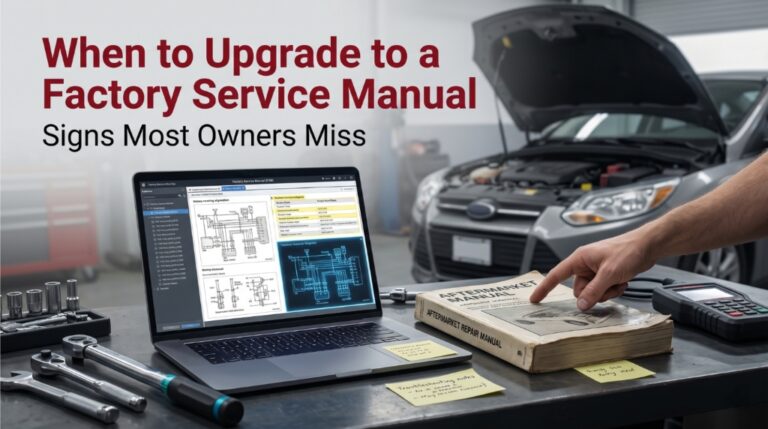
Skipping an upgrade to your factoryservicemanual isn’t just a minor oversight. It’s the kind of mistake that quietly compounds into misdiagnosed faults, repeated repairs, and serious safety exposure. Most vehicle owners never check until something fails.
Updates are critical if documentation lacks current software, recalls, or production specs. Switching to a Factory Service Manual (FSM) is essential for complex overhauls. FSMs provide precise torque specs and schematics, often missing from aftermarket guides like Chilton or Haynes.
This article walks through the exact signals that confirm your factory service manual needs to be replaced, including a clear comparison table, system-specific triggers, and the right action for each scenario.
When to Upgrade to a Factory Service Manual: The Real Cost of Waiting
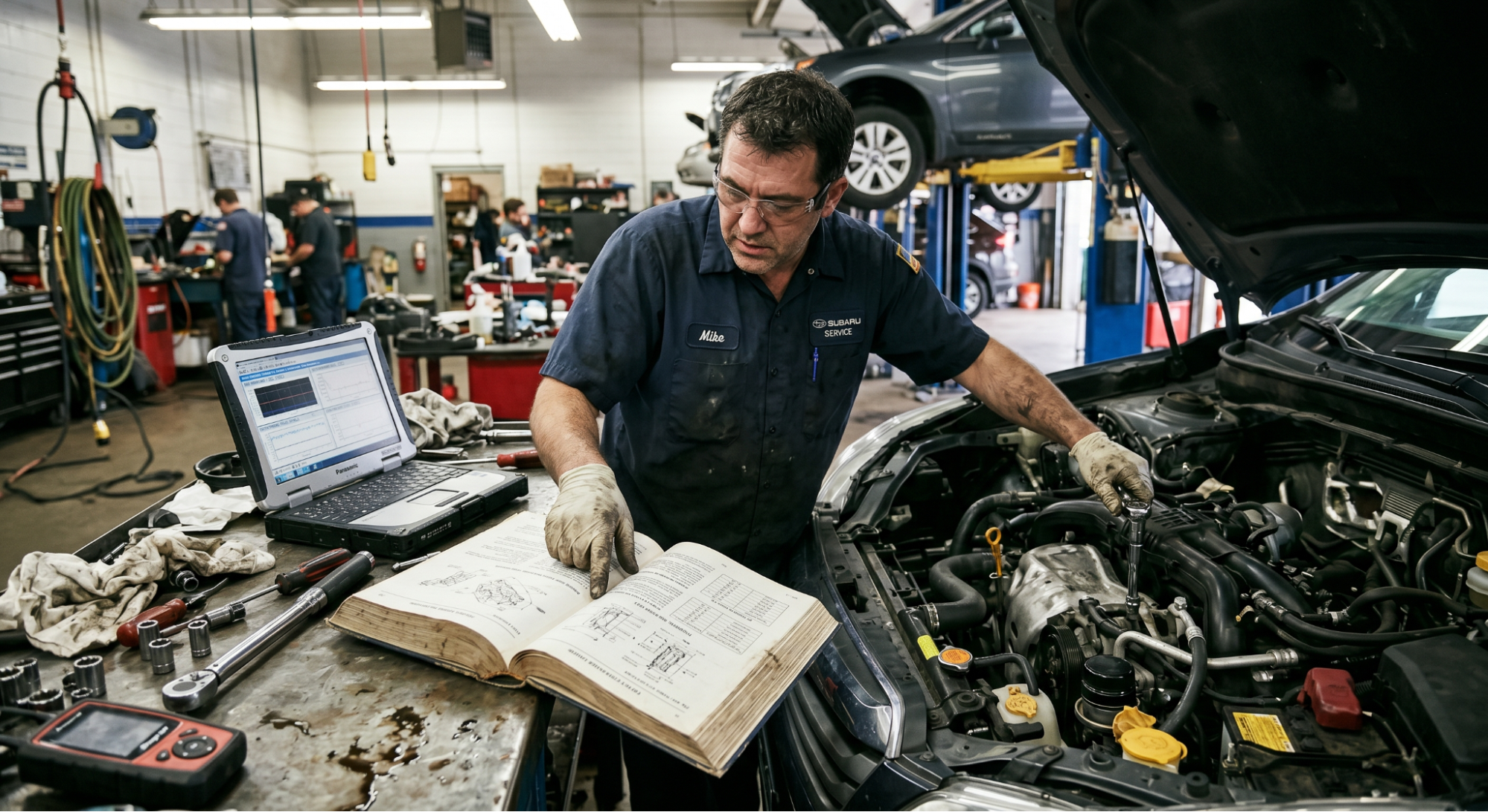
A factory service manual is the only document built directly by the manufacturer for your specific vehicle. It isn’t a general guide.
It’s a precision tool tied to your exact model, trim, year, and production batch. The moment it falls out of sync with your car’s actual configuration, every repair performed against it carries risk.
Most owners consider a manual upgrade only after an error has already occurred. The smarter move is knowing the signs before that happens. Here’s exactly what to look for, system by system.
Your Manual’s Model Year Doesn’t Match Your VIN
A mismatched model year is the most common and most overlooked trigger for a factory service manual upgrade. Even a six-month production gap between your manual and your vehicle can mean missing revised torque specs, updated fluid grades, or entirely rewritten component layouts.
Manufacturers release production-cycle documentation updates without public announcements. Changes to ECU configurations, suspension geometry, and brake line routing can vary significantly between model years. Your manual’s cover date doesn’t guarantee the accuracy of its content.
Cross-reference your full 17-digit VIN against the manual’s stated application range before any non-routine repair. This is the first filter, and it catches most compatibility problems immediately.
- Torque specs can differ by 10 to 20 percent between model years on the same platform
- Wiring harness configurations change at the factory level without visible exterior differences
- ECU software version references inside older manuals may be entirely obsolete
- Revised safety recall procedures do not appear in previously published editions
- Fluid capacities and grades are often updated mid-cycle for thermal or emissions compliance
A Recall or TSB Has Been Issued for Your Vehicle
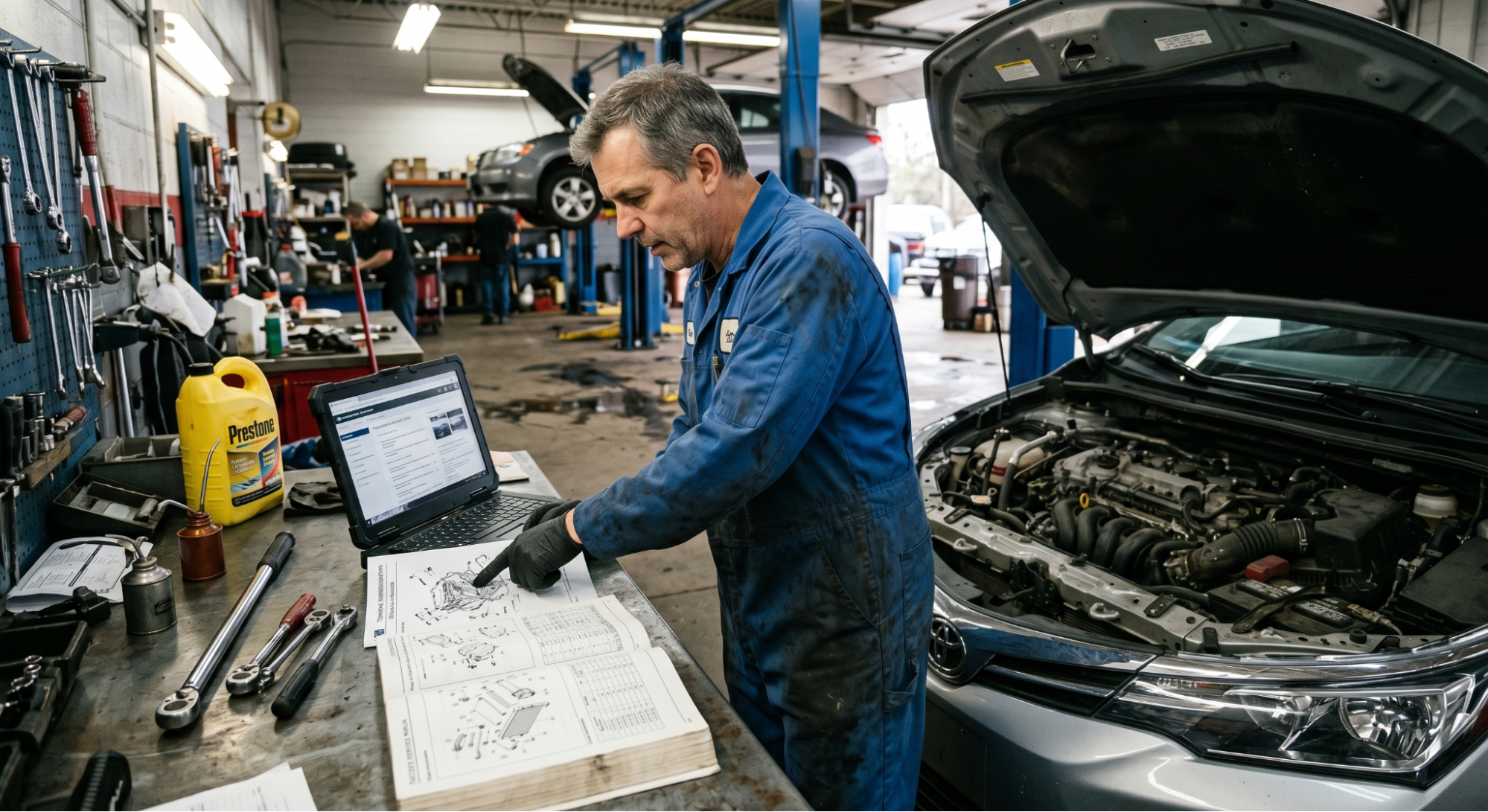
Technical service bulletins and safety recalls can invalidate entire chapters of a factory service manual. When a manufacturer issues a TSB, it means documented procedures have changed. Using the pre-recall manual to service an affected system isn’t just inaccurate, it can undo work already done under the recall.
This is especially common with cooling system repairs. For example, car overheating issues frequently produce TSBs that include revised thermostat sequences, updated coolant specifications, and new bleed procedures. An older factory service manual won’t contain any of this.
Every TSB carries a number that links to the original manual section it modifies. If your current manual doesn’t reflect that number, it’s already incomplete for any repair touching that system.
- Cross-check the TSB database against your manual’s edition and revision number
- Recalls can reclassify entire system procedures as non-compliant without replacing the manual
- Revised tightening sequences from TSBs must override whatever the printed edition says
- Post-recall warranty work done against an old manual can invalidate remaining coverage
- Dealer technical updates are not distributed to aftermarket manual publishers automatically
Repeated Repairs Are Failing Without a Clear Cause
If a repair performed exactly as documented still triggers fault codes, fails inspection, or produces the same symptoms within a short period, the manual itself is the most likely problem. Proper factory service documentation doesn’t produce repeated failures when followed correctly.
This signal often appears when diagnostic trees reference sensor values that no longer apply to updated hardware, or when component specifications listed in the manual have been superseded by a revised part number. Both scenarios make a correct repair look like a failure.
Comparing digital car manuals vs. mechanic advice helps clarify the stakes. When even experienced technicians produce inconsistent results, the common variable is almost always outdated or mismatched documentation.
- Repeated fault codes after a documented repair confirm a spec mismatch in the manual
- Failed inspections tied to correctly performed work indicate obsolete reference values
- Multiple part replacements with no resolution point to incorrect procedure steps
- Inconsistent results across the same repair on identical vehicles confirm a documentation error
- Calibration failures on advanced systems are almost always caused by superseded procedures
Vehicle Ownership or Workshop Has Recently Changed
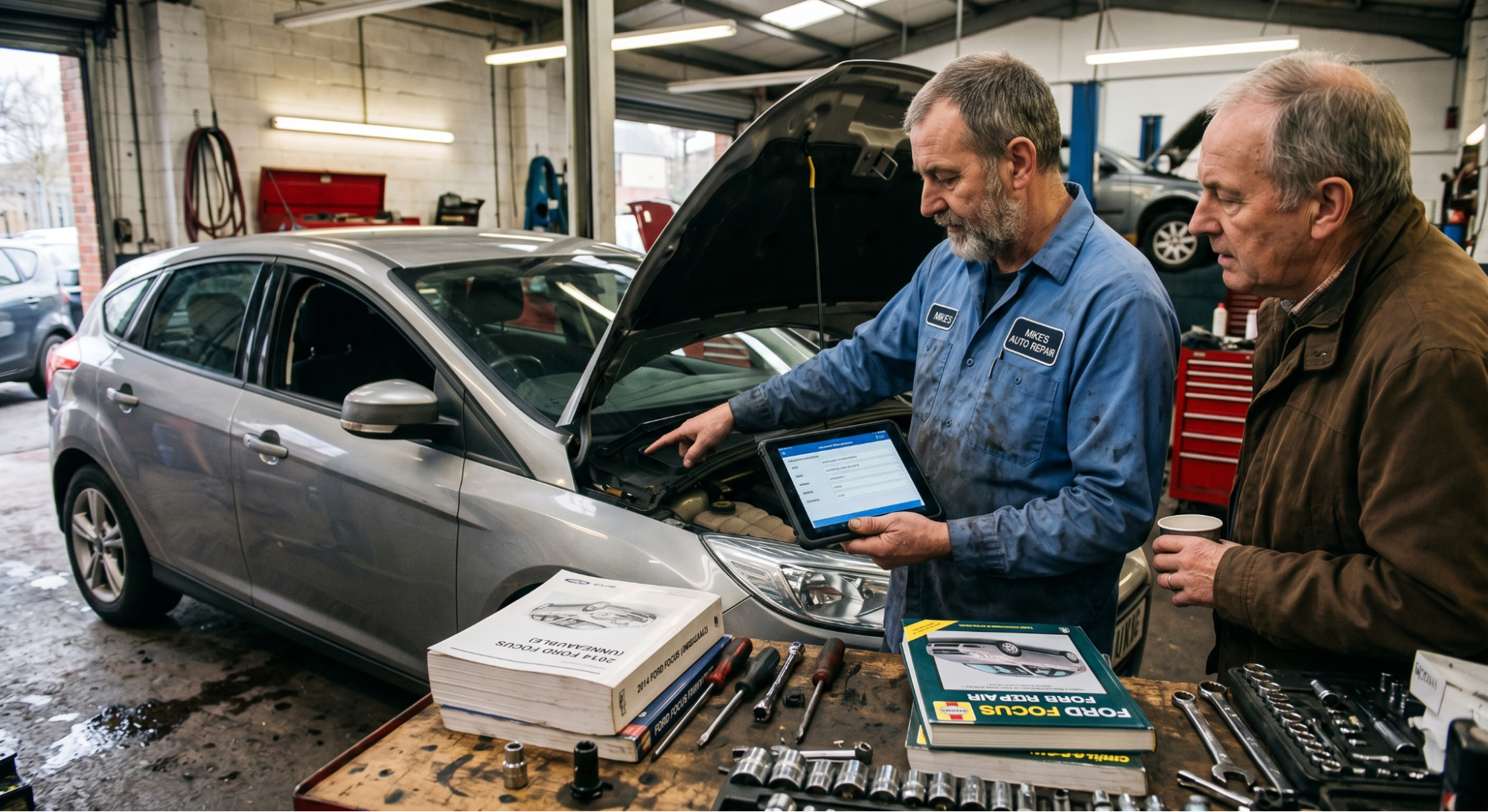
When a vehicle changes hands or a new workshop takes over servicing responsibilities, the factory service manual must be validated from scratch. Previous owners or technicians may have worked from aftermarket documentation, regional-market variants, or incorrect trim-level manuals.
Understanding how to choose the right workshop repair manual for a newly acquired vehicle starts with this step. A factory document sourced for the wrong market or wrong trim level can contain different part numbers, incompatible fluid specs, and alternative torque sequences that don’t match the actual vehicle.
VIN validation against the manual’s stated application range takes less than 5 minutes and prevents the most common source of inherited workshop errors.
- Always confirm manual compatibility using the full 17-digit VIN, not just the model name
- Regional variants use different part numbers, wiring specs, and emissions-related procedures
- Aftermarket manuals consolidate multiple models into one volume, losing trim-specific data
- A new workshop assumes liability when performing work using the previous owner’s manual
- Base and performance trim documentation often diverge significantly on suspension and brakes
Your Vehicle Has ADAS, Hybrid, or OTA Capability
Vehicles equipped with advanced driver assistance systems, hybrid or electric drivetrains, or over-the-air update capability require documentation that evolves as the vehicle evolves. A static printed factory service manual cannot keep pace with these systems.
ADAS calibration procedures are software-version-specific. A lane departure sensor calibrated against last year’s procedure may pass internal checks but fail real-world accuracy tests. The same applies to battery management systems and regenerative braking calibration sequences.
For these vehicles, knowing where to download genuine OEM workshop manuals in their latest versions is not optional. Subscription-based OEM platforms automatically push documentation updates, keeping calibration data aligned with the latest software state.
- ADAS calibration specs are software-dependent and change with every vehicle update
- Hybrid high-voltage battery service requires current safety procedures, not static editions
- OTA updates redefine fault code definitions and diagnostic reference trees
- Outdated documentation on EV platforms creates measurable safety liability
- Regenerative braking calibration sequences differ between software release versions
Final Takeaway
Upgrading to a current factory service manual is not a discretionary expense. It’s a direct function of repair accuracy, safety compliance, and the integrity of system-specific documentation.
The five signals covered here, model-year misalignment, post-recall obsolescence, repeated repair failures, ownership transitions, and modern vehicle systems, each represent a clear threshold. Cross any one of them, and the manual upgrade is no longer optional.
Start with the VIN check. From there, the right factory service documentation source becomes obvious, and the risk of working from the wrong manual disappears with it.
Frequently Asked Questions
Yes, and for most modern vehicles, it’s the better approach. Subscription-based OEM platforms such as TIS, WOWS, and ALLDATA deliver the same factory service documentation as a purchased manual, with one critical advantage: the content is updated continuously.
Any TSB, revised procedure, or post-recall correction is pushed to the platform without requiring a new purchase. For vehicles with active software development or recent safety recalls, a subscription portal keeps your documentation up to date in real time.
The practical limitation is that some portals restrict access by time period or number of VINs. A 24-hour access pass works well for a single job. Annual subscriptions suit independent workshops or regular DIY technicians. Confirm that the platform uses your vehicle’s full VIN for manual retrieval, not just the model name, to ensure trim-level accuracy.
Not always. Most factory service manuals are segmented by trim level, drivetrain configuration, and regional market.
A base trim manual will not include the calibration procedures for an adaptive suspension, premium braking system, or ADAS suite that are included on higher trims. Manufacturers often publish separate supplements or addendum volumes for these configurations.
The safest verification method is to cross-reference the manual’s stated application range against your vehicle’s full VIN decode. The VIN contains your exact plant, trim, engine, and equipment codes.
If the factory documentation doesn’t explicitly cover every element of your VIN decode, it’s incomplete for your specific vehicle.
ADAS calibration is software-version-dependent. Using an outdated factory service manual means calibrating the system against reference values that may no longer apply to your vehicle’s current software state.
The system may pass internal self-diagnostics while failing real-world accuracy requirements. This creates safety exposure that isn’t always visible during a post-repair inspection.
For forward-collision warning, automatic emergency braking, and lane-keep assist, recalibration to the wrong baseline can compress stopping distances, shift detection thresholds, or reduce intervention sensitivity.
These aren’t abstract risks. Manufacturers treat outdated service documentation for ADAS systems as a liability, which is why current-edition manuals are required for warranty-compliant ADAS work.
Some manufacturers offer limited free access to certain factory service content through public-facing portals. NHTSA’s online database contains safety recall documentation and some TSB summaries.
These are useful for cross-referencing recall status, but don’t provide the full repair procedures, torque specifications, or wiring diagrams found in a complete factory manual.
For complete documentation, low-cost time-limited access through official OEM portals is the most affordable route. The keyword is official. Third-party PDF uploads claiming to be factory documentation are frequently incomplete, modified for a different regional market, or based on pre-recall editions.
The cost of a 24-hour OEM subscription is almost always lower than the cost of one incorrect repair performed against unverified documentation.
A legitimate factory service manual will contain the manufacturer’s own part number system, match your VIN’s full application decode, and reference the manufacturer’s TSB numbering conventions. Cross-check the manual’s listed part numbers against an active OEM parts catalog for your vehicle.
If the numbers don’t align, the documentation source is either incorrect for your trim or based on a superseded edition.
For digital manuals, the platform hosting the documentation should provide a VIN entry field and confirm compatibility before displaying content. Platforms that deliver content based on model name alone are almost certainly using aggregated data that may miss trim-level or production-batch-specific details.
When in doubt, validate against the manufacturer’s own portal or request the edition number and compare it against the current release listed in the OEM service publication index.