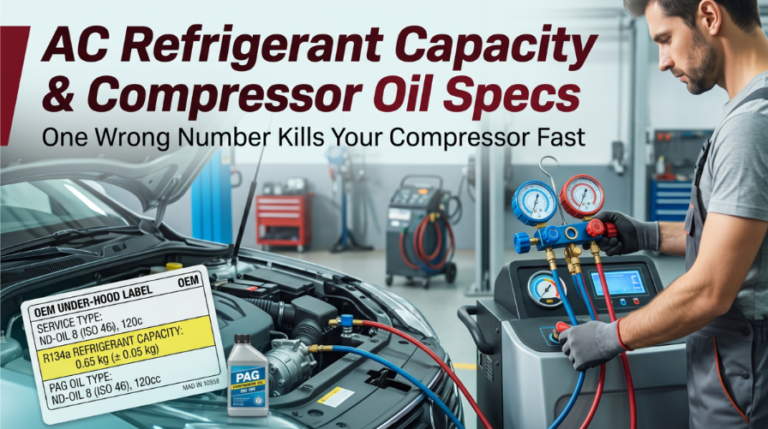
Your AC system’s refrigerant capacity, compressor oil specs, and oil type are not details you estimate they’re the exact numbers that keep a compressor alive or destroy it within a single season. Technicians who skip this step face seized compressors, sky-high repair bills, and unhappy customers before summer even peaks.
Precise matching of refrigerant charge and PAG oil viscosity is mandatory to prevent failure. Systems typically use R134a or R1234yf with specific ISO 46, 100, or 150 PAG oils. Typical capacities range from 14–25 oz of refrigerant and 3–6 oz of oil, but always confirm specs via the under-hood decal.
This guide covers how AC refrigerant capacity is measured, how compressor oil specs are selected by refrigerant type, how oil is distributed across components, and the critical mistakes that cost shops thousands of dollars every year.
AC Refrigerant Capacity & Compressor Oil Specs: The Data That Protects Every Job
Understanding AC refrigerant capacity and compressor oil specifications at the technical level separates guesswork from precision. Every vehicle carries a specific refrigerant charge in ounces, along with a matched oil type and viscosity, and both must be correct for the system to perform and last. Getting one wrong cascades into the failure of the other.
This section walks through every factor, with data and tables to support it.
Most failures trace back to one of two errors: wrong oil type for the refrigerant in use, or wrong total oil quantity during a component replacement. Both are avoidable when you know the specs before you open the system.
Why Refrigerant Type Controls Your Oil Choice
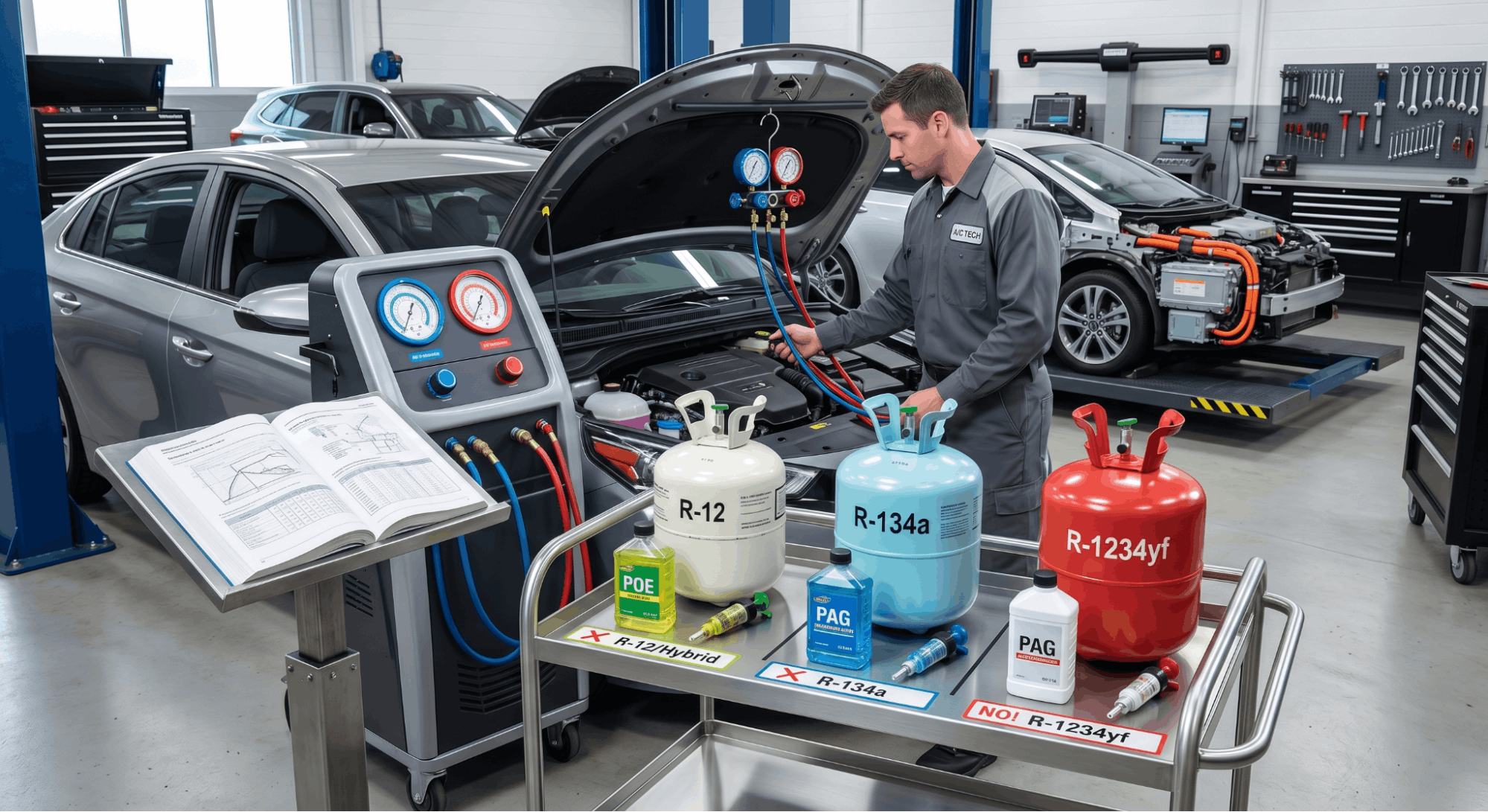
The refrigerant in the system is not just a cooling agent. It actively carries compressor oil through every line, condenser, evaporator, and accumulator in the system. The oil must be chemically compatible with the refrigerant, otherwise, it will not circulate or lubricate, leading to early compressor failure.
Three refrigerant types are currently in use across the vehicle fleet:
- R-12 pre-1994 vehicles. Requires mineral oil (525 SUS viscosity). Still found in classic and vintage cars.
- R-134a 1994 to mid-2010s standard. Requires PAG oil in ISO 46, 100, or 150 viscosity, depending on the compressor.
- R-1234yf post-2017 standard in most markets. Requires PAG YF 46 or PAG YF 100 specific to the compressor OEM.
Using standard R-134a PAG oil in an R-1234yf system is a direct path to compressor damage. The two oil families are not interchangeable, even though they look identical on a shelf. Manufacturers like GM and Chrysler now specify proprietary formulations, such as PAG-PSD1 and PAG-ND12, for their R-1234yf applications, and they will not accept warranty claims if a generic product is used.
Hybrid and fully electric vehicles add another layer. Their electric compressors require either POE oil (polyol ester) or a special PAG SP-A2 ISO 46 grade. Standard PAG oil is electrically conductive. Even a 1% contamination of PAG into a hybrid system can reduce the dielectric strength of the approved oil and require full system component replacement. That is not a cost most shops want to absorb.
Key takeaway: Never select oil before confirming the refrigerant type. They are a matched pair.
PAG Oil Viscosity: Choosing Between PAG 46, 100, and 150
Once the refrigerant type is confirmed, the PAG oil viscosity must match the compressor design. Using the wrong viscosity is just as harmful as using the wrong oil family. The result is either inadequate lubrication from oil too thin, or excess drag and heat from oil too thick.
|
PAG Grade |
ISO Viscosity |
Typical Application |
|
PAG 46 |
ISO 46 (thin) |
Most Asian imports, many Ford and Chrysler, Sanden SD-series compressors |
|
PAG 100 |
ISO 100 (medium) |
GM vehicles, Nippondenso, Zexel, Sanden TR-series compressors |
|
PAG 150 |
ISO 150 (thick) |
Older GM Harrison compressors, early 2000s applications |
|
PAG YF 46 |
ISO 46 (R-1234yf) |
Most post-2017 vehicles with Denso or Sanden compressors |
|
PAG YF 100 |
ISO 100 (R-1234yf) |
GM and select European R-1234yf applications |
Some technicians default to PAG 100 for all R-134a systems on the theory that its viscosity is a middle-ground compromise. Experienced shops know this approach fails compressors engineered for PAG 46 by creating too much drag in tight-tolerance bearings.
Always cross-reference the compressor manufacturer’s ID tag against OEM documentation.
Do not mix viscosity grades in the same system. The resulting blend falls outside spec for either application and accelerates wear at the shaft seals and pistons.
AC Refrigerant Capacity by Vehicle Class: Reference Data
Refrigerant capacity is expressed in ounces on the under-hood decal. That decal is the primary source ahead of any aftermarket guide or chart. When the decal is missing, use OEM service data from a factory source. You can also review the Find Your Factory Service Manual PDF by VIN for a reliable way to pull the correct OEM spec by vehicle identification number.
Typical refrigerant charge ranges by vehicle class:
|
Vehicle Class |
R-134a Capacity |
R-1234yf Capacity |
Total Oil Capacity |
|
Compact car |
15 to 20 oz |
14 to 20 oz |
4 to 5 oz |
|
Mid-size sedan |
20 to 26 oz |
19 to 25 oz |
5 to 7 oz |
|
Full-size SUV (single evap) |
24 to 32 oz |
22 to 30 oz |
6 to 8 oz |
|
Full-size SUV (dual evap) |
34 to 68 oz |
30 to 60 oz |
8 to 14 oz |
|
Pickup truck (single evap) |
22 to 28 oz |
20 to 26 oz |
5 to 7 oz |
A dual evaporator system found in most large SUVs and vans with rear AC carries significantly more refrigerant and oil than a single-evap setup. Treating it as a standard system results in chronic undercharging and compressor damage due to insufficient oil circulation.
Overcharging is equally damaging. Even a 10% refrigerant overcharge raises head pressure beyond design limits and forces the compressor to work harder than it was engineered to. Over time, that can lead to bearing wear, shaft seal failure, and a dead compressor well before its expected lifespan.
For vehicles approaching high mileage or entering summer driving, the broader Car Maintenance Tips for Summer guide covers AC checks as part of a full seasonal inspection routine.
How to Distribute Oil Correctly During Component Replacement
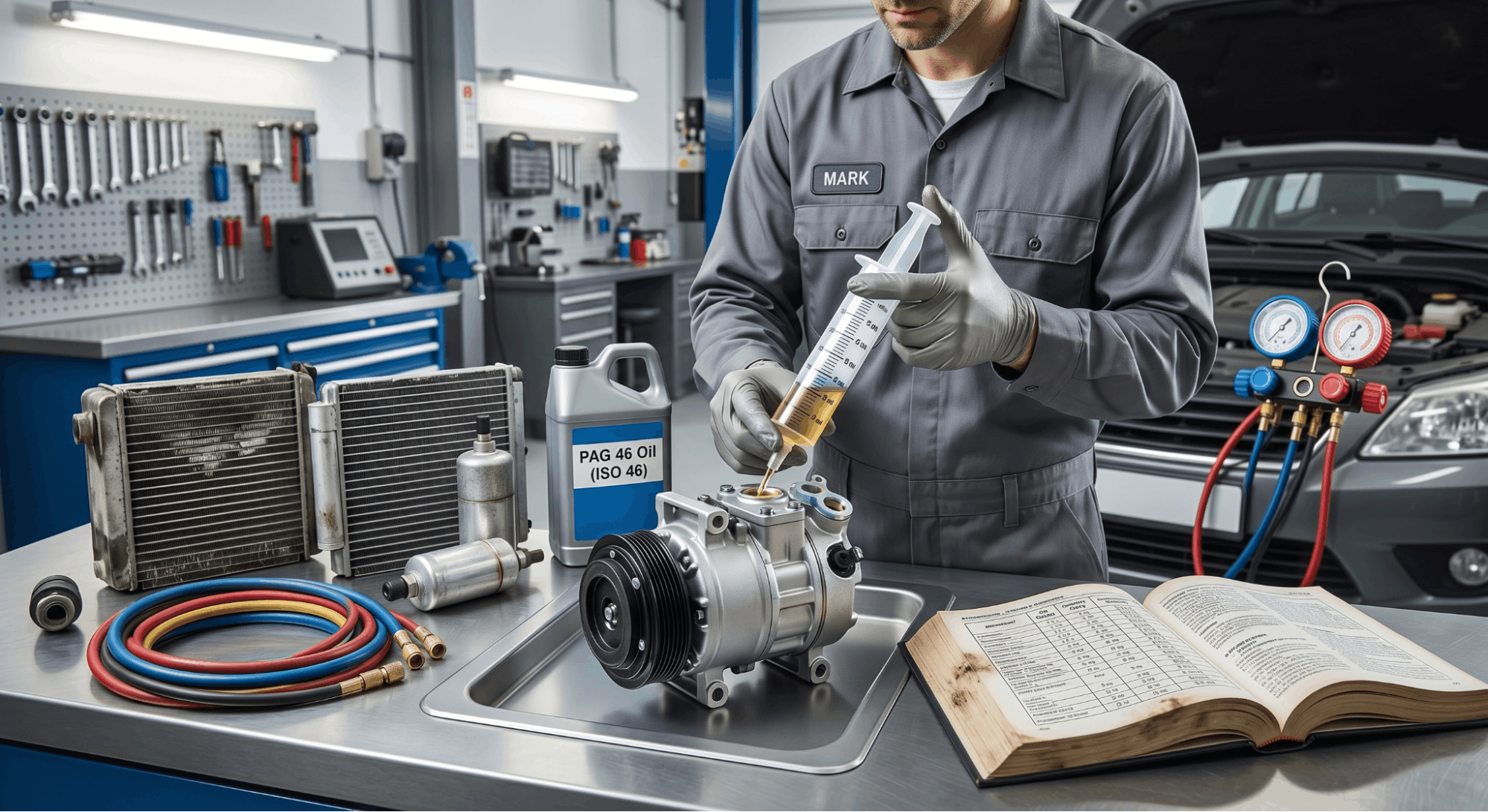
This is where most overcharge failures happen. When multiple components are replaced during a single service visit, technicians misread the spec sheet and add each component’s oil amount to the others. The total system oil capacity is not cumulative across replaced parts it is a fixed number that must be distributed correctly.
Here is how oil is split in a typical 6-ounce total system:
- Evaporator replacement: Add 1.5 oz
- Condenser replacement: Add 1.0 oz
- Accumulator/drier replacement: Add 1.0 oz
- Hose replacement (blown line): Add 1.0 oz
- Compressor replacement: Drain old unit, measure oil retained, calculate the difference from total system capacity, fill compressor to that amount
The compressor step is the most critical. When a compressor fails, debris and burnt oil may contaminate the system. After flushing all remaining components, the replacement compressor should receive only the oil needed to restore the system to OEM capacity, not a full pre-charge on top of whatever oil remains in other components.
After filling the compressor, manually rotate the shaft at least 10 full turns before connecting the lines and starting the system. Skipping this step causes oil slugging at first startup, where oil floods the compression chamber and damages the reed valves immediately on the first revolution.
If you are also servicing coolant during the same visit, the OEM Coolant Types & Bleeding Procedures guide handles that side of the job with equal precision.
Hybrid and EV Compressor Oil: A Separate Category Entirely
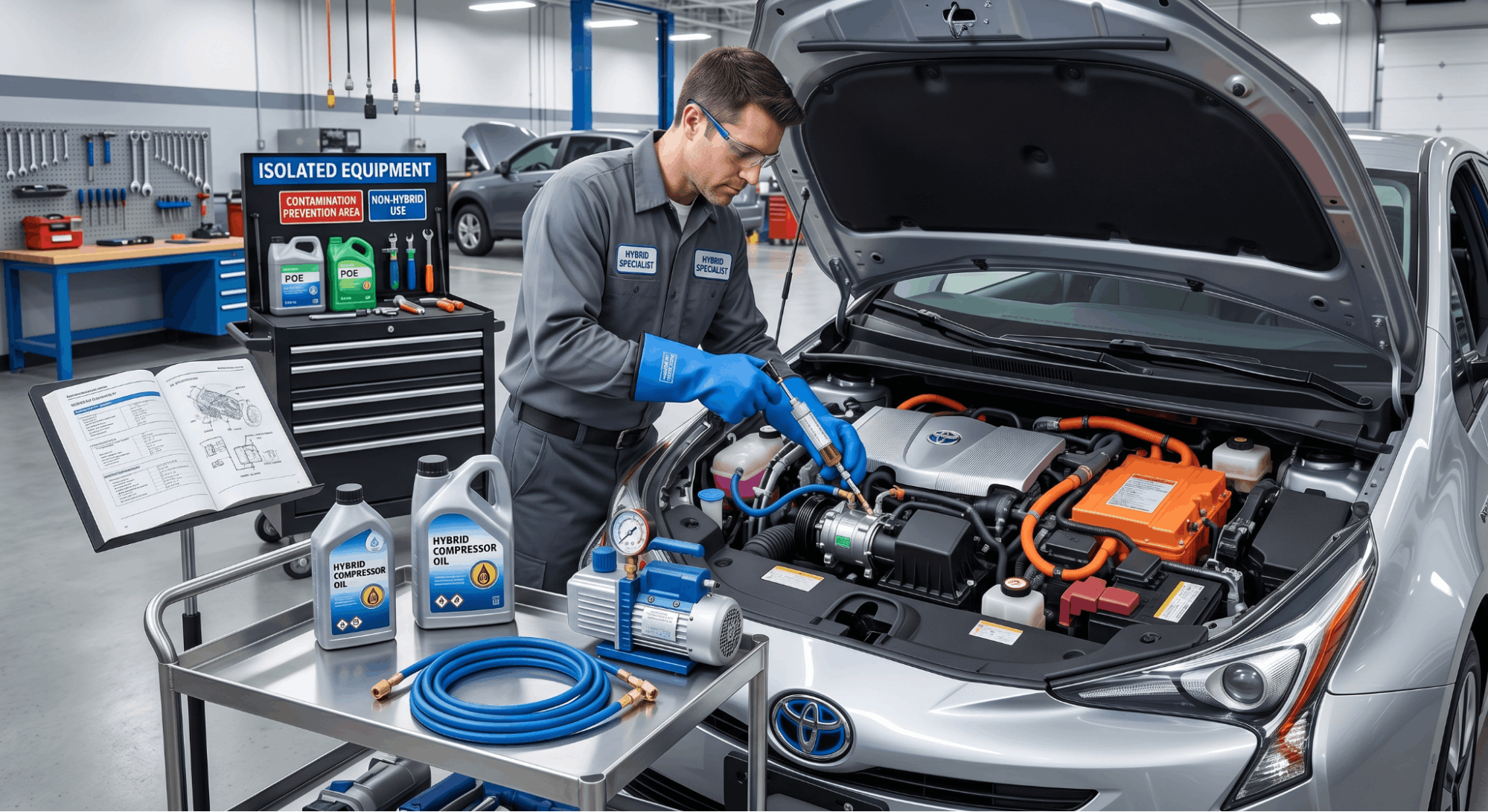
Hybrid and electric vehicle AC compressors are driven electrically, not by a belt. That single design difference changes the entire oil selection process. Standard PAG oil is electrically conductive and poses an electrocution risk when used in high-voltage compressor circuits.
This is not a minor concern it poses a real safety hazard to the technician and can destroy the compressor and surrounding components during a single service event.
The correct oil for most hybrid electric compressors is POE oil or a manufacturer-specified PAG SP-A2 grade. Key points:
- POE oil is non-conductive and compatible with most hybrid systems, but it is significantly more hygroscopic than PAG. Open containers must be sealed immediately and used quickly to prevent moisture contamination
- PAG SP-A2 (ISO 46) is a newer non-conductive PAG formulation that some manufacturers now prefer for its superior chemical stability over POE in R-1234yf applications
- Toyota hybrid systems have a detection system that, when the wrong oil is used, triggers a check engine light and disables the AC entirely
- As little as 1% standard PAG oil contaminating a hybrid system can degrade the dielectric properties of the approved oil and may require full system component replacement under the manufacturer’s guidelines
Shops servicing hybrid fleets should use dedicated equipment, separate hoses, injectors, and recovery machines to prevent cross-contamination between conventional and high-voltage systems.
For shops also tracking fluid capacities across vehicle types during service planning, the Transmission Fluid Capacities by the Manual resource provides a similar precision-focused approach for transmission service.
Reading Factory Specs When the Under-Hood Decal Is Gone
The under-hood decal is the first source, but it fades, peels, and disappears. When it is gone, the next step is to look up the factory service manual by VIN. That document will list:
- Refrigerant type and total charge in ounces
- Compressor oil type and viscosity
- Compressor manufacturer and model number
- Component-by-component oil distribution for full system rebuilds
Aftermarket capacity guides from suppliers like Four Seasons are useful secondary references, but they explicitly note that all oil specs assume the system has been properly cleaned and that a new accumulator or filter drier has been installed. If those steps were skipped, the guide numbers are no longer valid.
If OEM documentation is hard to source, Where to Download Genuine OEM Workshop Manuals provides a reliable sourcing path for authenticated service documents by make and model.
Conclusion
AC refrigerant capacity and compressor oil specs are precision data, not estimates. Using the wrong refrigerant type, the wrong PAG viscosity, or the wrong total oil volume during a component replacement will damage a new compressor before the first hot season ends.
Always start with the under-hood decal, verify against OEM factory data, distribute oil by component on full rebuilds, and treat hybrid system compressors as a completely separate oil category. These are not optional steps they are the foundation of every AC repair that lasts.
Frequently Asked Questions
Universal compressor oils are typically PAO-based blends designed to be compatible with a wide range of applications. The problem is that they are formulated as a compromise viscosity that does not precisely match either PAG 46 or PAG 100 specifications. For a compressor engineered to tight tolerances around a specific viscosity grade, a universal oil film may be too thin at operating temperature, leading to bearing wear and premature shaft seal failure.
DENSO warranty data shows that a significant portion of new compressor failures in the aftermarket trace back to the use of universal or incorrect oil. The risk far outweighs the convenience of stocking one product. Always use the OEM-specified PAG grade for the specific compressor and refrigerant combination.
An oil overcharge of even 30-50% above total system capacity immediately reduces cooling performance. Excess oil coats the internal heat-transfer surfaces of the condenser and evaporator, reducing the system’s heat transfer capacity.
When high-side pressures exceed design limits, the compressor works harder, and operating temperatures rise. In cases documented by MACS, a 150% overcharge caused sustained high head pressure and poor cooling, which appeared identical to a refrigerant or mechanical problem.
Identifying an overcharge requires knowing the exact total system oil capacity and measuring what is actually in the system. The fix is to remove the excess oil, not add more refrigerant to compensate.
The most reliable path is to use a factory service manual lookup with your VIN. The OEM service document will list the exact refrigerant type, the charge in ounces, the compressor oil grade, and the viscosity.
Aftermarket capacity guides from major suppliers are useful cross-references, but they come with the caveat that specs are valid only after proper system cleaning and a new accumulator installation.
Some vehicles built in the same year were shipped with different refrigerant types depending on the market region, so a VIN lookup is the only way to confirm which version your vehicle received. Never assume based on vehicle class or model year alone always verify with a primary source.
R-1234yf is a hydrofluoroolefin refrigerant with chemical properties different from those of R-134a. It is only marginally miscible with standard PAG oil grades, meaning the oil does not circulate as freely through the system as it does in an R-134a application.
To address this, manufacturers specify PAG YF grades, either PAG YF 46 or PAG YF 100, formulated specifically for R-1234yf compatibility. Some OEMs, like GM and Chrysler, have gone further and developed proprietary oil formulations tied to specific compressor models.
Using a standard R-134a PAG in an R-1234yf system results in inadequate lubrication, increased wear, and, in many cases, immediate voiding of the new compressor warranty. Always confirm the exact OEM oil spec before opening an R-1234yf system.
No. When replacing a compressor, especially after a failure, the old oil in the remaining system components should be treated as potentially contaminated. A failed compressor can send metal debris, sludge, and burnt oil throughout the system lines, evaporator, and condenser.
Even if the failure was not catastrophic, the oil that circulated through a worn or failed compressor has degraded. The correct procedure is to flush all serviceable components, replace the accumulator or dryer, and refill with fresh oil to the OEM-specified total system capacity.
The amount loaded into the new compressor is calculated as total system capacity minus the oil already in the remaining components, not a flat fill of a full new charge.