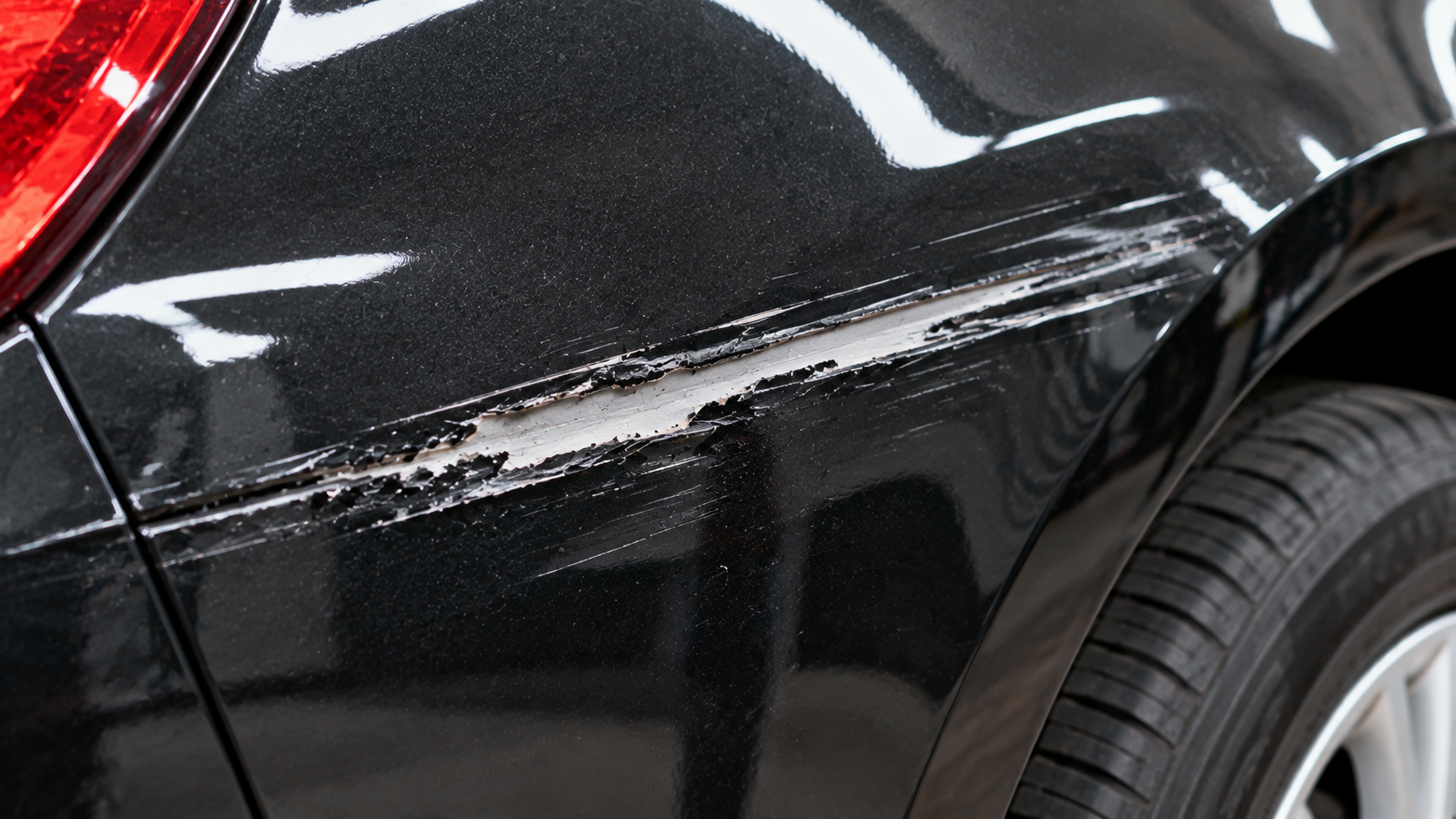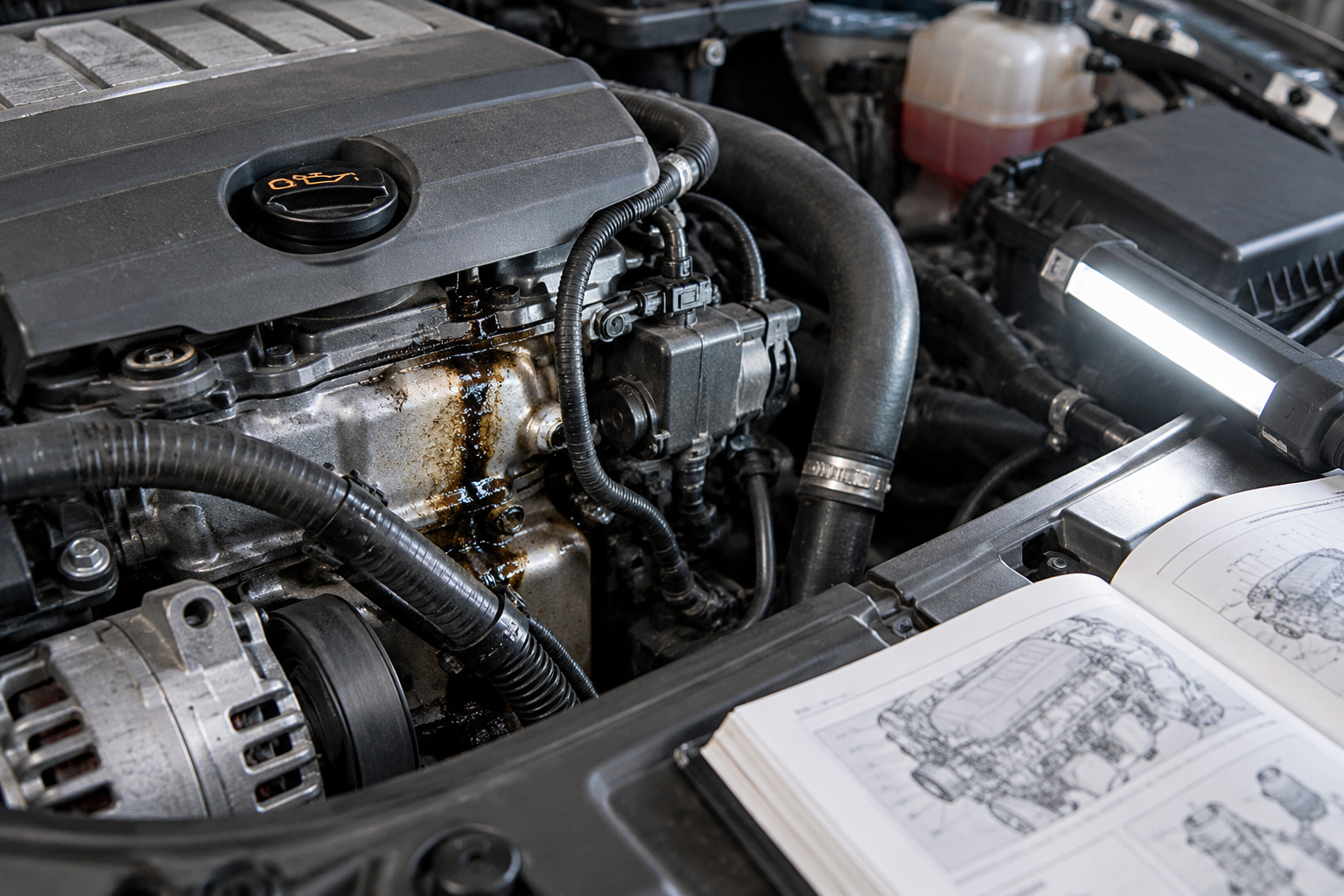
NXTmotors approaches an oil leak by identifying the fluid, tracing the fresh-oil path, assessing repair access, and checking the correct vehicle-specific workshop information before selecting parts. That process helps separate a manageable external oil leak from a repair that needs deeper access or professional equipment.
Quick Check
Before replacing a gasket or seal for an oil leak, find the correct workshop repair manual for your exact vehicle to verify the sealing point, component layout, specifications, and repair access.
Key Takeaway
- Trace an oil leak to its actual source before replacing any gasket, seal, or housing.
- An oil leak reaching the ground may not be directly below the failed sealing point because oil can travel across engine surfaces.
- Oil leak repair difficulty depends heavily on access, with some external seals relatively accessible and others requiring major component removal.
- The correct workshop manual helps verify oil leak component locations, sealing methods, specifications, access sequence, and model-specific differences.
- An oil leak accompanied by rapid oil loss, smoke, or an oil-pressure warning deserves prompt professional assessment.
How to Repair Oil Leak on a Car: Find the Source
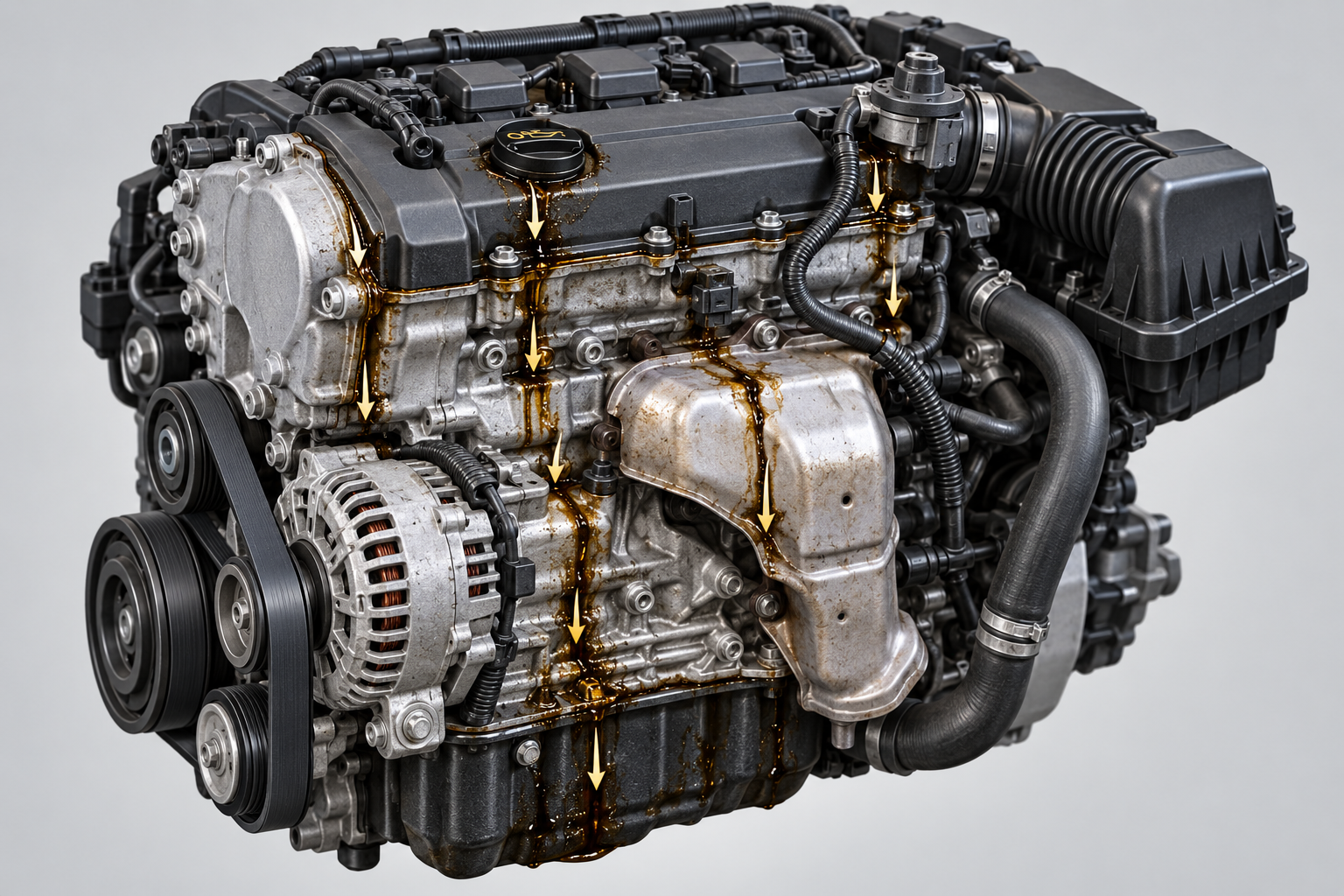
Diagnose an oil leak from the engine outward, not from the driveway upward. The visible drip point can be misleading because oil can move downward, rearward, or across adjacent engine surfaces before it finally falls from the vehicle.
Oil Leak Source Diagnostic Matrix
Oil Leak Location | Possible Oil Leak Source | What Can Confuse the Diagnosis | What a Workshop Manual Helps Verify |
Upper engine | Valve cover, upper seal, sensor, or housing | Oil spilled during service or oil traveling from another upper component | Cover layout, gasket position, nearby oil-containing components |
Side of engine | Filter housing, cooler connection, sender or seal | Oil spreading along the engine block | Component locations, oil circuit layout, connector arrangement |
Front of engine | Front cover, crankshaft or camshaft sealing area | Oil running down from an upper gasket | Front-cover layout, seal positions, access sequence |
Lower engine | Oil pan, drain area, or lower sealing point | Oil originating higher on the engine | Pan design, sealing method, surrounding components |
Engine and transmission junction | Rear-engine sealing area or oil traveling rearward | Transmission fluid or oil from a higher source | Engine/transmission layout and sealing locations |
Multiple wet areas | More than one leak or old residue | Previous spills, old seepage, airflow | Exploded diagrams and component relationships |
The first oil leak decision is confirming the fluid is really engine oil. Color can provide a clue, but fluid appearance can change with age and contamination, so diagnosis should consider where the fluid originates and which system is located above the wet area.
The next oil leak clue is the highest fresh wet point you can safely observe. Oil frequently runs downward from its source, which is why NXT motors guide to exploded-view manual diagrams can help connect a visible oil trail with the seals, housings, covers, and fasteners positioned above it.
Old oil residue can also make an oil leak look worse or make it seem like it's coming from several components. Residue from a previous leak or service can remain on engine surfaces and lower covers, so fresh evidence matters more than simply finding an oily component.
When repairing an oil leak on a car, the source-confirmation stage prevents one of the most avoidable mistakes: replacing the component nearest the drip without confirming it is the actual leak source. NXTmotors workshop information shows how oil-containing components are arranged on the exact engine before you decide how to repair it.
Common Oil Leak Sources on a Car
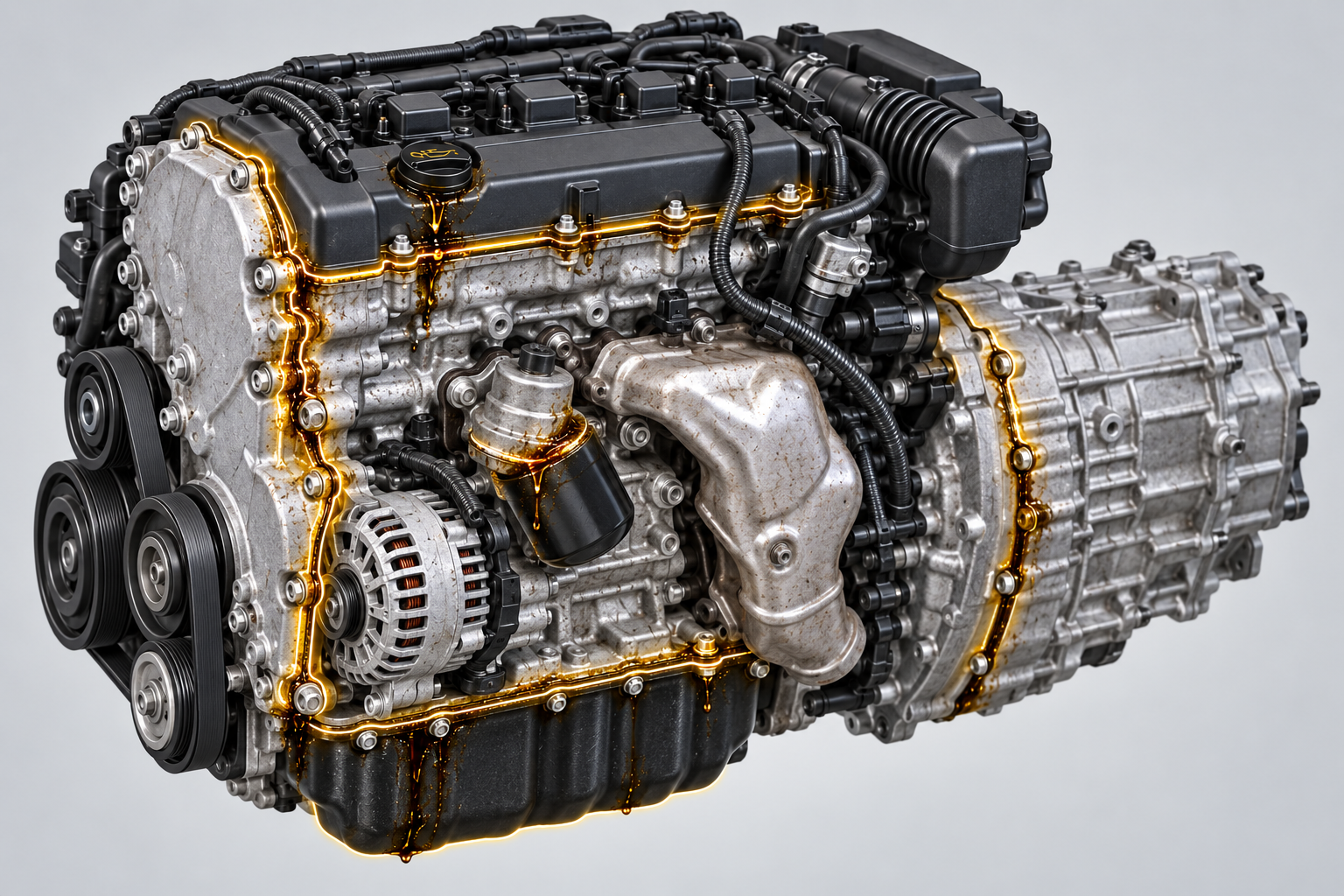
A car oil leak can begin at several external sealing points, but the correct list depends on the engine design. NXTmotors treats the workshop manual as the vehicle-specific map that identifies which gaskets, covers, housings, lines, and sensors actually exist on the engine being diagnosed.
Valve Cover Oil Leak
A valve-cover oil leak usually begins high on the engine, so oil may spread down the cylinder head or engine block before it becomes visible from below. Oil around the valve-cover area can also come from another nearby component, so you still need to confirm the wet gasket edge as the source.
Once you confirm a valve-cover oil leak, the applicable workshop information can clarify gasket arrangement, tightening sequence, approved sealing points, and surrounding components. NXTmotors keeps the detailed installation topic on its narrower valve cover gasket RTV and torque patterns page, so this pillar stays focused on broad oil-leak diagnosis.
Oil Pan Oil Leak
An oil-pan oil leak may involve the pan sealing surface, drain area, damaged pan, or another component directly above it. Because the oil pan sits low on the engine, it can also collect oil from a completely different leak higher up.
A proper workshop manual helps determine whether an apparent oil-pan leak actually starts at the pan and which components surround it. NXTmotors uses that information to judge repair access before assuming the pan gasket itself needs replacement.
Drain Plug Oil Leak
A drain-plug oil leak becomes particularly relevant when fresh oil appears shortly after an oil service. Consider the sealing washer, plug, oil-pan threads, and surrounding area, and don't assume every post-service drip comes from the same cause.
A workshop manual can provide the vehicle-specific drain-area information needed for an oil leak assessment. NXTmotors also treats a post-service leak differently from an older engine seep because the timing of the symptom changes which areas deserve attention first.
Oil Filter or Filter-Housing Leak
An oil-filter oil leak may appear around a spin-on filter, cartridge housing, housing seal, cooler assembly, or another part of the filter mounting system. Oil spilled during a recent service can mimic a continuing leak, so distinguish fresh oil from residue.
The NXTmotors workshop manual helps you identify the exact filter arrangement for the engine before you blame an oil-filter leak on the wrong component. This matters because different engines within the same model family may use different filter and cooler layouts.
Oil Cooler and Oil-Line Leak
Some engines use external oil coolers, turbocharger lubrication connections, or other oil-carrying lines that can leak. Other engines may not use the same arrangement at all, which makes generic repair advice unreliable.
For this type of oil leak, workshop diagrams help confirm whether the specific engine has an oil cooler, feed line, return line, or related sealing connection. NXTmotors uses the diagram to narrow the possible source before selecting a replacement component.
Front Cover Oil Leak
A front-engine oil leak can involve a cover joint, shaft seal, or another sealing point near the engine's front-drive or timing area. The actual seal may be small, but access can be much more involved when other engine components are positioned in front of it.
NXTmotors uses factory-style workshop information to understand the oil leak access requirements before classifying the job as straightforward or complex. This prevents a visible front-engine seep from being reduced to an oversimplified gasket-replacement recommendation.
Oil Pressure Switch or Sender Leak
An oil-pressure switch or sender can become an external oil leak point on engines where it connects directly to an oil passage. Oil around the sender still does not prove the component is leaking because oil can reach the area from a nearby gasket or housing.
A workshop manual helps identify the correct sender location and adjacent oil-containing components for an oil leak diagnosis. NXTmotors uses that vehicle-specific layout to separate a leaking component from oil simply passing over it.
Rear Engine Oil Leak
An oil leak near the engine-transmission junction can suggest a rear sealing point, but the visible location alone isn't enough for a confident diagnosis. Oil can travel rearward from higher engine areas, and another automotive fluid can also appear near the same junction.
A suspected rear-engine oil leak deserves careful confirmation because repairs can be extensive. The NXTmotors workshop manual explains the component layout and access requirements before an owner approves a major repair.
Model-Specific Oil Leak Points
An engine can have oil leak sources that do not appear on a generic list, including manufacturer-specific housings, oil-control components, gallery seals, cooler assemblies, turbo oil connections, and cover joints.
NXTmotors uses vehicle-specific workshop diagrams to close that oil leak information gap. Instead of assuming a leak source from another engine or forum discussion, the reader can see which sealing points actually exist on the correct engine.
Oil Leak Repair Complexity
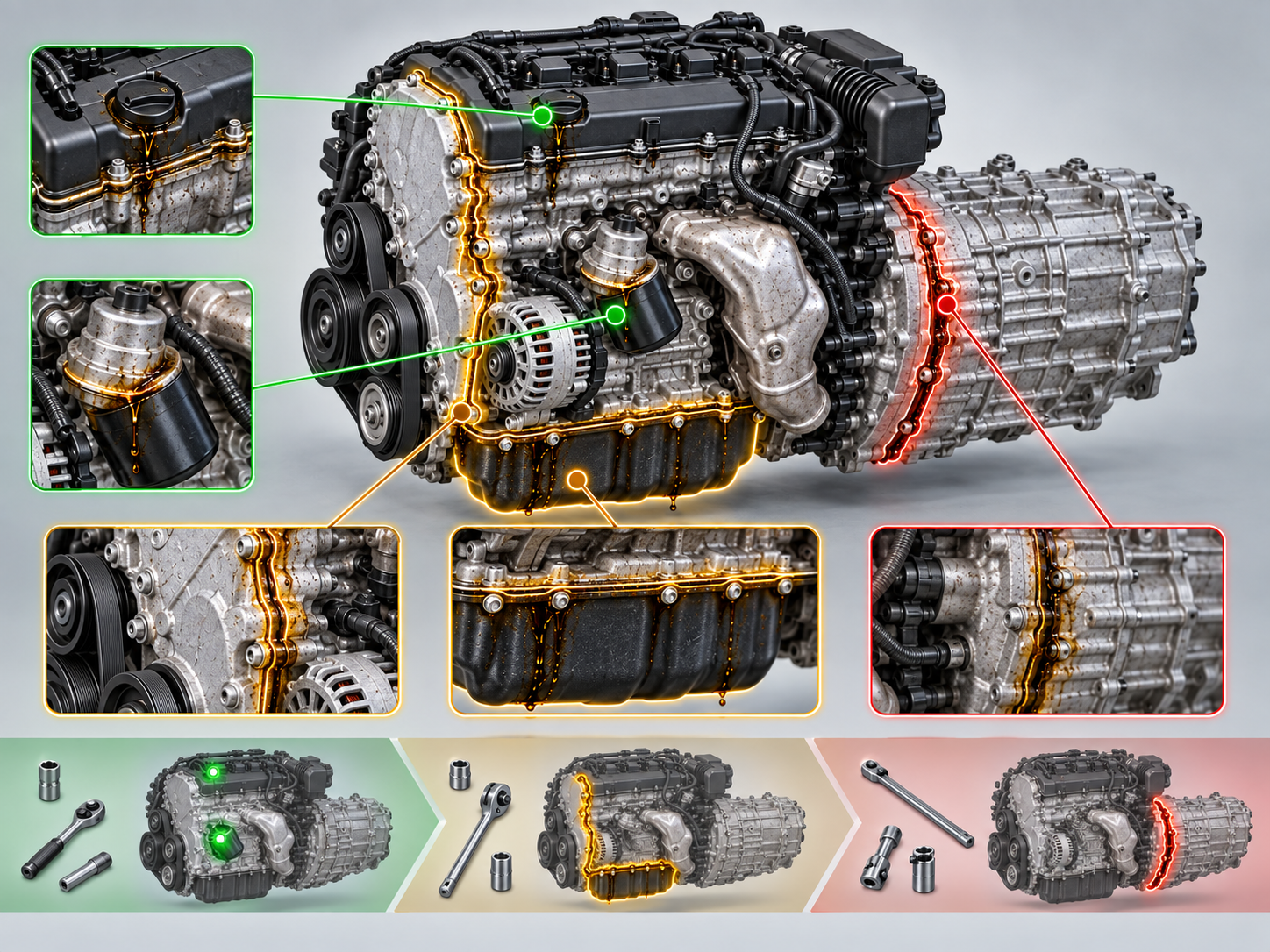
The cost and difficulty of an oil leak repair depend heavily on access. A relatively inexpensive seal can still require significant labor if you must remove several components before you can reach the leak.
Oil Leak Repair Access Comparison
Oil Leak Source Category | Typical Oil Leak Access | Information to Verify | When a Shop May Be Appropriate |
External filter or drain area | Lower complexity | Component type, sealing arrangement, specifications | Damaged threads, housing damage, uncertain leak source |
Valve-cover area | Low to moderate | Gasket layout, tightening data, sealing points | Access blocked by multiple components |
Oil-pan area | Moderate to high | Pan layout, sealing method, surrounding parts | Structural, exhaust, or drivetrain access is involved |
Front-cover or shaft-seal area | High | Cover layout, component sequence, special-tool notes | Complex engine access is required |
Rear-engine sealing area | High | Engine/transmission relationship | Major drivetrain access is required |
Turbo or external oil circuit | Varies | Line routing, seals, heat-sensitive components | Tight access or specialist equipment is required |
A simple-looking oil leak can become a larger repair if the sealing surface, housing, threads, or surrounding components are damaged. NXTmotors workshop information helps readers understand the full repair scope rather than judging difficulty by the gasket price alone.
A complex oil leak may also require information that goes beyond a basic owner's manual. NXTmotors explains when to use a factory service manual when repair access, specifications, component sequence, or diagnostic detail matters more.
Before deciding how to repair an oil leak, consider:
- Where the oil leak source is located on the engine
- Which components block access to the oil leak
- Whether special workshop equipment is listed for the oil leak repair
- Whether the leaking component has a gasket, sealant, O-ring, or another sealing method
- Whether professional equipment is more appropriate for the oil leak access
Before ordering parts, do this complexity check for how to repair an oil leak on a car. NXTmotors makes the decision easier by connecting the visible oil-leak problem to the correct vehicle-specific component layout.
Oil Leak Gaskets, Seals, RTV, and Torque
An oil leak repair isn't complete just because you bought a new gasket. The sealing surface, gasket position, specified sealant, fastener order, and tightening information can all affect whether the repaired joint remains sealed.
More tightening force isn't a universal oil leak solution. Excessive tightening can distort a cover or damage fasteners and threads, so vehicle-specific specifications matter more than trying to stop a leak by feel.
NXTmotors resource on engine cylinder-head torque specifications illustrates why tightening data must match the exact component. Never reuse a cylinder-head specification for an unrelated oil-leak fastener just because it belongs to the same engine.
Sealant also varies between oil leak repairs. Some joints use a formed gasket, some use manufacturer-specified sealant, and some use a combination at limited intersections or mating points.
The workshop manual turns that oil leak question into vehicle-specific information. NXTmotors uses the correct manual to determine what the manufacturer specifies, rather than treating RTV as a universal solution for every engine-oil sealing surface.
Oil Leak After an Oil Change
An oil leak after an oil change deserves a different first inspection because the service recently disturbed specific parts of the lubrication system. The filter, drain area, filler cap, and any service-accessed housings are logical areas to check before assuming an unrelated major engine seal failed at the same time.
A post-service oil leak can also be confused with oil that was spilled and left on an engine cover or undertray. Fresh repeated spots, falling oil level, or continued wetness are more important than one isolated drip.
Questions worth asking after a new oil leak appears following service include:
- Did the oil leak begin only after the oil change?
- Is the oil leak near the drain or filter area?
- Does fresh oil keep appearing after you clean away the old residue?
- Is the engine oil level changing as the oil leak continues?
- Is there a warning light, smoke, or burning smell with the oil leak?
NXTmotors workshop information can identify the exact filter, drain, and housing arrangement for that engine. That gives an oil leak after an oil change a defined diagnostic path rather than assuming every post-service leak has the same explanation.
Oil Leak vs Low Oil Level and Pressure Warning
An external oil leak, low engine-oil level, and low oil pressure are related but different conditions. An oil leak means lubricant is escaping, oil level describes how much remains, and oil pressure describes whether the lubrication system is maintaining the required operating pressure.
An oil leak can eventually cause a low oil level if enough oil is lost, but an oil-pressure warning does not prove an external gasket is the cause. Other lubrication-system or electrical problems can produce a warning without a visible leak.
NXTmotors keeps the broader warning-light intent separate in its guide to oil pressure warning light diagnosis. This prevents the broad oil leak pillar from cannibalizing a page that owns a different diagnostic question.
Treat an oil leak combined with a pressure warning, a rapidly falling oil level, or an obvious heavy loss as more urgent than a light seep. The correct workshop manual can identify sensor locations, oil-system information, and applicable diagnostic procedures, but a warning condition may still require immediate professional assessment.
Oil Leak Diagnosis With a Workshop Manual
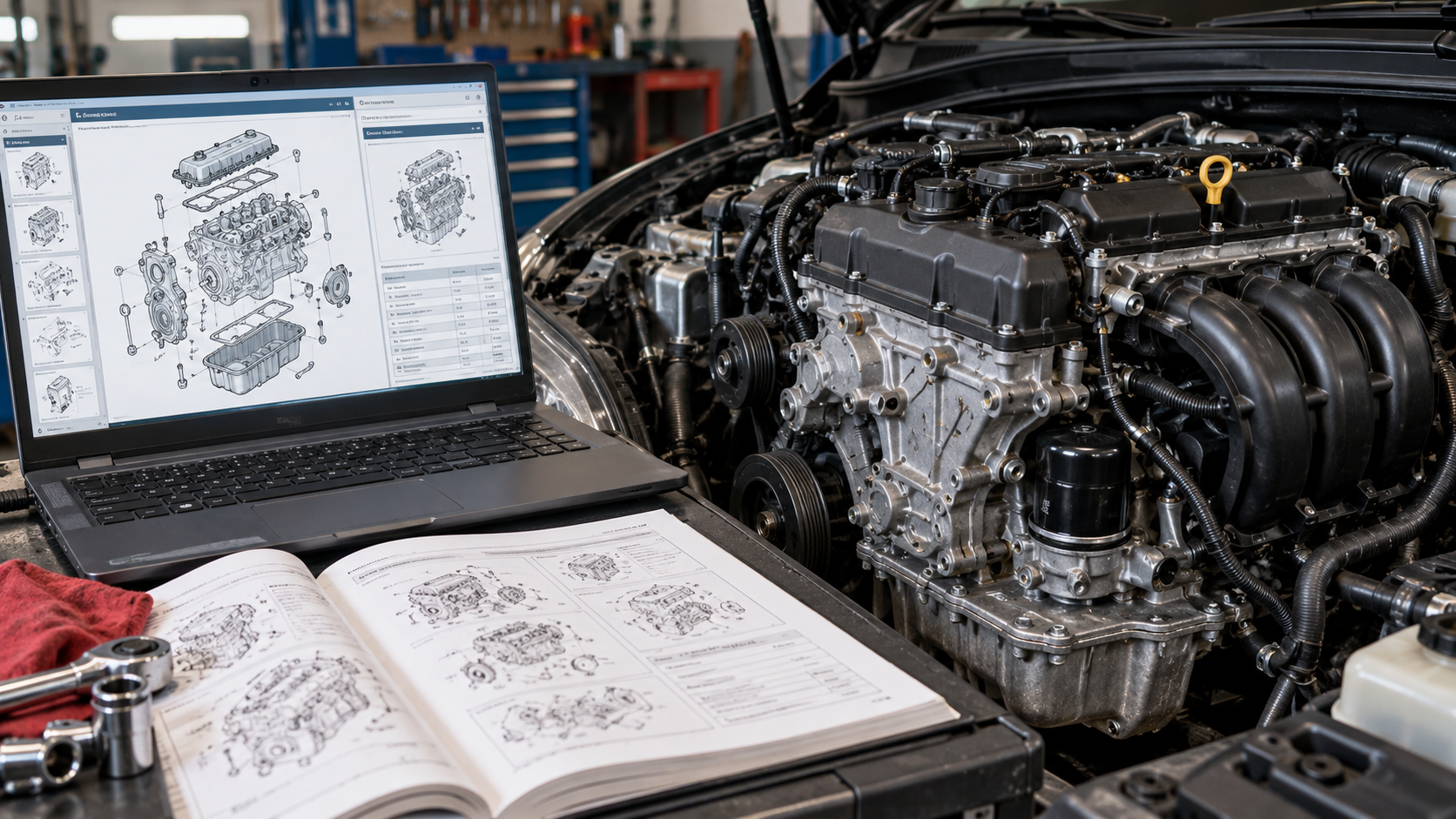
A workshop manual becomes valuable during oil leak diagnosis because the visible outside of the engine does not show every gasket, passage, housing, or hidden sealing point. Exploded diagrams help connect visible wetness with the components positioned above or behind it.
The first manual-related oil leak task is making sure the document matches the vehicle. NXTmotors explains how to choose the right workshop repair manual because model name alone may not distinguish every engine, drivetrain, market, or production variant.
Vehicle identification can also reduce uncertainty during an oil leak diagnosis. NXTmotors provides guidance on finding a factory service manual by VIN and understanding VIN-specific repair manuals when configuration details affect repair information.
The source of the workshop information also matters for an oil leak repair. NXTmotors comparison of OEM versus aftermarket manuals for DIY explains why different documentation sources may provide different levels of component detail and procedural information.
For readers seeking factory-style technical material for an oil leak, NXTmotors also explains where to find genuine OEM workshop manuals. The goal is to match the correct repair information to the correct vehicle rather than collect generic procedures.
A useful workshop manual can support an oil leak diagnosis by helping verify:
- The exact oil leak component location
- The gasket, O-ring, seal, or sealant arrangement
- The surrounding components affecting oil leak repair access
- Tightening or specification information where applicable
- Removal and installation sequence at a planning level
- Special-tool requirements that may change the oil leak repair decision
NXTmotors uses that information to reduce guesswork in an oil leak repair without claiming that a manual replaces practical experience, diagnostic equipment, or professional workshop capability.
Oil Leak Repair: Manual vs Repair Shop
A workshop manual and a repair shop solve different parts of an oil leak repair. NXTmotors provides vehicle-specific technical reference material, while a qualified workshop can provide physical inspection, equipment, access, diagnostic testing, and hands-on repair experience.
Oil Leak Manual vs Repair Shop
Oil Leak Decision | NXTmotors Workshop Manual | Repair Shop |
Identify oil-leak component layout | Shows vehicle-specific diagrams and component relationships | Inspects the physical engine |
Understand oil-leak access | Shows component sequence and surrounding systems | Confirms real-world accessibility |
Check oil-leak specifications | Provides applicable technical data where covered | Uses technical data during repair |
Understand special-tool needs | Identifies procedural or tool requirements | May already have required equipment |
Review an oil-leak estimate | Helps explain why certain components require removal | Provides labor and parts pricing |
Perform complex oil-leak work | Provides technical information | Supplies equipment, experience, and physical repair |
Having NXTmotors workshop information before approving an oil-leak repair can make the estimate easier to understand. The reader can see why an inexpensive seal may require substantial access and labor.
NXTmotors comparison of digital car manuals versus mechanic advice explains how technical information and professional experience can complement each other during an oil leak diagnosis.
A manual does not automatically make every oil leak repair appropriate for DIY work. A qualified repair facility is better suited to evaluate oil leaks that require major engine access, drivetrain separation, complex disassembly, or specialist equipment.
Oil Leak Repair Safety
An oil leak inspection can involve hot engine components, moving parts, electrical systems, and areas underneath the vehicle. Keep diagnosis within what you can safely observe without creating a new risk.
An oil leak near a hot exhaust component can produce smoke or a burning smell, which makes the leak location more important than the size of a driveway spot. Do not reach into hot or moving engine areas to confirm the source.
If you can't inspect an oil leak safely without lifting the vehicle, removing major components, or working around unfamiliar systems, leave it to a professional. The NXTmotors workshop manual can still help the owner understand the suspected source and repair scope before speaking with the technician.
Ford Oil Leak Repair
A Ford oil leak cannot be reduced to one universal procedure because Ford vehicles use different engine families, driveline layouts, and sealing systems. NXTmotors Ford category connects the broad oil-leak problem to the correct current workshop-manual inventory.
Ford F-150 Oil Leak Repair Factors
Match a Ford F-150 oil leak to the correct generation, engine, and drivetrain before selecting any procedure. For an applicable configuration, the 2007-2013 Ford F-150 2WD workshop manual provides a current NXTmotors manual destination.
The F-150 manual link does not prove that the model has a specific oil leak defect. It provides configuration-specific component layout and repair information once you identify the leak source.
Toyota Oil Leak Repair
Approach a Toyota oil leak by engine and model configuration rather than by brand name alone. NXTmotors Toyota category links oil-leak diagnosis to current manuals for specific vehicle configurations.
Toyota Camry Oil Leak Repair Factors
A Toyota Camry oil leak needs the correct generation and engine information before a gasket or seal procedure is applied. For an applicable vehicle, the 1997-2002 Toyota Camry LE workshop manual provides the relevant NXTmotors product/manual destination.
The Camry manual supports an oil leak diagnosis by clarifying the configuration-specific component arrangement. The existence of that manual should not be interpreted as evidence that the Camry has a particular common oil-leak failure.
BMW Oil Leak Repair
A BMW oil leak can involve tightly packaged engine components and different layouts across chassis and engine families. NXTmotors BMW category lets you narrow oil-leak repair information to the right vehicle, not just another BMW with a similar engine bay.
BMW 3 Series F30 Oil Leak Repair Factors
Trace a BMW F30 oil leak to the actual sealing point before choosing replacement parts. For an applicable configuration, the 2012-2018 BMW 3 Series F30 workshop manual is the current NXTmotors manual destination.
The F30 manual helps establish oil leak component location and access for the matching vehicle. It does not mean that every oil leak on an F30 comes from the same gasket, housing, or seal.
Volkswagen Oil Leak Repair
Match a Volkswagen oil leak to the correct engine and model configuration because oil-system layouts and sealing arrangements can differ significantly. NXTmotors' Volkswagen category provides a path from the broad oil-leak question to current, vehicle-specific workshop manuals.
Volkswagen Golf Mk6 Oil Leak Repair Factors
Diagnose a Volkswagen Golf Mk6 oil leak before blaming a filter housing, cover, gasket, or seal. For a matching configuration, the 2008-2013 Volkswagen Golf Mk6 workshop manual provides a current NXTmotors manual reference.
The Golf Mk6 manual can help verify oil-leak component arrangement and repair information once the source is narrowed. The product page shows the manual is available, not that it covers a common Golf oil-leak defect.
Oil Leak Repair: Confirm the Procedure
Once you've narrowed down the oil leak source, confirm the repair requirements before ordering parts or authorizing work. The correct procedure should match the exact vehicle, engine, sealing component, access path, specifications, and manufacturer-defined sealing method.
NXTmotors connects the broad oil leak problem with workshop-manual diagrams, technical references, brand categories, and vehicle-specific manual products. This gives readers a clearer technical picture before committing to an oil-leak repair.
If you are still deciding how to repair an oil leak on a car, choose the correct workshop repair manual for your vehicle and use its vehicle-specific information to confirm the source and repair scope. If the oil leak requires access, tools, or experience beyond what you can handle safely, the same information can make a professional repair discussion easier to understand.
Commonly Asked Questions About Oil Leak Repair
Can I Drive With an Oil Leak?
An oil leak doesn't have one universal safe-driving limit because severity depends on how quickly oil is being lost, the remaining oil level, where the oil is leaking, and whether warning indicators or smoke are present.
A slight seep and a rapidly dripping oil leak represent very different risks. If the oil leak is causing obvious oil loss, smoke, a burning smell, or an oil-pressure warning, continued driving can increase the risk of engine damage.
NXTmotors workshop information can help identify the system and repair location, but you still need to assess the oil-leak severity on the vehicle.
How Can I Tell Where an Oil Leak Is Coming From?
An oil leak should be traced by identifying the freshest visible oil and considering which oil-containing components are positioned above that point. The lowest wet component is not always the oil-leak source because gravity and airflow can move oil across the engine.
NXTmotors exploded diagrams and vehicle-specific workshop manuals can show which gasket, seal, housing, or sender is located near the fresh oil trace. If the oil leak cannot be inspected safely or the source remains uncertain, a professional inspection is preferable to replacing parts by guesswork.
Why Is There an Oil Leak After an Oil Change?
An oil leak after an oil change may be related to an area disturbed during service, such as the filter, drain plug, sealing washer, filter housing, or filler area. Oil spilled during service can also drip from an undertray or engine surface and resemble an active oil leak.
If fresh oil keeps appearing or the level is falling, the oil leak should be traced rather than dismissed as residue. NXTmotors workshop information helps identify the exact service components and sealing arrangement for the vehicle before a part is tightened or replaced.
Is a Small Oil Leak Serious?
A small oil leak may begin as light seepage, but one small spot does not show how quickly the oil leak may progress or how much oil is being lost while the engine is running. Leak location, contact with hot surfaces, oil-level change, and warning indicators are more useful than spot size alone.
A small oil leak should therefore be identified rather than ignored indefinitely. NXTmotors manual diagrams can help connect the visible seepage with the correct component so the owner can make a more informed repair decision.
Can a Valve Cover Gasket Cause an Oil Leak?
A valve-cover gasket can be one source of an external oil leak because it seals the joint between the valve cover and the engine. Oil from that area can move down the side of the engine, which can make the oil leak appear to originate from a lower component.
However, oil near the valve cover does not automatically prove that the gasket has failed. NXTmotors workshop information can show nearby oil-containing components and the gasket arrangement, so you can confirm the oil leak before following a narrower valve-cover repair procedure.
Can an Oil Leak Cause Smoke or a Burning Smell?
An oil leak can produce smoke or a burning smell when escaping oil reaches a sufficiently hot engine or exhaust surface. This symptom can occur even when the oil leak doesn't create a large puddle on the ground because some of the oil may burn before it reaches the bottom of the vehicle. Smoke or a strong burning smell with an oil leak deserves prompt attention.
NXTmotors workshop diagrams can help you identify oil-containing components near hot areas, but inspect hot engine parts only under safe workshop conditions.
Is an Oil Leak Expensive to Repair?
The cost of an oil leak repair depends less on the seal size and more on where the leak is located and what must be removed to reach it. An accessible external oil leak can require far less labor than a leak at a sealing point behind major engine or drivetrain components.
That is why an oil-leak estimate should identify the confirmed source before you judge the repair price. NXTmotors workshop manuals can show the access sequence and surrounding components, making it easier to understand why two apparently similar oil leak repairs can have very different labor requirements.