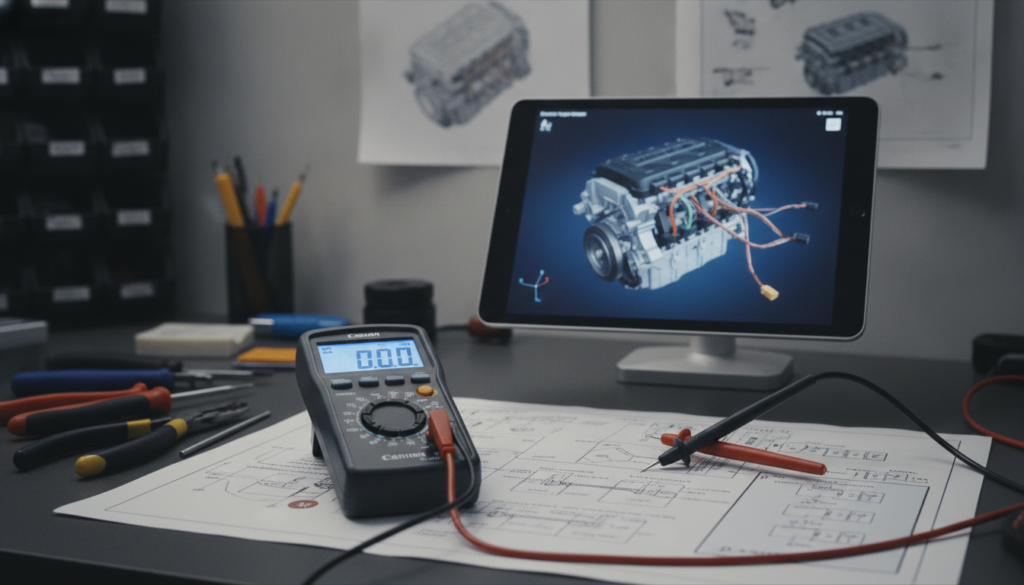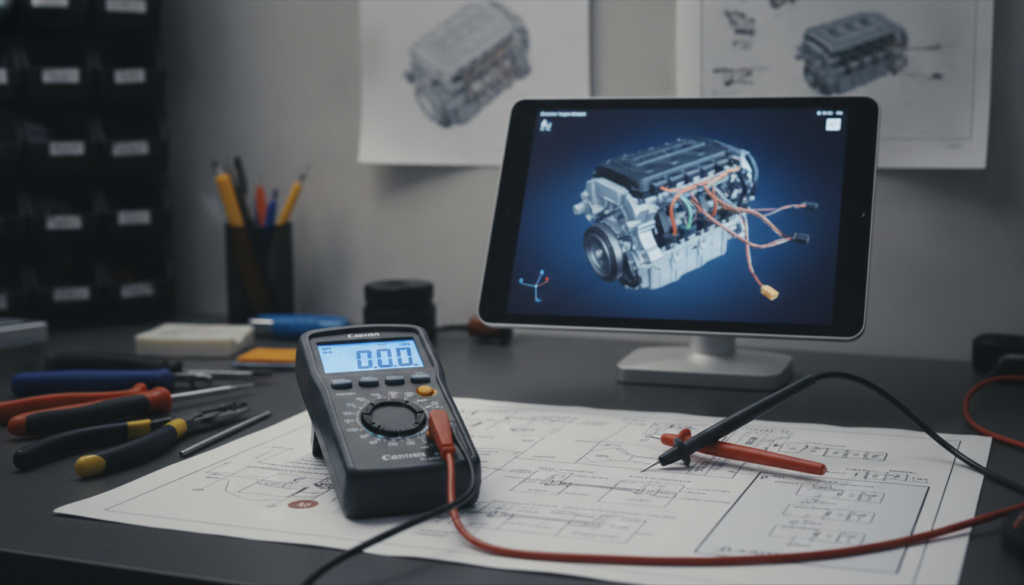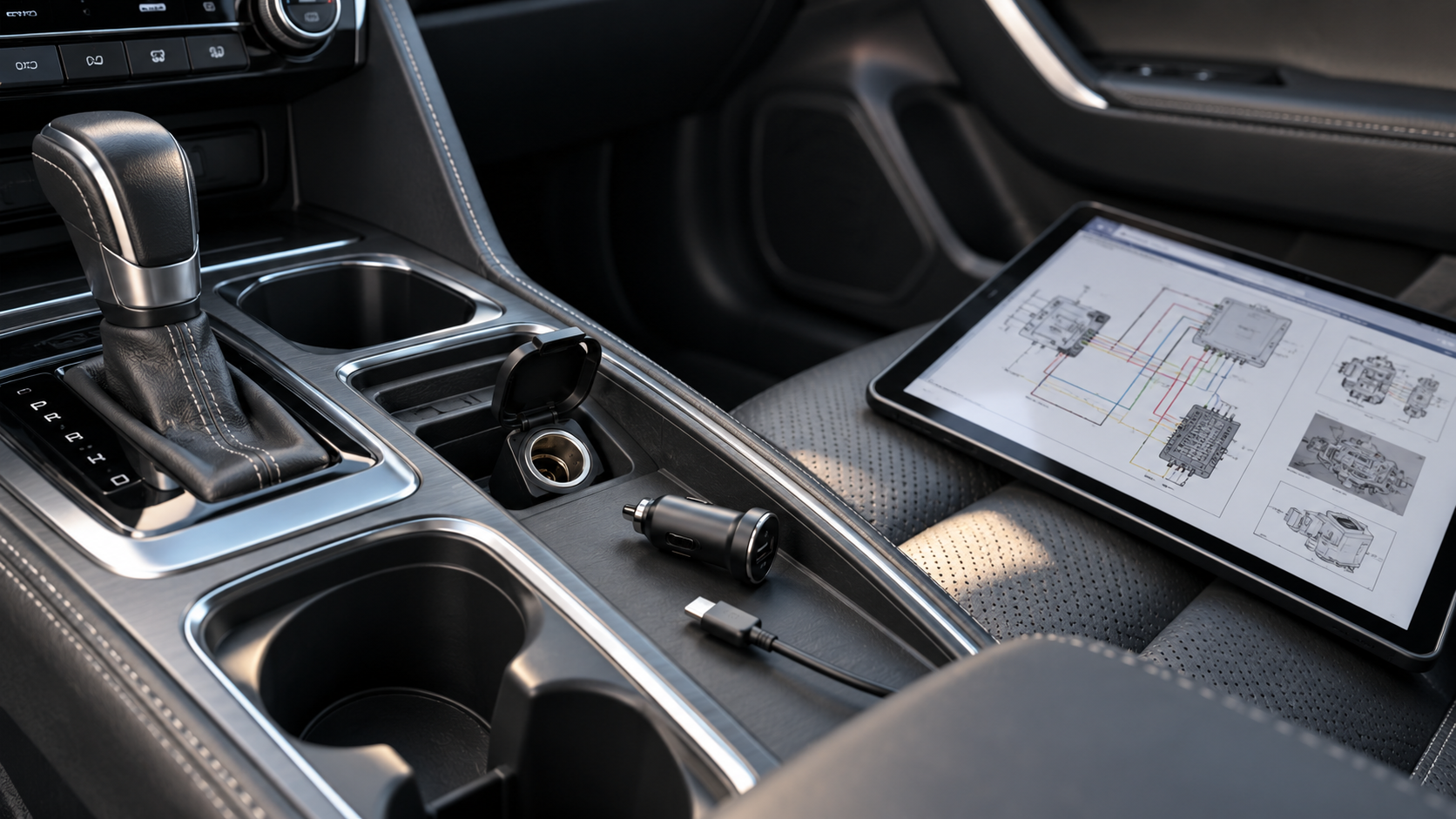
A dead cigarette lighter or 12V power socket can look like a simple socket failure, but replacing the outlet first can waste time and money. If you are researching how to repair a cigarette lighter in a car, the better approach is to determine whether the problem begins with the accessory, vehicle power mode, fuse, socket contact, ground, or wiring circuit.
NXTmotors uses vehicle-specific workshop information to match symptoms to the actual circuit layout, rather than treating every 12V outlet the same. Start with the power path, confirm where it stops, and only then decide what needs repair.
Quick Check
Before replacing a cigarette-lighter fuse or 12V socket, find the correct workshop repair manual for your vehicle so you can verify the power-outlet circuit, fuse assignment, wiring path, and repair access.
Key Takeaway
- A dead cigarette lighter or 12V socket does not automatically mean the socket itself has failed. The problem may be the accessory, power mode, fuse, contact, ground, wiring, relay, or control circuit.
- Check the vehicle-specific cigarette lighter fuse and power-outlet information before replacing parts because fuse locations, ratings, and outlet behavior vary between vehicles.
- A fuse that fails repeatedly indicates an unresolved 12V socket circuit problem. Do not install a higher-rated fuse to keep the outlet working.
- The correct NXTmotors workshop manual can help identify the cigarette lighter circuit, fuse assignment, connector location, wiring path, and repair access before disassembly.
- If the 12V socket repair requires trim removal, wiring diagnosis, repeated fuse troubleshooting, or uncertain electrical work, professional diagnosis may be the safer and faster option.
How to Repair a Cigarette Lighter in a Car: Find Power
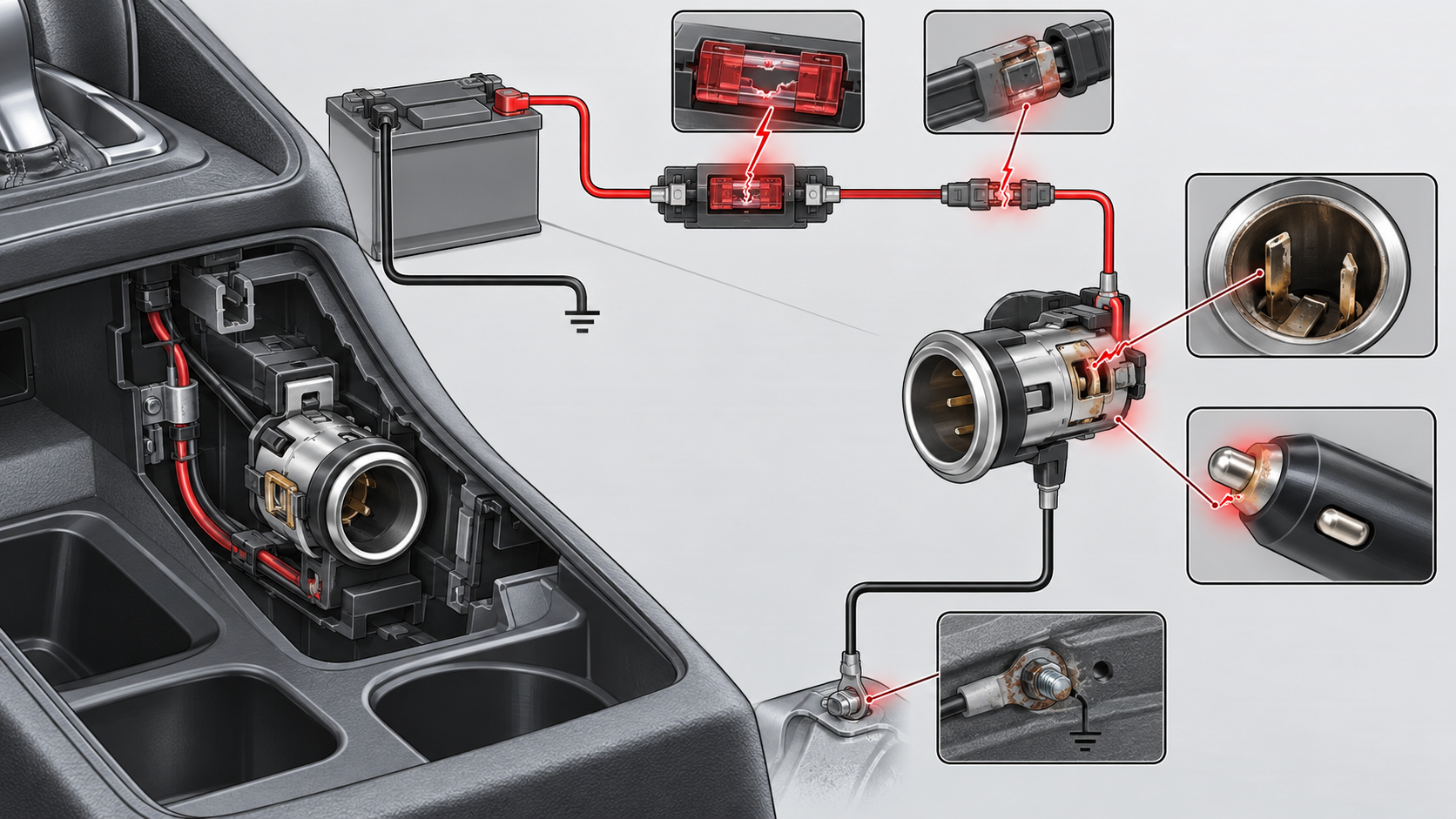
A cigarette lighter or 12V socket depends on more than the visible outlet in the dashboard or console. Depending on the vehicle, its power path can include a fuse, ignition or accessory-power logic, wiring, a ground path, connectors, and sometimes a relay or electronic control strategy.
Cigarette Lighter Fault-Check Matrix
Cigarette Lighter Symptom | Possible 12V Socket Cause | What to Verify First | What the Workshop Manual Helps Confirm |
No device works in one socket | Fuse, socket contact, connector, local wiring | Correct vehicle power mode and another known-good accessory | Outlet fuse, socket circuit, connector and wiring path |
One charger fails but another works | Accessory or plug fault | Accessory compatibility and plug fit | Outlet rating and approved accessory information where provided |
Several 12V sockets are dead | Shared fuse, relay, power supply or control logic | Whether the outlets share a circuit | Fuse/relay layout and circuit distribution |
12V socket works only with ignition on | Normal accessory-power strategy | ACC/ON behavior for that vehicle | Power-outlet operating conditions |
Fuse fails again after replacement | Overload, short, damaged socket or wiring fault | Stop repeated replacement and identify the cause | Circuit diagram, wire routing and affected components |
Power is present, but connection is intermittent | Worn, contaminated, or damaged socket contact | Visible condition and plug fit | Socket assembly and connector arrangement |
The first cigarette lighter diagnosis determines whether the outlet is supposed to be powered in the vehicle's current operating mode. Some 12V sockets operate only with the ignition or accessory mode active, while others may remain powered for a period after the vehicle is switched off.
That difference matters because a correctly functioning 12V socket can appear completely dead when the vehicle is in the wrong power state. NXTmotors workshop information helps you identify how the specific vehicle powers its accessory outlets, rather than assuming every socket is permanently live.
A second simple cigarette lighter check is whether the problem follows the device or stays with the outlet. If another compatible 12V accessory works normally, the socket circuit may be fine and the original charger or adapter may be the real fault.
If no compatible accessory works, you'll need to narrow down the 12V socket circuit further. At that point, the fuse and vehicle-specific electrical diagram become more useful than repeatedly testing different plugs.
Cigarette Lighter Fuse and Power Checks
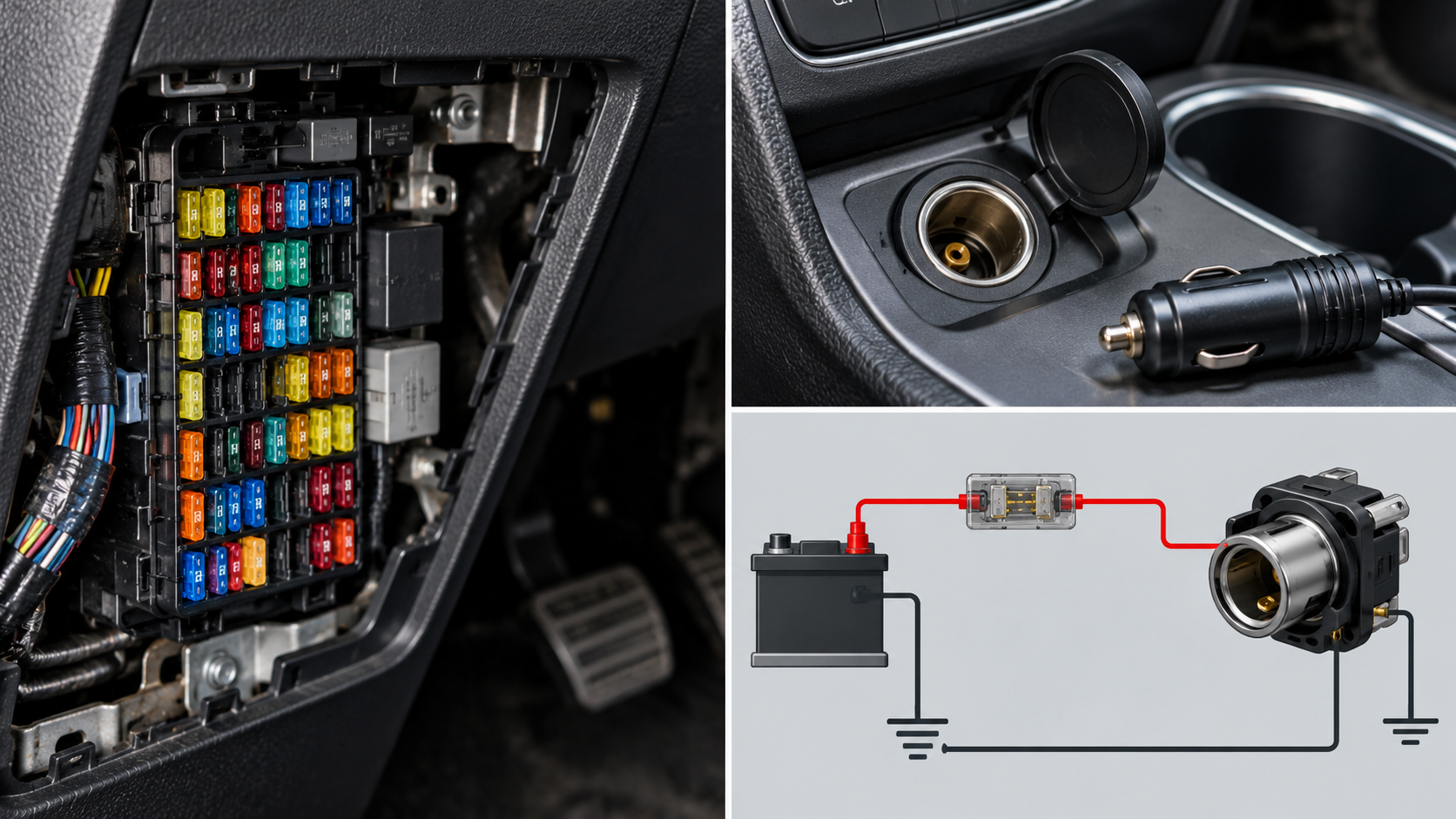
A cigarette lighter fuse protects the 12V power-outlet circuit from excessive current or certain electrical faults. A dead socket can therefore be caused by a fuse opening before the socket itself suffers any permanent damage.
The important point is that there is no universal cigarette lighter fuse number or rating for every vehicle. One model may label the circuit "CIG," another may use "P/OUTLET," "POWER POINT," "AUX PWR," or another manufacturer-specific description.
NXTmotors workshop manuals make this 12V socket fuse check more precise because the right manual identifies the applicable fuse panel, circuit designation, and related electrical components for the exact model and configuration.
A few cigarette-lighter fuse principles are worth keeping clear:
- Use only the specified cigarette lighter fuse rating for that vehicle and circuit.
- Do not install a higher-rated fuse because the correct fuse keeps opening.
- A repeatedly failing 12V socket fuse points to an unresolved overload or circuit fault.
- Different 12V outlets in the same vehicle may use separate fuses or separate power strategies.
- The fuse label should be verified against vehicle-specific information rather than guessed from another model.
The NXTmotors resource on relay testing procedures and manual pinouts is useful when a cigarette lighter circuit includes a relay or switched accessory-power feed. Not every outlet uses a dedicated relay, which is why you should check the vehicle-specific circuit first.
A fuse that fails repeatedly should not be treated as the repair itself. The cigarette lighter fuse is doing its protective job, so the next step is determining what is causing the excessive current or short-circuit condition.
Cigarette Lighter Socket and Contact Faults
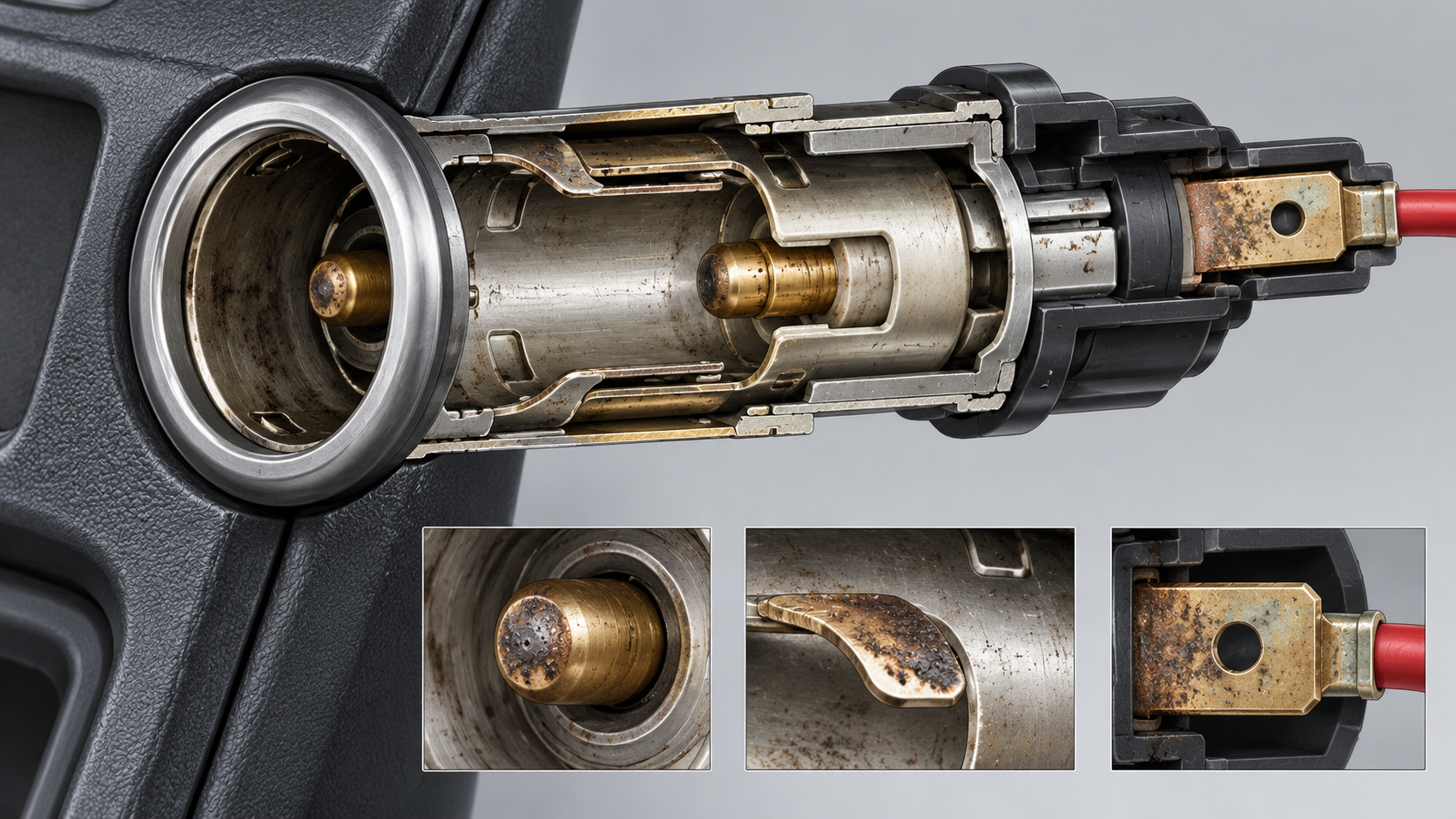
If the cigarette lighter fuse and power strategy are correct, the outlet assembly becomes a more realistic suspect. A 12V accessory plug needs firm electrical contact inside the socket, and wear, contamination, heat damage, or physical distortion can interrupt that connection.
A cigarette lighter socket can also be damaged by an accessory that does not fit properly. A loose plug may work intermittently, disconnect over bumps, or become warm because the electrical contact is poor.
A safe visual inspection of the 12V socket can identify obvious debris, discoloration, corrosion, looseness, or physical damage. Do not insert metal tools or other conductive objects into an energized power outlet.
The workshop manual becomes useful when the cigarette lighter socket itself needs to be accessed because dashboard and console construction varies significantly. On one vehicle the socket may be part of a small removable trim assembly, while another may require more involved console access.
NXTmotors uses the manual to establish the correct 12V socket assembly and access path before interior panels are disturbed. That reduces the risk of breaking hidden clips, disconnecting the wrong connector, or ordering a socket that belongs to another trim configuration.
Cigarette Lighter Wiring and Short-Circuit Faults
A cigarette lighter circuit that has a good fuse, correct power mode, and an apparently sound socket may need wiring diagnosis. The fault may be in the power feed, connector, ground path, or another component on the circuit.
Electrical diagrams are especially useful because a 12V socket problem may not follow the physical route obvious from the dashboard. Wiring can pass through connectors, junction blocks, relay panels, or body-control circuits before reaching the outlet.
NXTmotors' guide to reading auto wiring diagrams explains the logic behind tracing a circuit from supply to load and ground. That same approach applies when a cigarette lighter fuse keeps failing or the outlet loses power somewhere in the circuit.
Wire color can help identify a circuit, but a cigarette lighter repair should not rely on color alone. Manufacturers may change wire colors by model year, market, or harness section, so the wiring diagram remains the more reliable reference.
The NXTmotors guide to decoding factory wiring color codes is useful when you must match 12V socket wiring to a factory schematic rather than guess based on what appears behind the console.
If the cigarette lighter wiring requires trim removal, connector testing, or harness repair, the job moves beyond a simple visual check. That is where a competent automotive electrician or technician may be more appropriate, particularly when other electrical systems share the same area.
Cigarette Lighter Ground Faults
A working 12V socket needs a complete power and ground path. A poor ground can create a dead outlet, intermittent operation, or voltage loss even when the fuse and power feed appear correct.
The difficulty is that the cigarette lighter ground point may not be physically close to the socket. The circuit can connect through a harness to a shared chassis ground located elsewhere behind the dashboard, console, or body structure.
NXTmotors' guide to finding hidden chassis ground points through a manual shows why you should identify the 12V socket ground from the vehicle's electrical documentation rather than assuming the nearest visible body bolt is the correct ground.
A ground-related cigarette lighter fault also needs to be separated from a damaged power feed. Vehicle-specific wiring information clarifies that distinction by showing which side of the socket circuit carries power and which path completes the circuit to ground.
Cigarette Lighter Fuse Keeps Blowing
A cigarette lighter fuse that keeps blowing is different from a single fuse that failed once. Repeated fuse failure indicates that something continues to overload or short the protected 12V circuit.
Possible causes of a repeated 12V socket fuse failure include:
- An accessory that draws more current than the outlet permits
- A defective 12V charger or adapter
- Conductive debris or physical damage inside the socket
- Damaged socket insulation or internal contact
- Pinched, rubbed, or otherwise damaged wiring
- A fault in another device sharing the protected circuit
The correct response to a repeatedly failing cigarette lighter fuse is not to increase the fuse rating. The specified fuse protects the wiring and other components from current beyond the circuit's intended capacity.
NXTmotors workshop information can help identify what else shares the 12V socket fuse, which is important when the outlet is not the only load on that circuit. A repeated failure may require professional circuit testing rather than another fuse replacement.
Cigarette Lighter vs 12V Power Outlet
The terms cigarette lighter, 12V socket, accessory power outlet, and power point are often used for similar round outlets, but the vehicle manual should determine how a specific socket is intended to be used.
Older vehicles may have had an actual heating-element cigarette lighter, while many newer vehicles provide a 12V accessory outlet intended only for electrical accessories. A socket that looks similar does not automatically mean the vehicle manufacturer designed it for the same purpose.
For this repair, the key component is the 12V power outlet circuit, not the smoking-related heating element. NXTmotors workshop and owner information can help identify how the specific vehicle labels the circuit and what operating limits or precautions apply.
That distinction can also explain why searching only for "cigarette lighter fuse" sometimes fails. The same 12V socket may appear in workshop documentation under "power outlet," "accessory socket," or another manufacturer-specific term.
Cigarette Lighter Repair With a Wiring Diagram
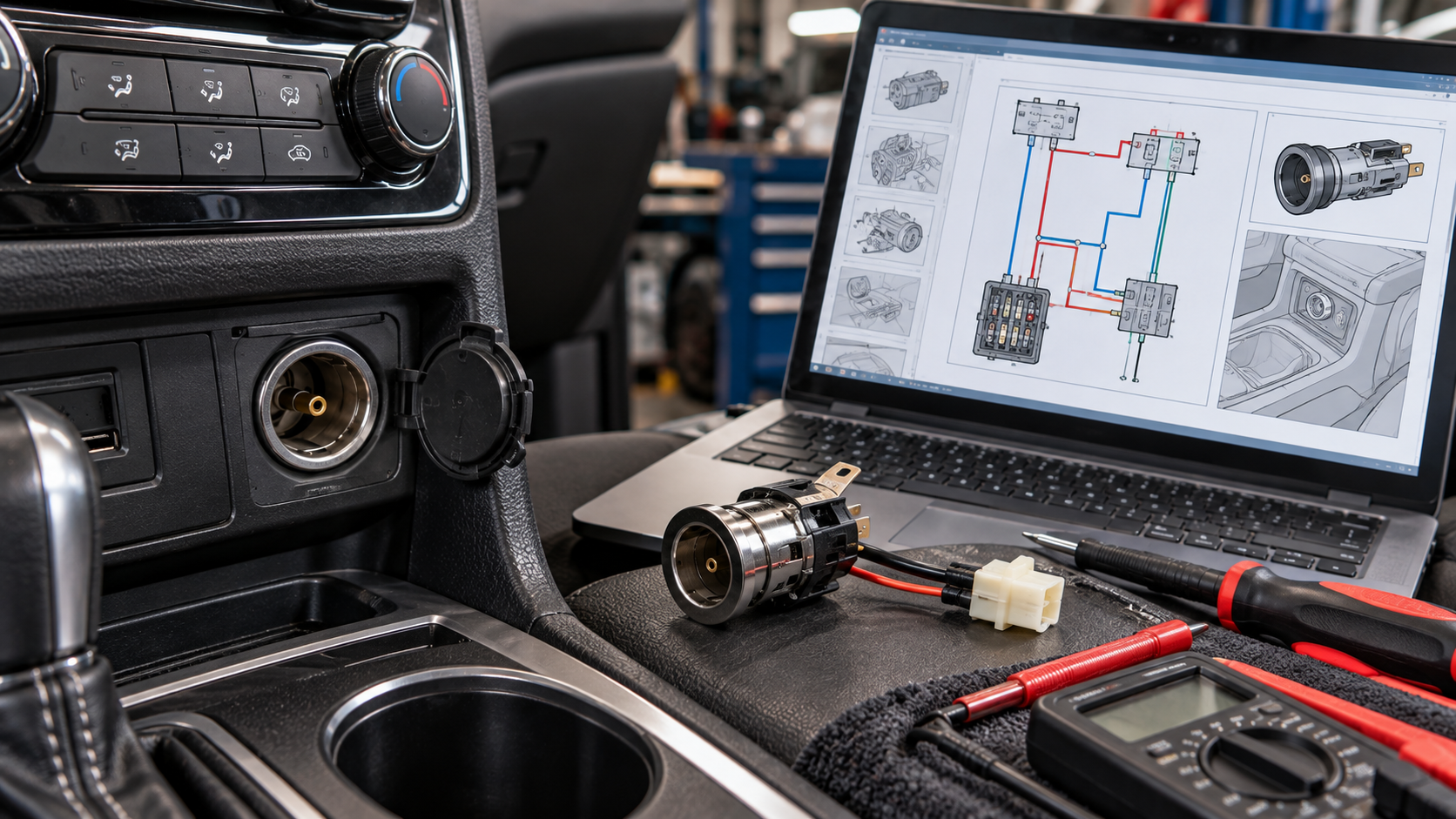
A wiring diagram gives the cigarette lighter repair a logical path instead of a parts-swapping approach. The diagram can show how the outlet relates to its fuse, switched power source, connector, ground, and any control or relay components.
For a 12V socket circuit, the diagram is most useful when the obvious checks do not explain the failure. It can answer questions such as whether several sockets share one feed, whether power changes with ignition state, or whether the circuit passes through a junction or relay.
The NXTmotors resource on navigating interactive PDF workshop manuals can help you locate terms such as cigarette lighter, power outlet, accessory socket, fuse, connector, and wiring diagram inside a large digital service manual.
The right manual also prevents you from applying one vehicle's cigarette lighter circuit to another model simply because the dashboard socket looks the same. The electrical architecture behind two similar outlets can be completely different.
Cigarette Lighter Repair Manual Selection
A workshop manual is only useful for a cigarette lighter repair if it matches the correct vehicle. Model year, engine, body configuration, market, and electrical architecture can affect fuse assignments and wiring layouts.
NXTmotors explains how to choose the right workshop repair manual so that 12V socket diagnosis is based on the correct configuration rather than a similar model from another year.
Where vehicle identification is important, NXTmotors also covers finding a factory service manual by VIN and the role of VIN-specific repair manuals. That can reduce ambiguity when a cigarette lighter circuit changes across trim or production variants.
Manual source quality matters as well. Comparing OEM and aftermarket manuals for DIY helps explain why the level of electrical detail available for a 12V socket repair can differ from one source to another.
For readers who want factory-style technical information, NXTmotors also explains where to find genuine OEM workshop manuals. The goal isn't more documentation for its own sake, but the correct cigarette lighter circuit information for the vehicle being repaired.
Cigarette Lighter Repair: Manual vs Repair Shop
A workshop manual and a repair shop solve different parts of a cigarette lighter repair. The manual provides the vehicle-specific technical map, while the shop provides hands-on testing, electrical equipment, trim-removal experience, and wiring-repair capability.
Cigarette Lighter Manual vs Shop Comparison
Cigarette Lighter Repair Need | NXTmotors Workshop Manual | Repair Shop |
Identify 12V socket fuse | Shows applicable fuse/circuit information where covered | Can physically test the circuit |
Understand outlet power logic | Shows wiring and accessory-power strategy | Can confirm live behavior on the vehicle |
Trace cigarette lighter wiring | Provides schematic and connector information | Can test continuity, voltage and load conditions |
Locate 12V socket ground | Shows ground path and related diagrams | Can inspect and test the actual connection |
Access the cigarette lighter socket | Shows trim/component procedure where covered | Has tools and experience for disassembly |
Diagnose repeated fuse failure | Helps identify circuit branches and loads | Better suited to live fault isolation and wiring repair |
A NXTmotors workshop manual can reduce guesswork in a 12V socket repair, but it does not replace the equipment or skill needed for every electrical fault. This is especially true when a fuse repeatedly fails, or the wiring must be accessed behind multiple trim panels.
The NXTmotors comparison of digital car manuals versus mechanic advice explains why the two resources can work together. A cigarette lighter repair is often easier to discuss with a technician when the owner already understands the fuse, circuit, socket location, and likely access requirements.
Cigarette Lighter Repair Safety
A cigarette lighter circuit is part of the vehicle's electrical system, so even a relatively small 12V outlet should not be treated casually. The fuse protects the circuit, and bypassing it can cause wiring damage or overheating.
For a safe 12V socket inspection:
- Do not insert metal tools or conductive objects into an energized socket.
- Do not substitute a higher-rated fuse for the specified cigarette-lighter fuse.
- Stop replacing the fuse repeatedly if the new fuse fails again.
- Do not disassemble unfamiliar dashboard areas without checking for nearby electrical systems and trim procedures.
- Use professional electrical diagnosis when the fault moves beyond the fuse, visible socket condition, or known accessory.
The NXTmotors manual helps keep the cigarette lighter repair within the correct vehicle-specific boundaries by showing where the circuit runs and what to remove to reach it. If access approaches airbag wiring, complex control modules, or other unfamiliar electrical systems, professional service is the better choice.
Ford Cigarette Lighter Repair
Match a Ford cigarette lighter or power-point repair to the correct model and generation because fuse assignments, outlet locations, and accessory-power behavior can vary. NXTmotors' Ford category connects the broad 12V socket problem with current model-specific workshop manuals.
Ford F-150 Cigarette Lighter Repair Factors
For a matching vehicle, the 2007–2013 Ford F-150 2WD workshop manual is a current NXTmotors destination for F-150 cigarette lighter and electrical-system information for that configuration.
The F-150 manual link does not imply that the model has a common cigarette lighter fault. It helps you verify the correct fuse, wiring architecture, connector arrangement, and repair procedure after you've narrowed down the 12V socket problem.
Toyota Cigarette Lighter Repair
A Toyota cigarette lighter repair should start with the correct model year and electrical documentation, not a fuse number copied from another Toyota. Even within one model family, outlet location and fuse assignment can change.
Toyota Camry Cigarette Lighter Repair Factors
For a matching configuration, the 1997–2002 Toyota Camry LE workshop manual provides the NXTmotors manual destination for checking Camry 12V socket electrical information.
The Camry manual supports the cigarette lighter diagnosis by providing vehicle-specific technical context where applicable. The manual's existence does not prove the Camry has a known or common socket failure.
BMW Cigarette Lighter Repair
A BMW cigarette lighter or 12V socket repair can involve electrical power-management logic in addition to a simple fuse and outlet. Check the exact architecture against the specific chassis and production configuration.
BMW F30 Cigarette Lighter Repair Factors
For an applicable vehicle, the 2012–2018 BMW 3 Series F30 workshop manual is the current NXTmotors destination to consult for F30 electrical and power-outlet information.
The F30 manual helps place the 12V socket fault in the correct electrical system, rather than assuming a fuse location or circuit from another BMW platform applies.
Volkswagen Cigarette Lighter Repair
Volkswagen cigarette lighter repair should also match the exact model and electrical configuration. Similar-looking accessory sockets can be supplied through different fuse panels or ignition-power strategies.
Volkswagen Golf Mk6 Cigarette Lighter Factors
For a matching vehicle, the 2008–2013 Volkswagen Golf Mk6 workshop manual provides the NXTmotors manual destination for checking Golf Mk6 12V socket and electrical information.
Use the Golf Mk6 manual to verify the correct cigarette lighter circuit, not to assume every dead Golf socket has the same cause. Diagnosis still needs to separate accessory, fuse, socket, ground, and wiring faults.
Cigarette Lighter Repair: Confirm the Fault First
Before ordering a cigarette lighter socket, fuse, connector, or other electrical part, confirm where the 12V circuit actually stops working. A dead outlet can be caused by the accessory, ignition-power strategy, fuse, socket contact, ground, wiring, relay, or another component in the power path.
NXTmotors connects that cigarette lighter diagnosis to the right workshop information for your exact vehicle. That makes it easier to understand the circuit before replacing parts or authorizing electrical work.
If you are still working out how to repair a cigarette lighter in a car, choose the correct workshop repair manual for your vehicle and use its electrical information to confirm the fuse, socket circuit, wiring path, and access requirements. If the 12V socket problem involves repeated fuse failure, hidden wiring, or uncertain electrical diagnosis, a qualified repair shop can use the same information alongside hands-on testing.
Commonly Asked Questions About Cigarette Lighter Repair
Why Is My Cigarette Lighter Not Working?
A cigarette lighter may stop working because the connected accessory has failed, the vehicle is in a power mode where the outlet is inactive, the fuse has opened, the socket contact is damaged, or the power or ground circuit has a fault.
Start by treating the cigarette lighter as a complete 12V circuit rather than assuming the visible socket has failed. The correct NXT motors workshop manual can help identify the outlet's fuse, power strategy, wiring, and connector information for the exact vehicle.
What if the Cigarette Lighter Fuse Is Good?
If the cigarette lighter fuse is good but the 12V socket remains dead, the fault may be further along the circuit. Possible areas include the socket contact, connector, ground, switched-power supply, relay or wiring.
A good fuse only confirms that the fuse itself has not opened. NXT motors workshop information can help map the cigarette lighter circuit so a technician or competent repairer can determine where power or ground is being lost instead of replacing the socket by guesswork.
Why Does the Cigarette Lighter Fuse Keep Blowing?
A cigarette lighter fuse that keeps blowing usually means the circuit is still experiencing excessive current or a short-circuit condition. A faulty accessory, damaged socket, conductive debris, damaged wiring, or another load on the shared circuit can all contribute.
Do not solve a repeated cigarette lighter fuse failure by installing a higher-rated fuse. The correct workshop manual can identify the protected circuit and related components, while persistent faults are better handled with proper electrical testing.
Which Fuse Controls the Cigarette Lighter?
The cigarette lighter fuse doesn't have the same number or label in every car. Depending on the manufacturer, the circuit may be listed as CIG, power outlet, accessory socket, power point or another abbreviation, and one vehicle can have separate fuses for different 12V outlets.
The most reliable approach is to check the exact vehicle documentation. NXTmotors workshop manuals can help you identify the correct fuse panel and circuit information, rather than relying on a fuse number from another model year.
Does a Cigarette Lighter Only Work With the Ignition On?
Some cigarette lighter and 12V sockets operate only when the ignition is in ACC or ON, while others may stay powered with the vehicle off or remain active for a retained-accessory period. This behavior depends on the vehicle's electrical design, so a socket that appears dead may be operating normally.
The correct NXTmotors workshop or vehicle manual can clarify the cigarette lighter power strategy before you replace a fuse or socket unnecessarily.
Can a Cigarette Lighter Drain the Car Battery?
A cigarette lighter or 12V socket can drain the battery if the outlet stays powered with the vehicle off and a connected accessory keeps drawing current. Whether that happens depends on the vehicle's accessory-power strategy and the device you're using.
Some cigarette lighter circuits switch off automatically, while others may remain live. NXTmotors vehicle-specific manual information can help you determine how the outlet is powered, so you don't assume all 12V sockets behave the same way.
Is a 12V Power Outlet the Same as a Cigarette Lighter?
A 12V power outlet and cigarette lighter socket can look very similar, but the vehicle manufacturer may describe and rate them differently. Many modern vehicles use the round socket only as an accessory power outlet, not a heating-element cigarette lighter.
For repairs, the key factors are the 12V electrical circuit, fuse, socket, and power rating specified for that vehicle. NXTmotors manual information helps identify the correct terminology and circuit rather than assuming every round socket has identical functions.