Posted on

DIY Immobilizer Key Reprogramming Steps: What the Dealer Won’t Tell You First
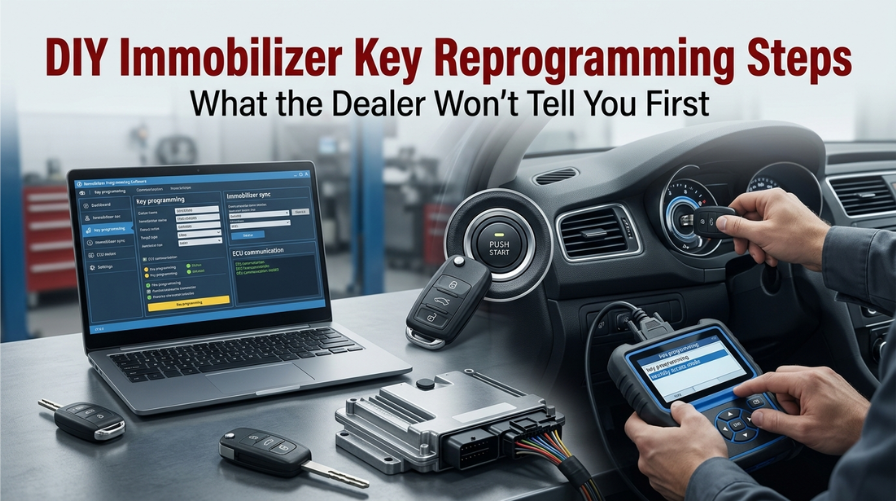
DIY immobilizer key programming using ECU and diagnostic tool

Many DIY immobilizer key reprogramming steps found online fail because they aren’t system-specific. Incorrect attempts can trigger a security lockout requiring an expensive dealer reset.

Confirm your vehicle’s specific immobilizer type and have all keys ready before starting. While many pre-2010 models allow DIY syncing with the ECU, others require professional tools.

This guide outlines system types, DIY-compatible vehicles, ignition-cycle steps, and when to seek professional help

DIY Immobilizer Key Reprogramming Steps: Why the System Type Decides Everything

technician programming immobilizer key using diagnostic scan tool

Vehicle immobilizer systems differ, which determines whether DIY reprogramming is possible or licensed diagnostic software is required. Attempting to use onboard stationary methods on systems that require an OBD connection will fail, as the system ignores the input.

Identify your immobilizer generation first to save time and avoid security lockouts. Only the factory service manual can confirm the correct method for your specific vehicle.

Step 1: Identify Your Immobilizer System Type First

Before any physical reprogramming step begins, identify which immobilizer architecture your vehicle uses. This single piece of information determines the entire procedure.

The four main immobilizer system types:

System Type

How It Works

DIY Possible?

Tool Required

Onboard/Stationary

Ignition cycle sequence programs the key

Yes, on supported models

None or basic OBD-II reader

OBD-Based Programming

Scan tool writes key ID to ECU/immobilizer module

Limited

TPMS/immobilizer-capable scan tool

Dealer-Only (Encrypted)

Manufacturer cryptographic key is required

No

Dealer-only equipment

Proximity/Smart Key

RF enrollment via infotainment or dedicated tool

Sometimes

Varies by manufacturer

GM vehicles from the 1990s and early 2000s using the VATS (Vehicle Anti-Theft System) or PASS-Key systems often support onboard reprogramming using a specific ignition-on, ignition-off timing sequence. 

Ford uses a PATS (Passive Anti-Theft System) that supports stationary reprogramming on older models but requires a scan tool on post-2010 models. 

Honda and Toyota systems from the early 2000s often support onboard programming when a valid existing key is present, but newer encrypted systems require dealer- or locksmith-grade equipment.

Locating the correct factory reprogramming procedure for your exact build specification is the first step. For vehicle-specific documentation matched to your VIN, this resource on VIN-Specific Manuals is the most reliable starting point before any programming attempt.

Step 2: Confirm What Keys and Tools You Need Before Starting

technician preparing keys and scan tool for immobilizer programming

Failing to have all required items present at the start of the session is one of the most common causes of incomplete immobilizer reprogramming. Some systems erase all stored key IDs when programming mode is activated. If you start without all keys present, every previously programmed key becomes inactive.

Required items by system type:

  • Onboard systems (GM, older Ford, older Honda): All existing programmed keys must be physically present. Some systems require two working programmed keys to authorize adding a third
  • OBD-based systems: A compatible scan tool with immobilizer programming module and, in some cases, an internet-connected licensing token (some tools charge per-vehicle access)
  • New blank transponder key: Must be the correct transponder chip type for your vehicle. Chip types include Philips 46, Philips 48, Texas Instruments DST-80, ID13, and others. The wrong chip type will not communicate with the immobilizer module, regardless of the programming sequence used
  • Factory security PIN or seed/key data: Some vehicles (particularly European makes, including VAG group vehicles) require the factory immobilizer PIN to authorize new key enrollment. This PIN may appear in your original vehicle documentation or can be retrieved via OBD with a compatible tool

To find the correct factory security PIN retrieval procedure and immobilizer module documentation for your vehicle, this guide, Find Your Factory Service Manual PDF by VIN, lists the most reliable sources.

Step 3: Execute the Onboard Reprogramming Sequence Correctly

technician performing ignition cycle for immobilizer key programming inside car

For vehicles that support reprogramming the onboard immobilizer key without additional tools, the ignition-cycle sequence is the core procedure. These steps must be performed in precise timing most systems have a window of 5 to 15 seconds between each action.

General onboard reprogramming sequence (confirm your exact vehicle’s steps in the factory manual):

  1. Insert an already-programmed key into the ignition and turn to the ON position. Do not crank the engine
  2. After the security light illuminates and extinguishes (typically 10 to 15 seconds), turn the ignition OFF and remove the key within 5 seconds
  3. Within 10 seconds, insert the next programmed key and repeat the ON-to-OFF cycle. This signals the system that a trusted key holder is authorizing programming mode
  4. Some systems require repeating Steps 2 and 3 with a second existing programmed key confirm your vehicle’s specific count in the factory manual
  5. After the authorization sequence, insert the new blank transponder key and turn the system will recognize it is unregistered and enter learning mode
  6. Wait for the security light to flash several times, then extinguish. This confirms the new key has been stored in the immobilizer module
  7. Turn ignition OFF, remove the key, and test by attempting to start the engine

Common failures at this stage trace to timing errors, moving too quickly or too slowly between ignition cycles. The factory service manual specifies the exact window in seconds. Generic internet procedures often cite approximate values that are close but not exact for your specific module.

For vehicles where the reprogramming sequence involves reading fault codes before and after the procedure, this guide, Read OBD-II Codes Using Manual Flowcharts, covers how to interpret the immobilizer-related DTCs that may appear during the process.

Step 4: Use a Scan Tool for OBD-Based Reprogramming

technician programming car key using obd scan tool inside vehicle

For vehicles without onboard reprogramming, an immobilizer-capable scan tool connects to the OBD port and writes the new key‘s transponder ID directly to the ECU or a dedicated immobilizer control module.

OBD-based key reprogramming procedure:

  1. Connect the scan tool to the OBD-II port under the dashboard
  2. Navigate to the Security, Immobilizer, or Anti-Theft section in the scan tool menu, not the generic Engine or Body section
  3. Select “Key Programming” or “Transponder Registration”
  4. The scan tool will prompt for the security PIN or seed/key. Enter the correct factory PIN for your vehicle
  5. Follow the on-screen prompts to trigger the new key into programming mode. Most tools prompt you to insert the new key and turn to ON at a specific step
  6. The tool writes the new transponder ID to the immobilizer module memory confirm the on-screen success message before exiting
  7. Test the new key by starting the engine. If it starts, the reprogramming is confirmed

If the scan tool reports “PIN incorrect,” do not attempt to guess additional PIN combinations some systems lock permanently after three failed attempts. Retrieve the correct PIN from factory documentation or a VIN-based PIN lookup service before retrying.

Understanding the ECU and immobilizer module architecture helps significantly when using a scan tool for this type of programming. This breakdown of ECU Pinout Charts Explained for Diagnostics covers the module communication structure relevant to immobilizer circuit diagnosis.

Step 5: Recognize When DIY Is Not the Right Path

Some immobilizer systems are genuinely not accessible without manufacturer-level tools, and attempting to proceed past that boundary creates problems that are more expensive than professional programming.

Clear indicators that DIY reprogramming is not viable:

  • Your vehicle is a post-2015 European make (VAG group, BMW, Mercedes), these use rolling-code encrypted transponder systems that require manufacturer diagnostic tools
  • You have no existing programmed keys most onboard systems require at least one valid existing key to authorize the session. Without it, the immobilizer cannot verify ownership before entering programming mode
  • The security light remains on continuously, and the vehicle is in a no-start condition. This may indicate an immobilizer module fault rather than a simple unprogrammed key, which requires diagnostic investigation before any reprogramming attempt
  • Your vehicle uses proximity smart keys with encrypted RF enrollment. The hardware matching between the smart key and the BCM typically requires proprietary tools

If these conditions apply, a licensed automotive locksmith is usually the most cost-effective professional option. Locksmiths with NASTF (National Automotive Service Task Force) vehicle security access are authorized to reprogram immobilizers on most makes and typically charge 30 to 50 percent less than dealership rates.

For understanding when the complexity of a vehicle’s security or electrical systems warrants upgrading to full factory service documentation rather than relying on general repair guides, this article, “When to Upgrade to a Factory Service Manual,” provides clear guidance.

Conclusion

DIY immobilizer key reprogramming is genuinely achievable on a wide range of vehicles, but only when the correct system type is identified first, all required keys and tools are present, and the factory-documented sequence is followed precisely. Shortcuts based on generic online procedures often lead to failures that are sometimes harder to reverse than the original problem.

Know your system type. Get the right documentation. Follow the exact timing. That approach finishes the job without creating a lockout situation or an unnecessary dealer visit.

Frequently Asked Questions

A transponder key contains a passive RFID chip embedded in the plastic head of a traditional cut key. When inserted into the ignition, the chip responds to a signal from the immobilizer antenna ring and transmits its unique ID code. 

A smart key (also called a proximity key or key fob) communicates via active radio frequency and enables push-button start without insertion. Reprogramming a transponder key involves writing its chip ID to the immobilizer module, a process that can sometimes be done onboard. 

Reprogramming a smart key typically requires a bidirectional scan tool or proprietary dealer software because the enrollment involves encrypted RF pairing rather than just an ID code write.

It depends on the vehicle and system generation. Older vehicles (pre-2005 for most makes) with basic transponder or VATS systems may be programmable via an OBD-based tool without an existing working key, provided the correct PIN is available. 

Most modern vehicles with encrypted immobilizer systems require at least one existing valid key to authorize the programming session without it, the system has no mechanism to verify ownership before accepting a new key. In all-keys-lost situations for modern vehicles, a licensed automotive locksmith or authorized dealer is typically the only viable option. 

They use NASTF-authorized PIN retrieval and manufacturer-approved programming tools to complete the enrollment.

Most immobilizer systems support between 4 and 8 programmed keys, with 4 to 6 being the most common limit. Some systems, particularly those on older Honda models, use specific programmer tools that erase all stored key IDs before writing new ones, which means all keys must be re-enrolled in the same session. 

Other systems allow additive enrollment, where a new key is added to the existing stored IDs without clearing the others. Your factory service manual will specify the maximum stored key count and whether the system uses erase-then-write or additive enrollment. 

Confirming this before starting prevents accidentally de-programming existing working keys during the session.

A persistent security light after a completed reprogramming sequence has several possible causes. The most common is that the sequence did not complete a timing error successfully during the ignition cycle, causing the immobilizer module to exit programming mode before storing the new key ID. 

A second cause is a mismatch between the transponder chip type in the new key and the system’s expected chip format. The immobilizer antenna received a signal but could not recognize the chip protocol. 

A third cause is a pre-existing fault in the immobilizer module that existed before the reprogramming attempt. Reading immobilizer-specific fault codes with a compatible scan tool will confirm which of these scenarios applies before attempting the sequence again.

Disconnecting the battery resets volatile memory in some immobilizer modules, which can clear a soft lockout caused by too many failed key attempts, but it does not clear the programmed key database, which is stored in non-volatile memory. 

On some older GM PASS-Key systems, a battery disconnect followed by a 10-minute wait allows the security system to reset its timer and accept a programming attempt it previously rejected due to incorrect timing. 

On modern encrypted systems, a battery disconnect has no effect on immobilizer lockouts. If a hard lockout has occurred, a scan tool capable of resetting the immobilizer module’s attempt counter is required before any further reprogramming can proceed.
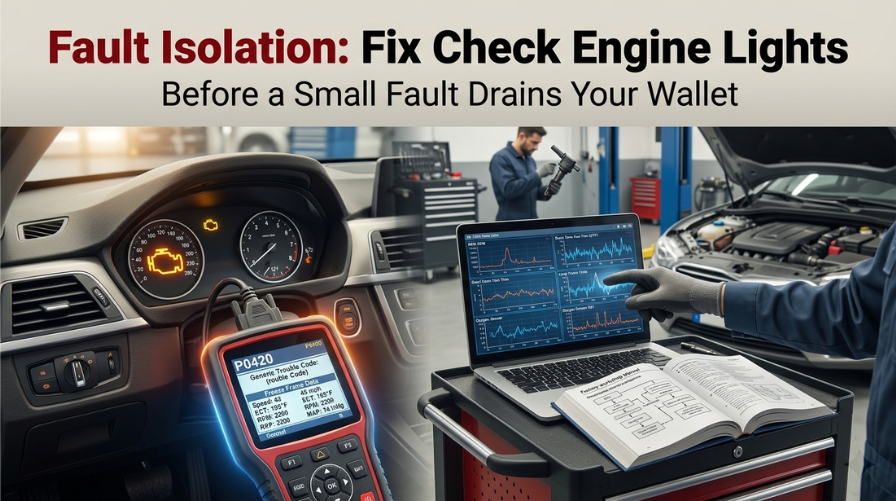
Posted on

Fault Isolation: Fix Check Engine Lights Right Before a Small Fault Drains Your Wallet

Technician diagnosing check engine light using OBD scanner and live data

A fault left untraced, an engine light dismissed without proper isolation, and no clear plan to fix things the right way, that combination turns a $90 sensor job into a $900 mistake. Most drivers panic or blindly clear the code, and the light returns within days.

Fixing a check engine light requires a specific sequence: read DTCs, save freeze frame data, isolate the root cause, and confirm with live data. A solid light is non-urgent, but a flashing light indicates a severe misfire that risks damage to the catalytic converter.

This guide breaks down every step of that sequence, so your diagnosis hits the root cause the first time, not the third.

Fault Isolation: Fix Check Engine Lights Right — The Method Professionals Actually Follow

Most drivers pull one code, replace the part it names, and watch the light return within two drive cycles. That is not fault isolation, that is expensive guessing. Real isolation means tracing a 

Diagnostic Trouble Code (DTC) to the system, ruling out downstream effects, and confirming the actual failure with live sensor data before any part is ordered.

Step 1: Pull Every Code — Not Just the First One

Before anything else, connect your OBD-II scanner to the diagnostic port under the driver’s side dashboard. Turn the ignition to “ON” without starting the engine, then read all stored and pending DTCs. Write down every single code, do not stop at the first one.

The letter prefix tells you the affected system immediately:

Code Prefix

System Affected

Common Examples

P

Powertrain (engine, fuel, transmission)

P0171, P0300, P0420

B

Body control (airbags, interior)

B1000, B2799

C

Chassis (ABS, suspension, brakes)

C0035, C0121

U

Network/communication

U0100, U0401

When multiple codes appear together, one is almost always the primary fault that triggers the others. Address the earliest-triggered or most foundational code first. 

Replacing a downstream component while the upstream fault remains active guarantees the code returns. The Check Engine Light step-by-step diagnostic using factory repair manuals resource outlines this prioritization process precisely.

Step 2: Save Freeze Frame Data Before Clearing Anything

technician reviewing freeze frame data using obd scan tool in car

Freeze-frame data is the ECU’s snapshot of engine conditions at the exact moment the check engine light triggered. It records RPM, vehicle speed, coolant temperature, throttle position, engine load percentage, and fuel trim values, all captured at the fault instant.

Never clear codes before saving this data. Clearing resets all readiness monitors and permanently erases freeze frame, which is often your single most valuable diagnostic clue.

Screenshot it, write it down, or export it from your scanner app. Then cross-reference these key parameters:

  • Engine Load %: High load at fault time suggests a mechanical or fuel delivery issue
  • Coolant Temperature: Cold-start faults point to sensor or warm-up circuit problems
  • Short-Term Fuel Trim: Values above +10% signal an active lean condition
  • RPM at Fault: Idle-only faults behave very differently from cruise-speed faults

A lean code triggered at idle versus one triggered at highway speed narrows the possible causes by more than half before any physical inspection begins.

Step 3: Isolate the Root Fault — Not the Symptom Code

This is the critical step most DIYers skip. An OBD-II code identifies the affected circuit or system, not the failed component. P0420 flags catalytic converter efficiency below threshold, but a failing converter is rarely the initiating cause.

Common fault isolation traps by code:

  • P0420: Often caused by misfires, O2 sensor failure, or an exhaust leak — not a bad catalyst
  • P0171 (Lean Bank 1): Frequently traced to a vacuum leak or weak fuel pump — not just the MAF sensor
  • P0300 (Random Misfire): Can originate from low fuel pressure or carbon-fouled injectors — not only spark plugs

Use OBD-II manual diagnostic flowcharts to walk each code through its proper decision tree. This prevents condemning a healthy component based on a misread symptom code.

Before touching any sensor, inspect the wiring harness and connector at the ECU. A corroded or damaged pin can cause the same fault code as a dead sensor, at a fraction of the cost of a repair. The ECU pinout charts, explained in the diagnostics guide, map every connector for the most common engine configurations.

Step 4: Confirm the Fault With Live Data — Then Order Parts

technician analyzing live engine data with obd scanner during diagnostics

Live data is real-time proof that confirms or eliminates your working diagnosis. With the scanner connected and the engine running, compare sensor output against factory specification ranges for your exact vehicle.

Focus on these live data parameters during fault confirmation:

  • STFT/LTFT (Fuel Trims): Long-term fuel trim above +10% at idle confirms the ECU is compensating for a lean condition
  • O2 Sensor Switching: A flat or slow-switching signal indicates a failing sensor or downstream exhaust problem
  • Misfire Counters Per Cylinder: Isolates an active misfire to a specific cylinder — guiding coil, plug, or injector testing
  • MAF g/s at Idle: Deviations from displacement-based spec suggest sensor contamination or air intake leaks

Pull factory spec ranges for your specific engine from your vehicle’s service manual using the VIN. The factory service manual PDF by VIN resource provides the exact thresholds for each model year and engine variant, not generic estimates.

Step 5: Fix Right, Then Verify Through a Full Drive Cycle

technician verifying car repair using obd drive cycle on road

After completing the repair, clear the stored DTC and complete a proper OBD-II drive cycle for the affected monitor. Simply clearing the code and driving around the block isn’t verification—it’s hope. 

Drive cycles require specific conditions: cold start, idle period, steady cruise speed, deceleration, and sometimes a set engine temperature range.

Post-repair verification checklist:

  • Clear the DTC and freeze frame after the confirmed repair
  • Complete the full drive cycle for the affected monitor group
  • Reconnect the scanner and check the I/M readiness monitor status
  • Confirm all monitors show “Ready” or “Complete.”
  • Verify zero new stored or pending codes after the drive cycle

If the code returns after this process, do not repeat the same repair. Re-evaluate using fresh live data. Comparing OEM vs. aftermarket repair manual accuracy for DIY diagnostics helps confirm whether the reference source you used contains the correct diagnostic tree for your application.

Conclusion

Fault isolation is not one action it is five sequential steps that each build on the last. The check engine light is only the starting signal. Reading every DTC, capturing a freeze frame before clearing anything, tracing to the upstream fault, confirming with live data, and verifying through a proper drive cycle are what produce a lasting fix

Every shortcut in that sequence increases the chance the light will return, and the repair bill will grow. Work the process correctly once, and the engine stays right.

Frequently Asked Questions

A flashing check engine light signals an active, repeated misfire, not a pending or stored fault. Every driving mile in this condition pushes raw, unburned fuel directly into the catalytic converter, raising its internal temperature well beyond the designed operating range. 

Sustained exposure destroys the substrate inside the converter, turning a straightforward ignition coil or spark plug repair into a catalytic converter replacement that typically costs between $900 and $2,500, depending on the vehicle. 

The safest response is to immediately reduce engine load, find a safe stopping point, shut the engine off, and arrange a tow. No destination is worth that cost difference.

OBD-II codes identify affected circuits and systems, not the specific failed part. A P0138 code, for example, flags abnormally high voltage at a specific oxygen sensor, but elevated voltage at that sensor can result from a rich-running fuel condition rather than a faulty sensor itself. 

Replacing the sensor without investigating the fuel trims and injector data leaves the rich condition active, and the ECU logs the same code again within one to two drive cycles. 

Accurate fault isolation using live data before any part purchase is the only method that prevents this pattern. The code tells you where to look, not what to buy.

A pending DTC is the system’s initial detection of an out-of-range reading that appeared once but has not yet repeated enough times to trigger the check engine light. A stored or confirmed 

DTC has been detected on at least 2 consecutive drive cycles, during which the engine light illuminates. Pending codes matter significantly during diagnosis because they often represent the initiating fault that later generates confirmed, downstream codes. 

Experienced technicians review pending codes during every scan because pending codes often reveal root system failures before they escalate into a full set of confirmed fault codes with more complex diagnostic paths.

Disconnecting the battery clears stored DTCs and turns off the check engine light, but it resolves nothing mechanically. The OBD-II system detects the same underlying fault during the very next drive cycle and logs the code again. 

Beyond that, disconnecting the battery resets all readiness monitors to “Not Ready,” which causes an immediate failure at an emissions inspection even when no fault codes are currently stored. The monitors require several complete drive cycles to return to “Ready” status. 

Additionally, erasing freeze-frame data during battery disconnection eliminates the most useful diagnostic snapshot, making subsequent diagnosis harder and slower.

Generic OBD-II scanners read standardized P0 codes reliably across virtually all makes and model years since 1996. Manufacturer-specific codes identified by the “1” as the second digit, such as P1XXX, require either a professional-grade enhanced scan tool or a brand-validated diagnostic interface. 

A generic scanner may display the code number without a meaningful description, or it may misidentify the affected system entirely. For accurate fault isolation on these proprietary codes, cross-reference with an OEM factory service manual specific to your vehicle’s make and model year. 

Using a validated OEM reference ensures the diagnostic flowchart you follow was designed for that exact engine management system configuration.

Posted on

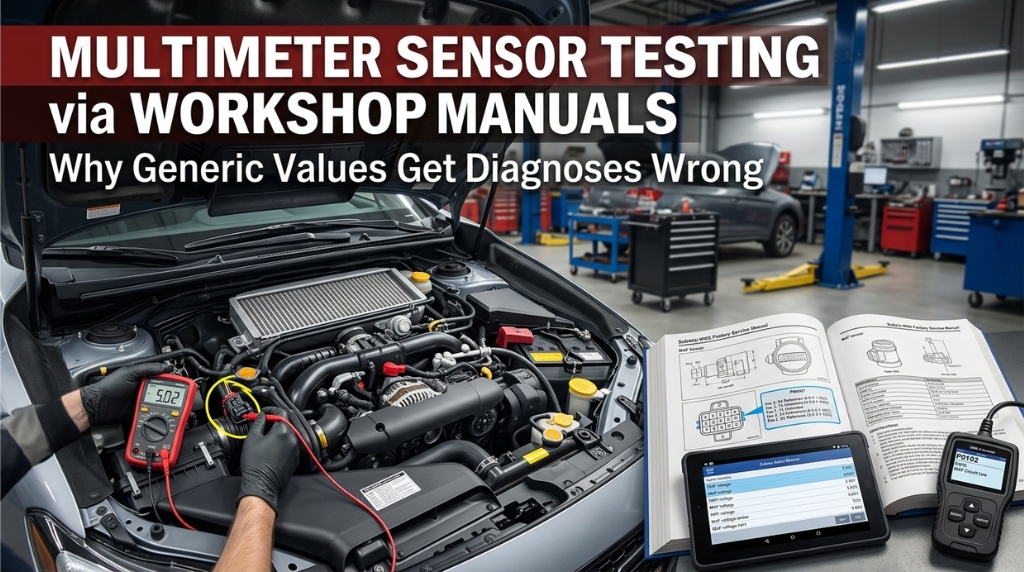
Multimeter Sensor Testing via Workshop Manuals: Why Generic Values Get Diagnoses Wrong

Technician testing engine sensor with multimeter using workshop manual data

Testing sensors with a multimeter without a workshop manual risks using generic values that differ from your ECU’s specific requirements. Since sensor issues cause over 40% of engine fault codes, precise test values are essential.

Always retrieve the DTC and consult the manual for engine-specific data before measuring. Accurate diagnosis depends on manufacturer-specific pinouts and expected electrical signals.

This guide explains how to use multimeter functions for various sensors, interpret workshop manual specs, and avoid common testing errors.

Multimeter Sensor Testing via Workshop Manuals: Why the Spec Table Changes Everything

technician testing sensor with multimeter using workshop manual specs

Generic sensor test values circulate widely online, and most of them are close enough to cause real diagnostic problems. A coolant temperature sensor on a Toyota 2GR-FE engine follows a different resistance curve than the same sensor category on a Honda K-series. Using the wrong curve means a healthy sensor looks out of spec, and a failing one looks fine.

Workshop manuals contain the exact resistance tables, reference voltage ranges, and output signal specifications for every sensor in the vehicle indexed by engine code and model year. Without that document open during multimeter testing, every reading is an educated guess measured against uncertain criteria.

Step 1: Set Up the Multimeter Correctly Before Any Test

The most common cause of inaccurate sensor readings is the wrong multimeter setting — not a faulty sensor. Before touching a connector, confirm the correct test mode and range for the measurement you are about to take.

Multimeter functions used in sensor testing and when to use them:

Function

Symbol

Used For

Caution

DC Voltage

V⎓

Most sensor output signals, reference voltage checks

Never test resistance on a powered circuit

Resistance / Ohms

Ω

Coolant temp sensor, fuel level sender, ignition coil

Ignition must be OFF, component unplugged

Continuity

♐ or speaker icon

Wiring harness, ground paths, fuse integrity

Use with ignition OFF only

AC Voltage

V∼

Crankshaft and camshaft position sensors (magnetic type)

Not used for Hall-effect sensors

Frequency / Hz

Hz

MAF sensors with frequency output, wheel speed sensors

Requires engine running or wheel movement

Consult your workshop manual for the specific measurement type required for each sensor. Digital Hall-effect crank sensors need frequency or DC voltage modes, while magnetic reluctor types require AC voltage. Selecting the incorrect mode can result in a false zero reading, leading to an incorrect open-circuit indication in a functional sensor.

Always verify your multimeter leads are in the correct port before testing. Using the non-fused port for current measurements will blow the meter’s internal fuse and potentially damage the circuit you are testing.

Step 2: Read the Workshop Manual Spec Table for the Target Sensor

technician referencing workshop manual sensor specification table during testing

Before connecting any probe, find the sensor specification table in your workshop manual. These tables appear in the Engine Management, Engine Controls, or Electrical Diagnosis section the exact location varies by manufacturer.

The spec table will show:

  • Test condition: Key-on engine-off (KOEO), key-on engine-running (KOER), or specific temperature/load conditions
  • Connector pin number: Which terminal to probe and which to use as reference
  • Expected value: The actual number your multimeter should display if the sensor is healthy
  • Pass/fail threshold: The acceptable range, not just a single number

Finding the correct factory manual documentation for your VIN is the first step before any sensor work begins. This guide to Find Your Factory Service Manual PDF by VIN shows how to quickly locate the right document.

If you need to evaluate which type of workshop manual provides the most accurate sensor specification tables, a factory service manual versus an aftermarket guide, this practical comparison of OEM vs Aftermarket Manuals for DIY clarifies the accuracy differences relevant to electrical diagnostics.

For the most reliable sources of verified, year-specific factory service documentation, this resource on Where to Download Genuine OEM Workshop Manuals remains the best starting point.

Step 3: Test the Five Core Sensor Types Correctly

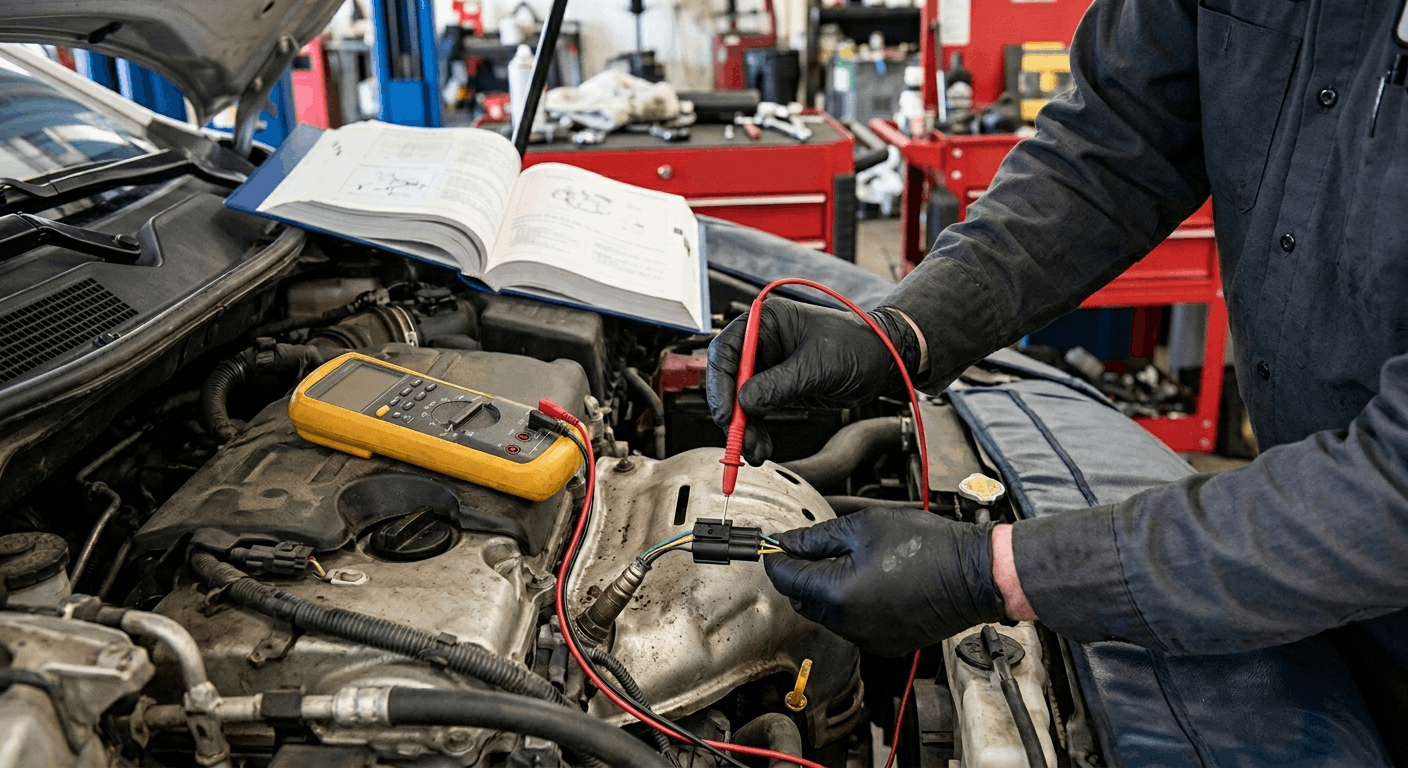
technician testing oxygen sensor with multimeter in engine bay

Each sensor category requires a different multimeter approach and a different section of the workshop manual. Here is how to approach each one using the factory specification as your reference.

Oxygen Sensor (O2)

Set the multimeter to DC voltage, 2V range. Back-probe the signal wire with the engine at operating temperature. A healthy upstream O2 sensor switches between 0.1V (lean) and 0.9V (rich) several times per second. 

A reading that stays near 0.45V indicates a lazy or contaminated sensor that is not responding to changes in the mixture. 

Check the heater circuit resistance with the ignition off. Your workshop manual will specify the expected range, typically 4 to 14 ohms, depending on the manufacturer.

Coolant Temperature Sensor (CTS)

Set the multimeter to resistance (ohms) with the ignition off and the sensor connector unplugged. The CTS is a negative temperature coefficient (NTC) resistor, whose resistance decreases as temperature increases. 

Your workshop manual will include a resistance-temperature table. At 20°C (cold engine), most CTS units read between 2,000 and 3,000 ohms. 

At 80°C (normal operating temp), the reading drops to approximately 200-400 ohms. A reading of OL (open loop) at any temperature indicates an open circuit inside the sensor.

Throttle Position Sensor (TPS)

Set the multimeter to DC voltage with the ignition on and engine off. Back-probe the signal wire and ground pin as specified in the workshop manual

At idle (closed throttle), expect 0.5-1.0V. As the throttle opens, the voltage should climb smoothly to 4.5-4.8V at wide-open throttle. 

Any dropout, jump, or dead spot in the voltage sweep indicates a worn resistive track inside the TPS. The manual will confirm the acceptable sweep range for your specific unit.

Mass Air Flow Sensor (MAF)

There are two MAF types, each requiring different multimeter settings. Voltage-output MAF sensors: set to DC voltage, check the 5V reference supply and the signal output at idle (typically 0.8V to 1.5V, rising under load). 

Frequency-output MAF sensors: set to Hz mode and check for a range of 30 to 150 Hz at idle. Your workshop manual will specify which type your vehicle uses and the exact idle frequency. 

Measuring a frequency sensor in voltage mode produces a false average reading that cannot confirm sensor health.

Crankshaft Position Sensor (CKP)

Magnetic CKP sensors produce an AC sine wave set to AC voltage and check the output while cranking. Your workshop manual will specify the minimum acceptable AC voltage during cranking (typically 0.5V AC or higher). 

Hall-effect CKP sensors produce a digital square wave set to a DC voltage and confirm that the signal switches cleanly between 0V and the reference voltage (5V or 12V, depending on design) during cranking. 

A multimeter alone is limited for CKP diagnosis; an oscilloscope shows the waveform shape more accurately, but the presence or absence can still confirm a dead sensor quickly.

Step 4: Use Back-Probing Correctly — Never Pierce Wires

technician back probing sensor connector using multimeter correctly

The physical technique of connecting the multimeter probe to a live sensor connector matters as much as the test values. Incorrect probing damages connectors, causes intermittent faults, and invalidates test results.

Correct probing technique:

  • Use a back-probe tool, a thin, blunt probe that slides alongside the terminal through the rear of the connector without widening the pin socket
  • Never insert a sharp probe tip directly into the front of the connector terminal, even slight widening reduces contact force and creates an intermittent fault that appears after reassembly
  • Never pierce the wire insulation with a sharp probe. This creates a moisture entry point that corrodes the conductor from the inside, producing a fault weeks after the repair
  • Connect the multimeter black lead to chassis ground or the connector’s dedicated ground pin, as specified in the workshop manual, not to the battery negative, which can introduce minor voltage differences on long harness runs

Your workshop manual will show a connector diagram for each sensor with pin numbers labeled. Match pin numbers in the diagram to physical pin positions in the connector before probing. On multi-pin connectors, a misidentified pin can produce a reading from a completely different circuit.

For vehicle-specific connector diagrams and sensor pin assignments matched to your exact build specification, VIN-Specific Manuals eliminate the risk of using a slightly incorrect variant document.

Step 5: Interpret Readings Against Workshop Manual Pass/Fail Criteria

A reading that falls within a generic online range but outside your workshop manual‘s specified tolerance will still produce a fault code on the next drive cycle. The manual defines what passes and fails — not the internet.

Common misinterpretations and their actual meaning:

  • CTS reads within the generic range, but fault code returns: The factory resistance-temperature curve for your specific engine may have tighter tolerances than generic guides show. Check the manual‘s exact spec table at the actual measured engine temperature
  • O2 sensor reads switching, but lean trim codes persist: Check the workshop manual for switching frequency specification. Some manufacturers specify a minimum switching cycle rate per second. A slow-switching sensor passes a basic voltage test but fails the speed criterion
  • MAF sensor voltage reads 1.2V at idle. Is that correct?: Only the manual can answer this. Idle voltage varies by engine displacement and MAF housing diameter. 1.2V is correct for some applications and low for others
  • TPS sweep looks smooth, but hesitation code remains: Some TPS specifications require the sweep to complete within a specific voltage range at partial throttle. Check the manual for partial-load voltage windows

For those still building their diagnostic reference library and uncertain which type of workshop documentation best matches their repair level and vehicle complexity, this overview of How to Choose the Right Workshop Repair Manual for Your Vehicle provides clear, experience-based guidance.

If free online manual sources are part of your documentation approach for sensor specification data, this practical guide, “Are Free Online Car Repair Manuals Safe,” covers the quality gaps that specifically affect electrical testing accuracy.

Conclusion

Multimeter sensor testing is precise when it is built on precise reference data. The workshop manual provides the test conditions, connector pin assignments, the correct measurement mode, and the exact pass/fail thresholds, none of which are reliably available from generic online sources.

Set the multimeter correctly. Find the spec table first. Test under the conditions specified in the manual. Compare against factory tolerances. That process completes the diagnosis the first time, without unnecessary part replacements or returning fault codes.

Frequently Asked Questions

A basic digital multimeter handles the majority of common sensor tests DC voltage for signal checks, resistance for temperature sensors and coils, and continuity for wiring integrity. An automotive-specific multimeter adds functions such as RPM measurement, duty cycle, pulse width, frequency mode (for MAF and wheel-speed sensor testing), and Min/Max recording. 

For a MAF sensor that outputs a frequency signal rather than a voltage signal, a basic DC-voltage meter will produce an averaged reading that cannot confirm sensor health. If your workshop manual specifies a frequency or duty cycle test for a specific sensor, you need a meter with those functions. 

For most NTC temperature sensors, throttle position sensors, and O2 voltage tests, a basic DMM is entirely sufficient.

The accuracy gap matters most on modern vehicles with model-year variants and trim-specific configurations. Online sensor specifications often are sourced from a generic specification that covers a range of model years or engine displacements. 

Your workshop manual contains the exact resistance-temperature curve, voltage-sweep range, or frequency-output specification for your specific engine code and emissions variant. A CTS resistance value published online for a 2.4L engine may differ from the actual spec for a 2.4L with the California emissions package, which uses a different sensor supplier. 

Using the wrong specification on a P0115 coolant temperature diagnosis can lead to replacing a healthy sensor or missing a fault that sits just outside the generic range.

Back-probing means inserting a thin, blunt instrument, a dedicated back-probe tool, or a very fine-gauge solid wire alongside the connector terminal through the rear of the connector housing, making contact with the terminal without altering its geometry. 

Piercing the wire insulation means pushing a sharp probe tip directly through the insulation to contact the conductor inside. Piercing creates a permanent entry point for moisture and contaminants, which can corrode the conductor internally over weeks or months, generating an intermittent fault that is extremely difficult to locate afterward. 

Back-probing leaves no damage. Every workshop manual describes the correct probing method for harness connector testing. Always use the method specified for each connector type.

Yes, and this is common with dynamically failing sensors rather than statically failing ones. A throttle position sensor may show a clean resistance sweep at room temperature but develop a dead spot under heat from the engine bay. 

An O2 sensor may show correct switching voltage during a static back-probe test but respond too slowly under actual combustion conditions, failing the ECU’s switching frequency criterion. A MAF sensor may read a correct idle voltage but produce an inconsistent frequency output under load, which is revealed only by an oscilloscope or a bidirectional scan tool during a drive cycle. 

The multimeter test confirms the sensor is not completely dead. The workshop manual‘s live data specifications, checked via a scan tool during actual operating conditions, confirm whether the sensor meets dynamic performance criteria.

Yes, always. Most engine sensors operate on a 5V reference supply from the ECU. If the reference voltage is absent, low, or unstable, the sensor output will also be incorrect, and testing the sensor output first gives you a reading that reflects the reference fault, not a sensor fault. 

Connect your multimeter to the reference supply pin at the sensor connector with the ignition on and engine off. Confirm the reference reads 4.9V to 5.1V as specified in the workshop manual

A reading below 4.5V or above 5.5V points to a wiring fault, an ECU output issue, or a shorted reference circuit, not a faulty sensor. Replacing the sensor on a degraded reference supply will not resolve the fault. Test the supply first, every time.

Posted on

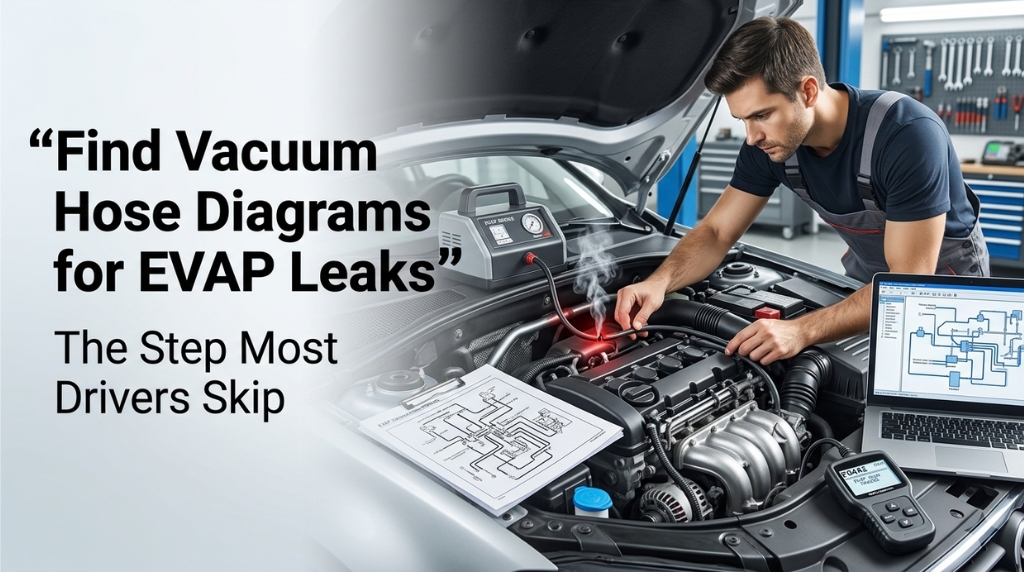
Find Vacuum Hose Diagrams for EVAP Leaks: The Step Most Drivers Skip

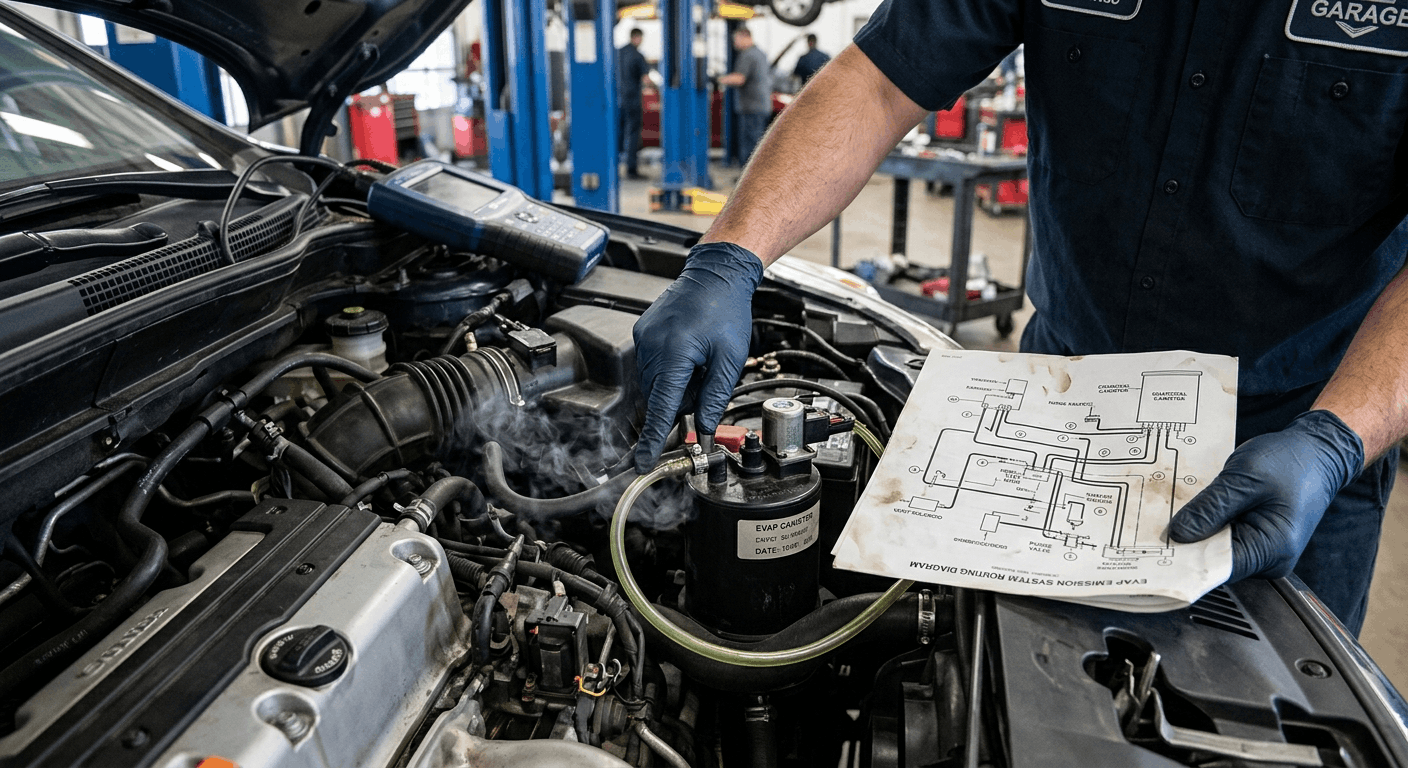
Technician tracing EVAP vacuum hose diagram leak

Chasing EVAP leaks like P0442 or P0455 without a vacuum hose diagram can lead to hours of wasted inspection time. Since codes only indicate a system fault, not a location, a precise map is essential to avoid missing the actual leak.

To locate a leak, trace hoses outward from the charcoal canister using a factory diagram. This maps the circuit from the intake manifold and purge valve to the fuel tank. Focus on likely failure points, such as the purge valve, filler neck, or hoses near the canister.

This guide explains how to find vehicle-specific diagrams, interpret the EVAP layout, and isolate leaks without unnecessary parts replacement.

Find Vacuum Hose Diagrams for EVAP Leaks: Where the Correct Map Changes Everything

Tracing EVAP hose paths without a diagram turns simple emissions repairs into lengthy diagnostic chores. Because manufacturers vary layouts, this network linking the tank, canister, and valves via vacuum lines requires a vehicle-specific map for accuracy.

A factory diagram details exact paths and flow directions. Without it, interpreting a smoke test is difficult; while smoke may be visible, you cannot easily identify which specific circuit is leaking without the routing map.

Step 1: Read the DTC First — It Narrows the Diagram Section

mechanic tracing evap vacuum hoses during diagnosis

Before searching for any diagram, the fault code narrows the search to a specific part of the EVAP system. Knowing which code is active tells you which circuit to focus on in the routing diagram — this saves significant time.

Common EVAP DTCs and what they indicate:

DTC Code

System Fault

Primary Hose Circuit to Check

P0440

EVAP system malfunction

The entire system starts with the canister and purge valve

P0441

Incorrect purge flow

Purge valve, vacuum line, and purge solenoid connector

P0442

Small evaporative leak (0.020″ or less)

Hose joints, clamps, and O-rings throughout the system

P0455

Gross evaporative leak (large)

Gas cap, filler neck, and main canister hose connections

P0446

Vent control circuit

Canister vent valve line and vent solenoid vacuum circuit

Gross leak codes like P0455 highlight major failures in the gas cap, filler neck hose, or canister line. Conversely, P0442 small leaks require precise inspection for hairline cracks or worn O-rings. A factory diagram identifies both large and small circuit paths, directing your initial search.

EPA data shows that 70% of EVAP leaks stem from component deterioration, such as aged rubber hoses and cracked connectors, while 30% stem from external issues, such as faulty gas caps. Diagrams prioritize these common deterioration points for more efficient diagnosis.

Step 2: Locate the Right Vacuum Hose Diagram for Your Vehicle

This is the step most people either skip or approach incorrectly. Using a generic EVAP diagram found online for a similar model year often shows the wrong hose routing — manufacturers change vacuum layouts between trims, engine variants, and production years without changing the body style.

Three places to find the correct vehicle-specific EVAP vacuum diagram:

Under-hood emissions label: Most vehicles manufactured after 1980 include a vacuum routing sticker affixed to the radiator support, underside of the hood, or fan shroud. This label is year-, engine-, and emissions-package-specific. 

It shows the complete EVAP and engine vacuum routing for that exact build. If the label is intact, it is the fastest reference available because it reflects what was physically installed at the factory.

Factory service manual: The full factory service manual contains the most detailed vacuum hose diagrams for every subsystem. For EVAP systems, this typically appears in the Emissions or Engine Controls section and includes component locations, hose diameters, routing paths, and solenoid positions. 

Factory diagrams differentiate between standard and California-emissions variants, which often have different canister sizes and additional hose connections.

OEM-level repair database: Manufacturer-authorized repair databases such as ALLDATA and Mitchell ProDemand contain the same factory diagrams used by dealership technicians. These are searchable by VIN, which eliminates the risk of using a slightly incorrect variant.

For guidance on where to download verified, year-specific factory service documentation for your vehicle before starting any EVAP leak diagnosis, this resource, “Where to Download Genuine OEM Workshop Manuals,” is a practical starting point.

Step 3: Read the EVAP Diagram — Trace Every Hose in Sequence

technician tracing evap vacuum hoses using diagram

A vacuum hose diagram for an EVAP system shows several distinct circuits running between five core components. Understanding the function of each circuit helps you trace leaks logically rather than randomly.

The five core EVAP components are shown in factory diagrams:

  • Fuel tank: The origin of fuel vapor — the diagram shows vent lines from the tank to the charcoal canister and the rollover valve position
  • Charcoal canister: The carbon storage unit that absorbs fuel vapor — the diagram shows the vent line in, the purge line out, and the vent valve connection at the base
  • Purge valve solenoid: The ECU-controlled valve that allows stored vapors to enter the intake under specific conditions — the diagram shows two hose connections: one to the canister and one to the intake manifold
  • Vent valve: Controls atmospheric pressure entry into the canister — the diagram shows its position near the canister and the vent hose routing
  • Intake manifold connection: The endpoint for purged vapors — the diagram shows where the purge hose connects to the intake, either upstream or downstream of the throttle body

When tracing the diagram against the physical vehicle, start at the charcoal canister and work outward in both directions toward the fuel tank and toward the purge valve. This systematic approach ensures no branch hose is missed.

The EVAP hose diagram also indicates hose diameter at each connection point. Using an incorrect-diameter replacement hose on any fitting results in either a restriction or a loose connection, both of which cause leak codes after repair. The diagram eliminates that guesswork entirely.

For technicians deciding between full factory service manuals and aftermarket guides for this type of emissions work, the practical trade-offs are worth understanding before committing to a documentation source: When to Upgrade to a Factory Service Manual.

Step 4: Use the Diagram with a Smoke Test for Precise Leak Location

A vacuum hose diagram and a smoke test are the two most reliable tools for locating EVAP leaks. Each one complements the other. The diagram tells you the circuit layout, and the smoke reveals exactly where the breach is.

Smoke test procedure using the diagram:

  1. Close the EVAP vent valve using a bidirectional scan tool (Mode $08 data) — this seals the system so smoke pressure is contained
  2. Connect the smoke machine to the EVAP test port or the fuel filler neck, following the connection point shown in your factory diagram
  3. Introduce smoke at low pressure — EVAP systems are fragile, and over-pressurization can damage vent valves or canister seals
  4. Hold your vacuum hose diagram and trace each line in the system visually while smoke is present
  5. Watch for smoke escaping at hose joints, solenoid connections, canister seams, and the filler neck — any exit point indicates a leak in that location
  6. Note the position on the diagram — this confirms which circuit the leak belongs to and which replacement part or section of hose is required

Without the diagram during a smoke test, escaping smoke reveals a location but not a circuit. With the diagram, you immediately know which component is upstream of the leak and which line needs to be replaced.

For situations where the EVAP fault appears alongside other warning lights, and you are uncertain whether the check engine light relates to the emissions system or to body electronics, this guide on SRS Airbag Light Reset Steps via OEM Manuals can help cleanly separate those diagnoses.

Step 5: Inspect and Repair Using the Diagram as a Reference Map

mechanic inspecting evap hoses with routing diagram

With the leak location confirmed via smoke and mapped against the diagram, physical inspection follows a direct path. The diagram tells you the hose specification, the fitting type at each end, and whether a clamp or a press-fit connector holds the joint.

Physical inspection checklist for EVAP hose leaks:

  • Rubber vacuum hoses: Look for cracks, splits, or brittleness at the ends where the hose meets the fitting. Aged rubber develops surface cracking that opens under vacuum pressure during system testing, but may look intact under static inspection
  • Plastic connectors and quick-connect fittings: Press-fit connectors crack at the locking tabs over time. The diagram shows every connector location. Check each one by pressing inward and pulling gently to confirm the lock is intact
  • O-rings at solenoid ports: Purge valve and vent valve solenoids use O-ring seals at their port connections. These harden and crack with age and produce small leaks that pass visual inspection but fail the smoke test
  • Canister body seams: Charcoal canisters on high-mileage vehicles can develop hairline cracks at the seam between the upper and lower housing, visible under smoke but not under visual inspection alone
  • Gas cap and filler neck: A P0455 gross leak code should prompt an inspection of the gas cap seal first. Press the cap firmly, listen for the click, and verify the seal ring is intact and undeformed

The distinction between a factory diagram and an aftermarket guide becomes critical during this inspection phase. Aftermarket manuals sometimes show generalized EVAP layouts that omit California-spec components, regional variants, or mid-production changes. This comparison of Digital Car Manuals vs. Mechanic Advice covers when factory-level documentation is the necessary standard for emissions-related repairs.

For those still evaluating which type of workshop documentation best suits their repair level, this overview of How to Choose the Right Workshop Repair Manual for Your Vehicle provides clear guidance before the next job starts.

Conclusion

EVAP leaks are fixable, but only when you use the correct vacuum hose diagram for your specific vehicle. The DTC code narrows the circuit. The factory diagram maps the exact path. The smoke test reveals the breach. And the physical inspection confirms the component.

Skip any one of those steps, and the repair becomes a series of educated guesses. Use all four together, and the job finishes the first time, with no repeated codes and no unnecessary parts replaced.

Frequently Asked Questions

Yes, and it is the most common cause of a gross EVAP leak code. The gas cap is part of the sealed EVAP system. When the PCM runs a leak detection test, it pressurizes or applies a vacuum to the entire system, including the fuel tank and filler neck. 

A gas cap with a degraded seal ring, an incorrect part number, or an improper seating allows that pressure to escape immediately, which the system interprets as a gross leak

Replacing the cap with a correct OEM-spec unit and clearing the code is always the first step before any further EVAP diagnosis on a P0455. If the code returns after 2 to 3 drive cycles with the new cap, a physical hose or component leak exists in the system.

A P0455 gross leak is typically large enough to be detected by visual inspection or a basic smoke test, a disconnected hose, a missing gas cap, or a cracked canister with an obvious opening. A P0442 small leak is a breach of 0.020 inches or less and requires a calibrated smoke machine at the correct low pressure to reveal. 

The location also differs statistically: P0455 codes most often trace to the gas cap, filler neck, or main canister hose connections. P0442 codes more commonly trace to aging O-rings, micro-cracks in smaller vacuum lines, or hairline cracks at plastic connector locking tabs. 

Your factory vacuum hose diagram is essential for P0442 diagnosis, specifically, because the potential leak points are distributed throughout the system.

Yes, often significantly. California emissions regulations require enhanced EVAP systems that include additional vapor recovery components, larger charcoal canisters, and, in some cases, a second vent valve or a separate leak detection pump assembly. 

These differences change the vacuum hose routing shown in the diagram, the number of connection points, and the number of solenoids the PCM monitors. Using a standard-emissions EVAP diagram on a California-spec vehicle or vice versa will show the wrong hose routing for several circuits and lead to incorrect inspection conclusions. 

Always confirm your vehicle’s emissions package specification before selecting the diagram to use. The VIN can confirm the build specification, and the factory documentation database search by VIN returns the correct variant.

A hand vacuum pump is useful for testing individual EVAP valves, specifically the purge valve and vent valve, to confirm they hold pressure and open/close correctly. When the engine is off, the purge valve should hold vacuum (in the closed position). 

When applied to the vent valve, it should hold a vacuum only when the PCM commands the valve closed. What a hand vacuum pump cannot do is pressurize the entire EVAP system to locate a hose leak, as a smoke machine does. 

It can help isolate a faulty valve, but finding a cracked hose or deteriorated O-ring in the system circuit requires either smoke testing or a very methodical visual inspection with the vacuum hose diagram as your guide.

A purge valve replacement resolves a P0441 (incorrect purge flow) or a purge valve electrical circuit code. If the EVAP leak code returns after the purge valve is replaced, the original leak was in a different part of the system. 

This is one of the most common post-repair comebacks in EVAP diagnosis, a part is replaced based on its association with the code rather than confirmed testing of that specific component. The purge valve is only one of several vacuum connections in the EVAP circuit. 

Returning codes after a valve replacement almost always mean the leak is elsewhere in the hose routing, specifically at aged rubber lines, cracked plastic fittings, or a compromised canister. Using the factory vacuum hose diagram to trace every connection in the circuit is the step that prevents this outcome.

Posted on

TPMS Sensor Relearn Steps from OEM Manuals: The Reason Your Light Stays On

Technician performing TPMS sensor relearn procedure

Neglecting the TPMS relearn steps in OEM manuals after a tire rotation or sensor replacement often leaves the warning light active. Using the wrong procedure for your vehicle is a common error in professional shops and DIY settings alike.

To reset the light, identify if your vehicle uses a stationary, OBD, or automatic relearn, then follow the OEM manual precisely. Methods are specific to make and model.

This guide details the three TPMS relearn types, provides instructions for finding them in your OEM manual, and explains how to troubleshoot sensor ID confirmation failures.

TPMS Sensor Relearn Steps from OEM Manuals: Why Manufacturer Procedure Matters

technician performing tpms sensor procedure

Standard TPMS guides often fail because each manufacturer uses a unique ECU architecture. Only the OEM service manual provides the exact relearn procedure required for your vehicle.

AMRA data shows that 38% of vehicles use automatic, 35% stationary, and 27% OBD relearns. Using the incorrect method causes the ECU to ignore or misstore sensor IDs, leading to persistent fault codes.

Consulting the OEM manual to identify and follow the specific relearn type is essential for a successful, efficient repair.

Step 1: Determine Your TPMS Relearn Type Before Starting

The single most critical step happens before any tool touches the vehicle. Your OEM service manual will specify the exact relearn type under the Tire Pressure Monitoring System section, typically in the Chassis or Body Electrical chapter, depending on the manufacturer.

The three relearn types and what defines them:

Relearn Type

Tool Required

Drive Required

Common Vehicle Brands

Automatic

Optional TPMS tool to trigger

Yes — specific speed/duration

Dodge, Chrysler (pre-2012), and some GM

Stationary

TPMS activation tool + sometimes OBD connection

No

GM, Ford, and some Nissan

OBD

TPMS scan tool with OBD connection required

Sometimes post-relearn

Toyota, Honda, Subaru, Jaguar, Land Rover

If an OEM manual is unavailable, owner’s manuals often detail automatic and stationary relearn procedures. However, OBD relearners require a factory service manual for specific scan tool commands.

For universal TPMS sensors, you must program the sensor to the vehicle’s specifications and then perform the vehicle relearn; both steps are essential to extinguish the light.

If you need to locate the correct factory documentation before proceeding, this guide, “Where to Download Genuine OEM Workshop Manuals,” covers the most reliable sources currently available for year-specific service documentation.

Step 2: Execute the Stationary Relearn — No Drive Needed

technician triggering tpms sensor during relearn

The stationary relearn is the most common procedure for GM and Ford vehicles. It transfers new sensor IDs to the vehicle’s ECU while parked, using a TPMS activation tool to trigger each sensor in a manufacturer-specified sequence.

Standard stationary relearn sequence (general format — always confirm against your OEM manual):

  1. Inflate all four tires to the pressure listed on the door placard — not the tire sidewall
  2. Turn the ignition to the ON position without starting the engine
  3. Enter relearn mode using the vehicle’s DIC menu, trip odometer stem, or brake pedal sequence as specified in the OEM manual — the horn will chirp once, or the TPMS light will blink to confirm learn mode is active
  4. Starting with the left front wheel, hold the TPMS activation tool against the sidewall near the valve stem and trigger the sensor — the horn chirps once to confirm ID receipt
  5. Move clockwise: right front, then right rear, then left rear — trigger each sensor in sequence, waiting for the horn confirmation between each
  6. After the left rear sensor is confirmed, the horn will chirp twice — this signals that all four IDs have been successfully relearned
  7. Turn the ignition off to exit learn mode

Common failure points: missing the correct DIC menu path, using the wrong ignition sequence, or triggering sensors out of the clockwise order. Your OEM manual will specify the exact entry sequence for your model on GM push-button start vehicles, the procedure differs from the key-start version.

Step 3: Execute the OBD Relearn for Asian and European Vehicles

technician writing tpms sensor ids via obd

The OBD relearn is the standard for most Toyota, Honda, Subaru, Lexus, Jaguar, and Land Rover models. It uses a TPMS scan tool connected to the OBD port to write new sensor IDs directly to the ECU. The ECU does not automatically pick up these IDs.

OBD relearn sequence:

  1. Inflate all tires to door placard specification
  2. Trigger each TPMS sensor using the activation tool — record that each sensor responds. Any non-responding sensor must be addressed before proceeding
  3. Connect the TPMS scan tool to the vehicle’s OBD port under the dashboard
  4. Navigate to the TPMS or Tire Pressure section in the scan tool menu
  5. Select “Relearn” or “Write Sensor IDs to ECU” — the scan tool transfers the triggered sensor IDs to the vehicle’s ECU directly
  6. Confirm on the scan tool that all four sensor IDs were accepted
  7. Turn the ignition off, disconnect the OBD tool
  8. Some vehicles — notably Subaru and certain Toyota models — require a post-OBD drive of 10 to 20 minutes at 15 mph or higher before the TPMS light clears. Your OEM manual will specify if this drive cycle is needed

The choice between OEM and aftermarket TPMS sensors is critical during OBD relearns. Aftermarket units require precise MMY programming before triggering to ensure the ECU accepts the ID write. For a deeper look at compatibility, see this comparison of OEM vs Aftermarket Manuals: Best for DIY.

Step 4: Execute the Automatic Relearn — Drive-Based Confirmation

mechanic checking tire pressure before tpms drive

The automatic relearn requires no specialized tool for the relearn itself, but a TPMS tool is recommended to verify each sensor is transmitting before starting the drive. A sensor that appears to function at the start of a rotation may have a low battery or a damaged antenna — only a trigger test can confirm this.

Automatic relearn process:

  1. Verify all tires are inflated to the placard pressure
  2. Optionally trigger each sensor with a TPMS tool to confirm all four are transmitting before the drive
  3. Drive the vehicle at a sustained speed above 15 mph — most automatic relearn procedures require 10 to 20 minutes of uninterrupted driving at speeds between 20 and 60 mph
  4. Avoid stop-and-go traffic during this drive — the ECU needs continuous sensor transmissions at wheel speed to map and confirm each position
  5. The TPMS warning light will extinguish during or shortly after the drive when the ECU has confirmed all four sensor IDs and positions

Automatic relearn vehicles include most pre-2012 Chrysler and Dodge models, some Ford variants, and select GM trucks. Your OEM manual will state the exact minimum speed and duration for your specific model. A 2008 Dodge Charger, for example, specifies a minimum drive of 10 minutes at 15 mph or higher, with no stops exceeding 3 minutes.

For vehicles where the decision between full factory service documentation and aftermarket guides directly affects repair outcomes, this breakdown of Digital Car Manuals vs. Mechanic Advice covers the practical differences.

Step 5: Troubleshoot a Relearn That Won’t Confirm

Even with the correct procedure, some TPMS relearners fail to complete. The most common causes are interference, incorrect sequence, or a faulty sensor, and each has a different resolution.

Troubleshooting checklist when the relearn won’t confirm:

  • Horn doesn’t chirp during stationary relearn: Lower all windows, open doors, and turn off the radio — RF interference from electronics can block the 315 MHz or 433 MHz signal between the TPMS tool and the ECU
  • OBD relearn shows sensor ID write failed: Confirm the sensor was triggered after the OBD connection was established, not before — some ECUs only accept IDs that are written in the same session as the trigger
  • Automatic relearn light stays on after 20-minute drive: Check if any sensor battery is below threshold using a TPMS scan tool — a low-battery sensor transmits intermittently and may not complete enough cycles for ECU confirmation
  • Relearn completes but light returns within one drive: The OEM manual may specify a post-relearn initialization drive that was skipped — some Toyota and Honda models require the TPMS monitor to complete a full drive cycle before clearing permanently

For those building a reliable workshop documentation library specifically for safety and monitoring system service, this practical overview of How to Choose the Right Workshop Repair Manual for Your Vehicle is worth reviewing before starting the next job.

If a TPMS relearn failure is appearing alongside other warning lights, including SRS system alerts it is worth checking whether both systems share a BCM or body electronics fault. This guide on SRS Airbag Light Reset Steps via OEM Manuals covers the OEM-documented reset procedure for related body system faults.

Conclusion

TPMS sensor relearn is a manufacturer-specific process, and the OEM manual is the only document that contains the exact procedure for your vehicle. Identifying the correct relearn type first, following each step in the specified sequence, and verifying post-relearn with a scan tool that processes resolves the vast majority of persistent TPMS warning lights without replacing any additional hardware.

Get the type right. Follow the sequence. Confirm the result. That’s the complete job.

Frequently Asked Questions

It depends on the vehicle. For vehicles using a stationary or OBD relearn, rotating tires changes the physical position of each sensor ID relative to the wheel position the ECU has stored. 

If the ECU monitors position-specific data, which most direct TPMS systems do, a rotation without relearn causes the system to report incorrect wheel positions when a low-pressure alert occurs. 

Some automatic-relearn vehicles self-correct during the next extended drive, but stationary and OBD systems require a deliberate relearn after each rotation. Your OEM manual will specify whether a rotation triggers a relearn requirement for your specific system.

A blinking TPMS light for approximately 60 to 90 seconds, followed by a steady-on condition, is a specific diagnostic signal. The blinking indicates the TPMS system performed a self-test and detected a fault, usually a sensor that did not respond, a sensor with a critically low battery, or a system module fault. 

The steady light after the blink sequence means the fault has been logged and is active. This behavior is distinct from a steady-on light that appears after a low-pressure alert, which simply means tire pressure is below the 25% threshold. 

A blinking-then-steady pattern always warrants a TPMS scan tool read before proceeding with any relearn attempt.

Yes, and this is one of the most common reasons a relearn procedure fails to produce the confirming horn chirp during a stationary relearn or fails to write the sensor ID during an OBD relearn

The TPMS sensor battery has an average service life of 5 to 10 years, depending on the transmission frequency and ambient temperatures. A sensor with a battery below the operating threshold transmits intermittently or not at all when triggered by the activation tool. A TPMS scan tool will display the battery status for each sensor, typically shown as “Low,” “OK,” or a voltage percentage. 

Any sensor showing a low battery should be replaced before attempting the relearn procedure, as the ECU will not accept intermittent IDs into memory.

Mixing OEM and aftermarket sensors on the same vehicle is technically possible in most cases, but it introduces compatibility risk depending on the relearn type. For automatic relearn vehicles, the ECU simply reads the transmitted frequency. Aftermarket sensors operating on the correct frequency will be accepted. 

For OBD relearn vehicles, the ECU writes the specific sensor ID to its memory. Aftermarket sensors must be pre-programmed to the correct vehicle MMY before triggering, or the ID format will not match the ECU’s expectations. 

Most reputable aftermarket TPMS sensor manufacturers support programming to OEM ID formats, but the programming step must be completed before installation, not after.

Yes, without exception. The BCM (Body Control Module) or dedicated TPMS module stores the unique ID number and wheel position for every sensor fitted to the vehicle. When the module is replaced, the stored data is lost entirely. 

The replacement module starts with no sensor IDs registered, meaning the TPMS warning light will illuminate immediately after the module is installed. A full relearn using the procedure from the OEM service manual is required to register all four sensor IDs to the new module. 

On GM vehicles, this is particularly important because the BCM communicates with the sensors via the keyless entry receiver, so a BCM replacement may also require key fob reprogramming as part of the same service visit.

Posted on

Spark Plug Gap Specs & Engine Code Charts: What Most Mechanics Get Wrong

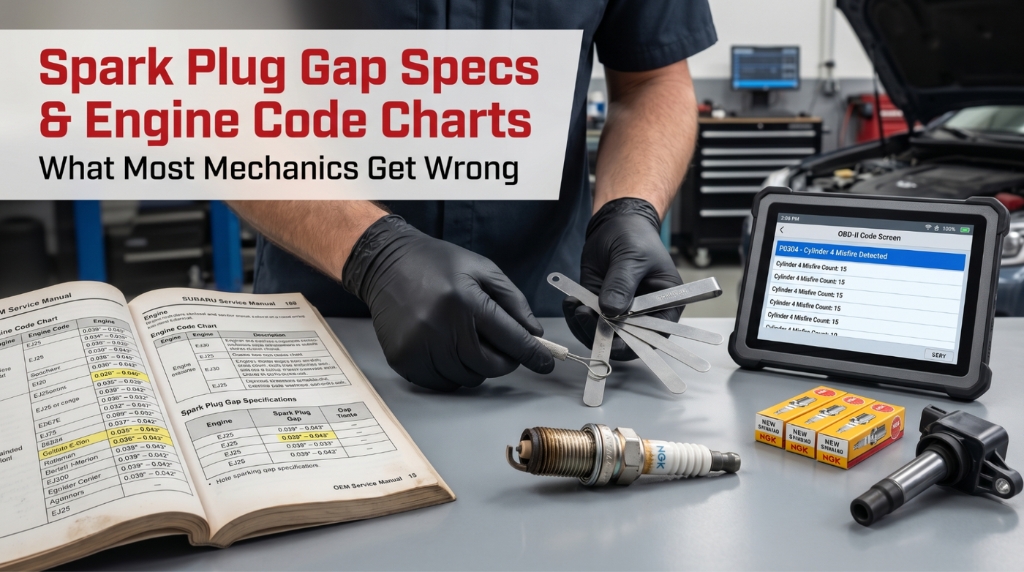
Technician measuring spark plug gap using OEM engine code chart

Using the wrong spark plug gap specs for your engine code can trigger misfires, fail emissions tests, and quietly erode power output. A gap error as small as 0.010 inches can destabilize combustion across every cycle.

Prevent issues by matching the gap to your vehicle’s specific factory engine code chart. Gaps typically range from 0.024″ to 0.060″ (0.6–1.5 mm). High-performance or forced-induction engines usually require tighter gaps (0.016″–0.032″) to avoid blowout. Always prioritize OEM manual or emissions label specs over generic data.

This article covers how to read engine code charts, apply precise gap specs, decode related OBD fault codes, and choose the right data source every time.

Spark Plug Gap Specs & Engine Code Charts: The Data You Need

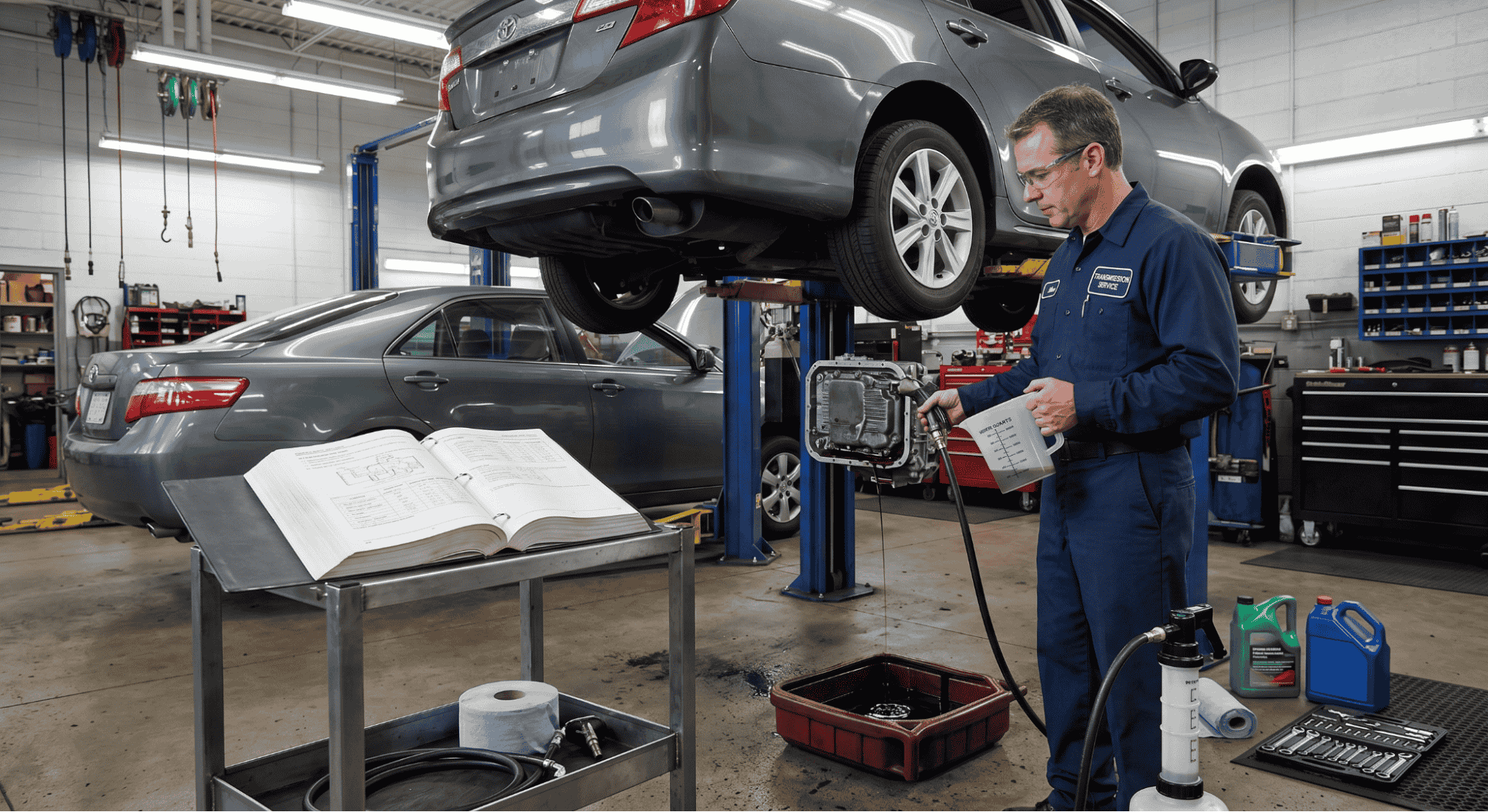
technician comparing transmission fluid capacity during service using factory manual

Every engine code carries a unique ignition tolerance. The factory charts exist to capture those tolerances with precision. Understanding how to read, apply, and cross-reference them with OBD data is the foundation of a proper spark plug installation.

Why Engine Code Decides Your Gap Spec

Every engine code corresponds to a specific compression ratio, fuel type, and ignition design. These variables set the upper and lower bounds for a functional spark plug gap.

A turbocharged engine running high boost pressure demands a tighter gap, typically 0.024 to 0.028 inches, to prevent spark blowout under load. Naturally aspirated engines run wider, often 0.040 to 0.060 inches, for stronger flame kernel ignition.

Key factors that define a gap spec by engine code:

  •       Compression ratio — higher compression needs a tighter gap
  •       Ignition system type — coil-on-plug vs. distributor-based setups
  •       Fuel type — gasoline, E85, and flex-fuel each affect combustion timing
  •       Forced induction — turbocharged and supercharged engines require tighter tolerances
  •       Engine management generation — OBD-I vs. OBD-II systems fire differently

Common Spark Plug Gap Specs by Engine Code:

Engine Type

Engine Code

Gap (inches)

Ignition System

Naturally Aspirated 4-Cyl

2ZR-FE

0.043

Coil-on-Plug

Turbocharged 4-Cyl

EJ255

0.028

Distributorless

V6 Naturally Aspirated

VQ35DE

0.044

Coil-on-Plug

V8 Performance

LS3

0.040

Coil-on-Plug

High-Compression NA

B18C1

0.028

Distributor

Flex-Fuel 4-Cyl

LUK

0.040

Coil-on-Plug

Note: Always verify against your OEM factory documentation. Values above are general references.

Reading Spark Plug Gap Charts Without Confusion

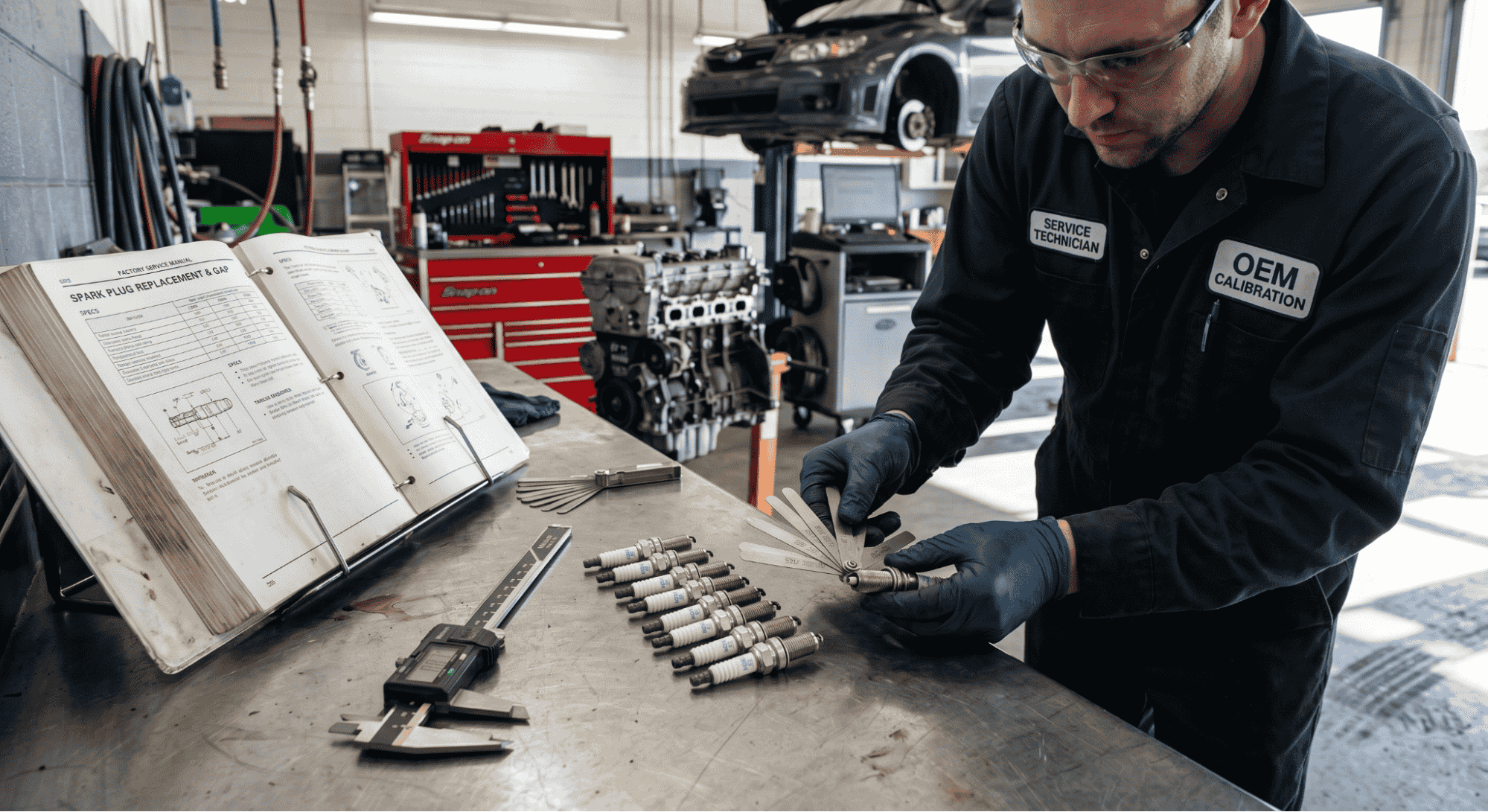
technician measuring spark plug gap using feeler gauge and factory manual

Gap charts from factory manuals list multiple values across trim levels and model years. Aftermarket plug boxes often display a generic “recommended” range, not your specific engine code spec.

The most reliable source is always the OEM factory service manual. If you need help locating the right document for your vehicle,

If you need the right documentation for your vehicle, Find Your Factory Service Manual PDF by VIN provides a straightforward way to source accurate OEM files.

How to read a gap chart correctly:

  1.   Locate your engine code. It’s usually stamped on the block or the emissions label under the hood
  2.   Cross-reference the code against the manufacturer’s official gap table
  3.   Confirm which ignition system column applies to your setup
  4.   Check the model year, mid-cycle production revisions sometimes alter gap specs
  5.   Note that the electrode material, iridium and platinum plugs, may have narrower recommended ranges

How to Gap a Spark Plug to Exact Spec

technician precisely adjusting spark plug gap with feeler gauge

Gapping a plug correctly is a hands-on skill, not just a number lookup. On modern engines with iridium- or platinum-tipped electrodes, aggressive bending can crack the fine-wire tip.

Use a quality feeler gauge set and work slowly. Coin-type gappers create uneven pressure and often leave the gap slightly off from where you intended.

Step-by-step gapping process:

  1.   Check the manufacturer’s spec first before removing the plug from the packaging
  2.   Use a blade-style feeler gauge, not a coin gapper, for accuracy to 0.001 inches
  3.   Slide the gauge through the gap until you feel light, consistent resistance
  4.   Adjust by bending only the ground electrode never apply force to the center electrode
  5. Re-check the gap after adjustment, as bending can shift the measurement slightly
  6. Cross-reference with the engine code chart one final time before installation

Engine Code Charts and OBD Misfire Codes: The Link

There is a direct relationship between gap spec errors and engine fault codes. A gap that’s too wide forces the ignition coil to produce excess voltage to bridge it.

Under high-RPM or heavy-load conditions, that coil voltage ceiling gets hit, and the spark fails. The result is a misfire code on the OBD scanner that appears to indicate a coil or injector problem.

Gap errors commonly trigger these OBD codes:

OBD Code

Description

Common Cause

P0300

Random/Multiple Cylinder Misfire

Gap too wide or too narrow

P0301-P0308

Cylinder-Specific Misfire

Incorrect gap for engine code

P0316

Misfire on Engine Startup

Cold-start gap failure

P0171

System Too Lean (Bank 1)

Incomplete combustion from a weak spark

P0172

System Too Rich (Bank 1)

Erratic combustion, unburned fuel

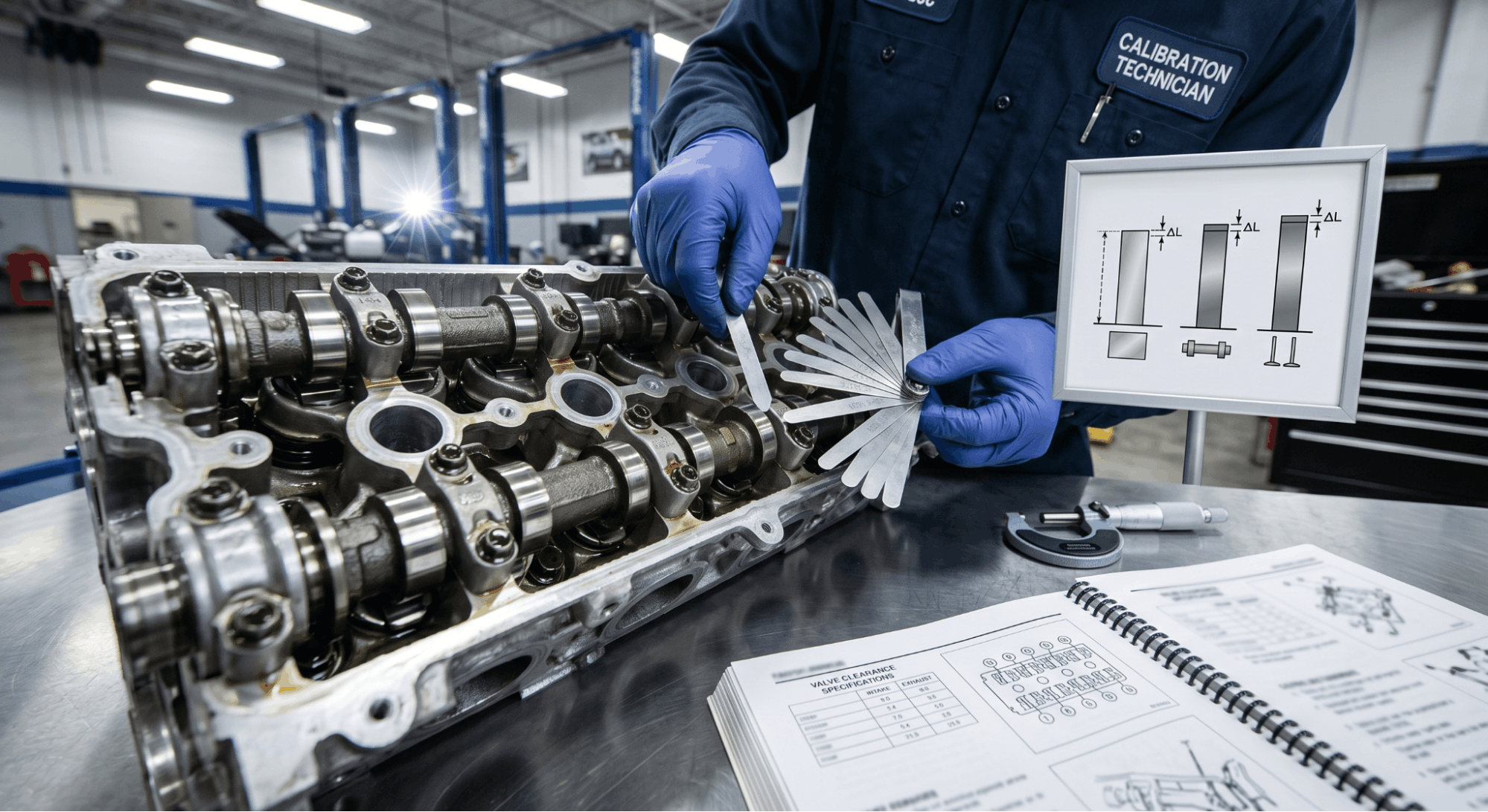
For engines with tight valve tolerances, combining this check with a review of Valve Clearance Tolerances in Factory Manuals can help isolate whether the misfire is ignition- or mechanical-related.

OEM vs. Aftermarket Gap Specs: Which Source Wins

Aftermarket plug makers like NGK, Denso, and Champion sometimes suggest gap specs that differ from factory values. These differences exist because their electrode materials may perform optimally at a slightly different gap.

For any unmodified engine, the OEM factory value takes precedence. Aftermarket gaps are calibrated for a broad vehicle population, not your exact engine code.

Spec Source

Gap Range

Reliability

OEM Factory Manual

Exact by engine code

Highest

Aftermarket Plug Box

Generic range

Moderate

Online Forums

Community estimates

Low

Tuner Recommendations

Modified engine only

Application-Specific

For accurate OEM documentation, Where to Download Genuine OEM Workshop Manuals is the most reliable starting point for sourcing the correct files.

Cylinder Head Torque and Plug Spec: Why Both Matter

Installing a plug to the correct gap spec but with the wrong torque compromises the seal between the plug and the cylinder head. That leak alters combustion pressure, skewing your entire performance baseline.

Thread size, plug reach, and seat design all affect the torque requirement. These values are listed in the same factory documentation as your gap specs never guess at them.

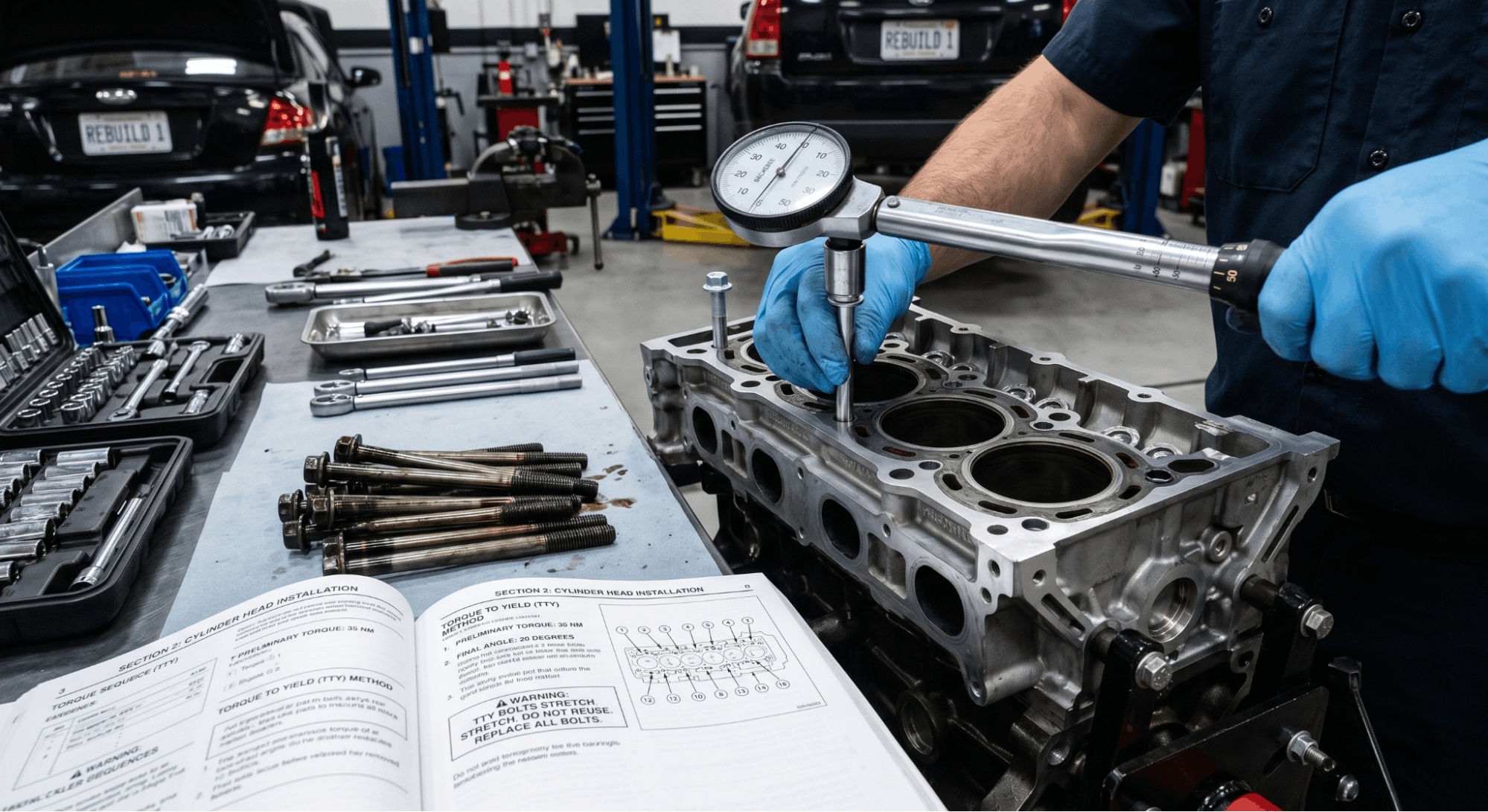
For a detailed breakdown of how torque sequencing affects engine sealing, Finding Engine Torque Specs for Cylinder Heads covers the factory torque logic in precise detail.

Typical spark plug torque specs by thread size:

Thread Size

Torque (ft-lbs)

Seat Type

10mm

7 – 11

Gasket

12mm

11 – 15

Taper

14mm

18 – 26

Gasket

18mm

25 – 30

Gasket

Final Takeaway: Match the Gap, Trust the Chart

Getting your spark plug gap specs right is a matter of matching your engine code to verified factory charts, then executing with precision.

Every misfire code, rough idle, and failed emissions test has a root cause. An incorrect plug gap is one of the most common and most overlooked sources of all three.

Use OEM documentation, verify your specific engine code, and double-check every gap with a calibrated feeler gauge. That’s how experienced mechanics work — and it’s the standard you should hold yourself to.

Frequently Asked Questions

No, and this mistake is more common than most mechanics admit. Even within the same model line, different engine codes, such as a base 2.0L vs. a performance 2.0T, carry different compression ratios and ignition systems.

Each of those variables directly affects the ideal spark plug gap. Using a single gap value across multiple codes can cause misfires, a rough idle, and increased fuel consumption. Always verify the gap spec individually for each engine code, even if the plugs are physically identical between trims.

The factory chart is the only source that accounts for all build-specific variables. Internet forums and generic charts are not a substitute for the OEM value.

Yes, it does, and the effect is larger than most drivers realize. A plug gapped too wide struggles to fire consistently under load, causing incomplete combustion. That unburned fuel exits through the exhaust, lowering efficiency and increasing emissions.

A gap that’s too tight produces a weak spark that fails to ignite the full air-fuel charge. Studies on combustion efficiency suggest incorrect plug gaps can reduce fuel economy by 4 to 10 percent, depending on the engine type and load conditions.

Matching the gap to the manufacturer’s engine code spec is one of the lowest-cost ways to restore efficiency. No part replacements, no labor-heavy repairs, just precision measurement.

Most factory schedules recommend inspecting the plug gap at every tune-up interval, typically 30,000 to 60,000 miles for copper plugs. Iridium and platinum types generally run 60,000 to 100,000 miles between inspections.

High-performance engines running boost, aggressive timing, or flex-fuel blends experience faster electrode wear. For those setups, gap checks every 15,000 to 20,000 miles are more appropriate. The engine code chart in the factory service manual usually specifies the inspection interval alongside the gap value.

Never assume a plug is within spec just because it hasn’t hit its replacement mileage. Electrode wear doesn’t follow a linear schedule heat cycles, oil quality, and fuel type all accelerate it.

On a stock engine, widening the gap beyond the factory spec usually hurts performance, not helps it. The reasoning is that a wider gap demands more coil voltage to bridge it.

Stock ignition systems are calibrated to deliver a specific voltage range. Exceeding that ceiling causes misfires under high-RPM or high-load conditions exactly when you need power most. Aftermarket ignition coils and CDI units can sometimes support wider gaps, but only with matching supporting modifications.

Tuned engines are a different conversation, but even then, any gap change should follow the tuner’s tested spec, not general internet advice. Chasing power through gap widening on an unmodified engine is a net loss almost every time.

Traditional feeler gauge sets are still the industry standard for plug gapping. A quality stainless steel feeler set gives accurate readings down to 0.001 inches, sufficient for even tight-tolerance engine codes.

Digital gauges exist, but they vary significantly in quality and can misread the curved gap profile of a spark plug electrode. For professional and DIY mechanics alike, a premium blade-type feeler gauge set, used with a consistent pressure technique, remains more reliable.

The key technique is to check the gap at two or three positions across the electrode, not just at the center point. Electrode wear is rarely uniform, and a single measurement can miss a low spot that affects spark performance under load.

Posted on

Transmission Fluid Capacities by the Manual: What Most Drivers Get Dangerously Wrong

Technician filling transmission fluid using OEM capacity specifications from service manual

Using the wrong transmission fluid capacities from a generic chart instead of your manual is silently destroying gearboxes across the country. The damage often begins before a single warning light appears. Most owners have no idea it’s happening.

Precise capacity specs are vital to avoid costly errors caused by confusion between dry and wet fill levels. Manual gearboxes typically hold 2–6 quarts (1.9–5.7 liters) for cars and up to 9 quarts for trucks, often filled to the plug hole. Always consult your manual for exact fluid requirements.

This article explains how to read capacities correctly, what the tables in your manual actually mean, and where most service mistakes begin.

Transmission Fluid Capacities by the Manual: The Numbers That Actually Matter

technician measuring valve clearance while referencing factory engine specs

Each vehicle requires a specific fluid volume set by its factory manual. These calculated tolerances protect internal components, such as valve bodies and gear sets, from unintended stress.

Experts stress that the manual is irreplaceable because a single platform can have multiple transmission variants with unique fill volumes. Correct service begins with understanding how these capacities are documented.

Why Factory Specs Beat Guesswork Every Time

technician comparing transmission fluid capacity during service using factory manual

Many owners rely on forum posts or shop estimates when adding transmission fluid. That works fine until one wrong number causes a slip, a solenoid fault, or a $4,000 rebuild.

Your manual lists the capacity engineered specifically for your drivetrain, accounting for torque converter volume, cooler line fill, and valve body passages. Generic databases average across variants and completely miss these distinctions.

  • Dry fill capacity covers the entire system after a rebuild or converter swap
  • Wet fill capacity applies only to a partial pan-drop service
  • Confusing the two is the single most common post-service transmission failure cause

Always confirm the service type before checking any capacity figure. A wet service performed with dry fill numbers can add 4–6 extra quarts, enough to cause foaming and pressure loss within one drive cycle.

For the correct documentation tied to your exact build, start by using a Find Your Factory Service Manual PDF by VIN lookup. This pulls specs matched to your specific configuration, not just the base model.

Dry Fill vs. Wet Fill: The Capacity You Must Know

These two terms appear in nearly every transmission service section. Confusing them causes more damage than most shops openly admit.

Dry fill is applied after a complete rebuild or replacement, when the torque converter has been emptied and drained. Wet fill applies during routine pan service, where a portion of fluid remains in the lines and the converter.

Fill Type

When It Applies

Typical Range

Dry Fill

Full rebuild, converter replacement

10–13 quarts

Wet Fill

Pan drop only

4–7 quarts

Total System

All lines, cooler, and converter filled

Up to 14+ quarts

Using dry-fill capacities during wet service significantly overfills the system. The fluid aerates under load, loses its lubrication film, and stops protecting moving parts. That process accelerates wear fast enough to show fault codes within hours.

How to Read Capacity Tables in Your Manual

Most factory manuals place fluid capacities in a lubrication or maintenance specifications section. Knowing where to look and how to interpret the data prevents the most common service errors.

OEM documentation lists capacities by transmission code, not just model year. A single vehicle line often carries three or four transmission variants, each with unique fill requirements that differ by as much as 3 quarts.

  • Locate the transmission ID tag on the case, near the pan rail
  • Match that code to the correct row in your manual’s capacity table
  • Confirm whether the listed figure is in quarts, liters, or pints. Unit errors happen more than most admit

For technicians working from digital documentation, learning to navigate Interactive PDF Workshop Manuals speeds up jumping directly to the correct spec table without sorting through hundreds of pages manually.

Common Capacity Mistakes That Damage Transmissions

technician verifying transmission fluid level using factory manual procedure

Even experienced technicians make capacity errors when working across multiple platforms in a single day. The margin for error is small, and the consequences are expensive.

Overfilling is the most destructive mistake. Extra fluid aerates under load, drops film strength, and creates pressure loss across the valve body. Underfilling starves the torque converter and clutch packs during high-demand operation.

  • Never estimate or measure every service, every time
  • Verify the transmission code before pulling a capacity spec from any manual
  • Recheck fluid level after a short warm drive cycle, since some systems redistribute volume as temperatures equalize
  • Use only the dipstick or fill port method your manual specifies. Aftermarket guides often reference a different procedure

Pulling specs from republished or reformatted sources introduces risk. Cross-referencing with Where to Download Genuine OEM Workshop Manuals confirms the data is unaltered and specific to your transmission, not a paraphrased summary.

Automatic vs. Manual: Capacity Differences Explained

Automatic and manual transmissions hold fundamentally different fluid volumes. Their capacities reflect different system designs, and those numbers are never interchangeable between types.

Manual gearboxes typically require 2–4 quarts of gear oil. Automatics, especially those with large torque converters, can require 10–14 quarts for a complete dry fill. CVTs and dual-clutch units fall in between, each requiring specific fluids with their own volume specs.

Transmission Type

Fluid Type

Average Capacity

Manual Gearbox

Gear Oil (GL-4/GL-5)

2–4 quarts

Automatic (standard)

ATF (Dexron, Mercon, etc.)

8–12 quarts

CVT

CVT-specific fluid

6–9 quarts

Dual-Clutch (DCT)

DCT-specific fluid

4–7 quarts

Your manual specifies both fluid type and volume for a reason. Using the correct viscosity at the wrong fill level or the right volume with the wrong product accelerates internal wear and often voids any remaining drivetrain warranty.

Conclusion

Transmission fluid capacities are not guesswork they are precision specifications that exist in your factory manual for a reason. Every gear set, seal, and solenoid in the system depends on the correct fill volume being applied at the correct service interval.

Use your factory documentation. Confirm your transmission code. Measure accurately and verify after a warm drive cycle. That disciplined process, done consistently, keeps transmissions running well past their expected service life and keeps costly surprises off the repair bill.

Frequently Asked Questions

Overfilling transmission fluid causes aeration, the fluid gets whipped into foam under load, and loses its lubricating film strength almost entirely. Metal components then run against each other without protection, accelerating wear rapidly.

Pressure drops across the valve body follow, triggering solenoid faults and clutch pack slipping. In severe cases, a single overfill event causes delayed engagement and fault codes within hours of driving.

The manual’s specified capacity is calibrated precisely to prevent this the system cannot self-correct once aeration begins under operating pressure.

Generic charts compile average figures, not your exact vehicle’s engineered spec. Transmission variants within the same model year can differ by 2–3 quarts depending on build configuration. 

Your vehicle’s ID tag decodes the exact variant, and only your factory manual maps that variant to the correct capacity figure. Online charts are acceptable for rough estimates during planning, but never for actual service work. 

The risk of damage from using the wrong number far outweighs the convenience of skipping a manual lookup, especially on a $4,000–$8,000 transmission.

The transmission code appears on a metal tag bolted to the case, usually near the pan rail. It also appears on the door jamb sticker or glovebox documentation in many vehicles. 

Once you have the code, match it directly to the fluid capacity table in your factory manual

If you’re working from a digital source, Find Your Factory Service Manual PDF by VIN gives direct access to the correct documentation tied to your build date and configuration, not just the base model trim.

Some are accurate, many are not. Free sources often pull from aggregated databases that fail to distinguish between transmission variants within the same platform. 

Errors in fluid capacities on free sites are consistently flagged on Reddit threads and automotive forums by technicians who discovered discrepancies mid-service. For accurate data, always verify against an OEM or licensed source.

Understanding Are Free Online Car Repair Manuals Safe breaks down which sources carry reliable specs and which introduce risk.

Yes — significantly. After a full rebuild, the torque converter must be drained and refilled from scratch. That shifts the applicable spec from wet fill to dry fill, which is typically 3–6 quarts higher depending on the platform. 

The manual lists both figures separately for exactly this reason. Using wet fill capacity after a rebuild leaves the converter starved for fluid from the very first start. 

Always confirm whether the service is a full-system fill or a partial service before pulling any capacity numbers from the documentation.

Posted on

Valve Clearance Tolerances in Factory Manuals: The Specs That Protect the Engine

Technician measuring valve clearance using feeler gauge and factory manual specs

Ignoring valve clearance tolerances listed in your factory manuals is one of the most overlooked causes of premature engine wear. Most drivers have no idea there’s even a number to check until something goes wrong. 

Factory service manuals provide critical valve lash specs to account for thermal expansion. Misinterpretation can lead to noise or burnt valves. For accuracy, measure the gap between the camshaft lobe and lifter or rocker arm with a feeler gauge while the engine is cold.

This guide covers exactly how to read, interpret, and apply valve clearance tolerances from factory manuals, with nothing left out.

Valve Clearance Tolerances in Factory Manuals: What Every Spec Really Means

technician measuring valve clearance using feeler gauge on engine

Factory manuals hold the most accurate valve clearance data available for any engine. Not a forum post, not a mechanic’s memory from 10 years ago. The manual. 

This section breaks down how those specs are structured, what the numbers represent, and why even a 0.02mm variance from factory tolerances can push your engine into trouble.

Why Factory Tolerances Exist and Why They Vary by Engine

technician measuring valve clearance while referencing factory engine specs

Every engine is built around specific thermal expansion rates. The gap between the cam and valve (the valve clearance) allows the metal to expand as the engine heats up without the valve remaining partially open.

Factory manuals account for this through a defined tolerance range. A typical example from a Nissan QR25DE lists cold intake clearance at 0.24–0.32 mm and cold exhaust at 0.26–0.34 mm. Those aren’t random numbers. They reflect the expansion behavior of that specific engine’s aluminum block, steel camshaft, and valve material combination.

Key reasons why tolerances differ engine to engine:

  • Material combinations, aluminum heads expand more than iron; factory engineers compensate by widening the cold tolerance range
  • Valve function exhaust valves run hotter than intakes and require more clearance to prevent heat-related valve stay
  • Valve train type shim-over-bucket, shim-under-bucket, and rocker arm setups all respond differently to thermal load

Always treat the factory manual spec as the baseline. Third-party guides often reference middle-range values without noting the full tolerance window.

Reading Intake vs. Exhaust Tolerances the Right Way

One of the most common mistakes during a valve adjustment is treating intake and exhaust specs as interchangeable. They’re not.

Exhaust valves run significantly hotter than intake valves during combustion. To compensate, factory manuals consistently assign exhaust clearances a slightly wider range. A Honda small engine spec, for example, lists intake at 0.15 mm ± 0.02 mm and exhaust at 0.20 mm ± 0.02 mm. That 0.05 mm difference is deliberate.

Here’s a simplified comparison table of common factory tolerance values across popular engines:

Engine

Intake (Cold)

Exhaust (Cold)

Toyota 2AZ-FE

0.15–0.25 mm

0.25–0.35 mm

Nissan QR25DE

0.24–0.32 mm

0.26–0.34 mm

Honda 1.5L (Civic)

0.15–0.19 mm

0.26–0.30 mm

Kawasaki ZX-14

0.10–0.20 mm

0.15–0.25 mm

Toyota 1C Diesel

0.20–0.30 mm

0.25–0.35 mm

Never assume one engine’s factory spec applies to another, even within the same manufacturer’s lineup.

Cold vs. Hot Valve Clearance Specs in Factory Manuals

Some factory manuals list two sets of valve clearance tolerances, one for cold and one for hot. This catches many people off guard. If you’ve ever found that the hot spec in your manual is larger than the cold spec, you’re not reading it wrong.

Some aluminum-heavy engines, like the Nissan QR series, expand, widening the measured gap at operating temperature. The factory manual for those engines lists a hot intake clearance of0.32–0.40 mm, versus the cold spec of 0.24–0.32 mm. Metal expansion in aluminum cam supports elevates the measurement, making the hot number appear larger.

Standard practice across most factory manuals:

  • Measure and adjust cold (stone cold, not just warm)
  • If the factory manual calls for a hot verification, do it after a full warm-up cycle
  • Always re-check cold specs after any hot measurement to confirm you’re still within factory tolerance

Skipping a re-check is how minor adjustment errors compound into long-term valve damage.

What Happens When Valve Clearance Falls Outside Factory Tolerances

technician inspecting valve clearance on exposed engine valve train

Going out of spec in either direction creates problems. The direction matters as much as the distance.

Too tight (below minimum tolerance): When clearance drops below the minimum spec listed in the factory manual, the valve stem expands under heat and may not fully seat. A valve that won’t fully close can’t shed heat to the seat effectively. This leads to burned valves, compression loss, hard cold starts, and rough idle. It’s the more dangerous direction to err.

Too loose (above maximum tolerance): Excessive clearance causes valve train noise, slightly reduced efficiency, and in extreme cases, cam lobe wear. It’s annoying and shortens component life, but rarely catastrophic on short notice. You’ll typically hear clatter from the top end before any real damage sets in.

Staying within the factory tolerance window, ideally near the midpoint, is the safest approach. Some experienced mechanics aim for the upper half of the exhaust valve range, giving thermal expansion more room to work without risking tight conditions at operating temperature.

If you need the original factory service manual PDF for your vehicle to check the correct valve clearance tolerances, you can find it by VIN, which is the most reliable starting point.

Feeler Gauges, Shim Selection, and Staying True to Factory Specs

technician measuring valve clearance and selecting engine shims

Once you’ve read your factory manual tolerances, the next step is accurate measurement. A feeler gauge inserted between the cam lobe and the valve lifter shows your current clearance. If it’s outside the factory tolerance range, a shim change is required.

Shim selection process (shim-over or shim-under bucket systems):

  1. Measure current clearance with the correct feeler gauge thickness
  2. Compare the measured gap against your factory manual tolerance range
  3. Calculate the difference to determine the required shim thickness
  4. Install the new shim and re-verify the measurement

Most factory manuals include a shim selection chart. The Toyota 2AZ-FE manual, for instance, provides a full lifter selection table paired with measured clearance values. Using OEM shims is especially recommended when adjusting clearances near the edge of tolerance. Aftermarket shims can vary slightly and tip you out of spec.

For navigating complex shim charts and multi-step procedures in your factory manual, knowing how to use interactive PDF workshop manuals can save a lot of time.

Where to Source Accurate Factory Manual Specs

Not every online source lists the correct valve clearance tolerances for your engine. Aftermarket repair manuals sometimes round or simplify ranges. Online forums often cite a single value from within the range without noting it’s not a fixed spec.

The safest sources, in order of reliability:

  • OEM factory service manuals (dealer-issued or downloadable originals like NXT Motors)
  • OEM workshop manuals distributed through official channels
  • Manufacturer-specific databases (Toyota TIS, Honda eService, etc.)

If you’re concerned about whether a free source is providing accurate data, it’s worth reviewing whether free online car repair manuals are reliable. And when sourcing manuals for less common engines, checking where to download genuine OEM workshop manuals ensures you’re working with the real published factory tolerances.

Conclusion

Valve clearance tolerances in factory manuals aren’t a suggestion. They’re the result of precision-engineering testing tailored to each engine’s materials, temperatures, and valve-train design. Reading them incorrectly or ignoring them entirely puts the engine at real risk at both ends of the range.

The practical takeaway is simple: always reference the original factory manual for your exact engine. Use the correct feeler gauge, measure cold unless the manual says otherwise, and aim for the midpoint of the tolerance range when possible. It’s a straightforward job when you have the right spec in front of you.

Frequently Asked Questions

No. Even within a manufacturer’s lineup, valve clearance tolerances vary by engine displacement, cam profile, head material, and valve train design. A Toyota 1C diesel has different specs than a 2AZ-FE gasoline engine despite both being Toyota products.

The factory manual for your specific engine is the only reliable reference. Cross-referencing specs between models, even similar ones, risks incorrect adjustment and potential engine damage over time.

.

It depends on the engine and the manufacturer’s recommendation in your factory manual. Most modern engines call for an inspection every 30,000 to 60,000 miles or every few years.

High-performance engines or those with bucket-and-shim systems tend to maintain clearances longer than those with rocker-arm designs.

Air-cooled and diesel engines typically require more frequent checks. Always follow the factory maintenance schedule rather than a generic interval, as different materials wear at different rates.

Yes, significantly. Installing aftermarket camshafts usually changes the lift and lobe profile, which directly affects the required valve clearance.

In those cases, the original factory tolerance no longer applies. You’d need the specs from the camshaft manufacturer, not the OEM factory manual.

Running factory tolerances on a modified valve train can result in valves being either dangerously tight or excessively loose under operating load.

A range gives the technician realistic flexibility, accounting for minor variations in shim availability and measurement conditions.

A fixed single value is common in older or simpler engines, where the valve train design leaves less room for adjustment. Both formats are valid, but a range is more practical.

If your factory manual lists a range, aim for the center. If it gives a fixed value, hit it to the nearest increment allowed by your shim.

 Indirectly, yes. Extreme cold means metal contracts more before startup, which can temporarily widen clearances beyond the factory manual’s measurements at standard conditions.

At high altitude, air-cooled engines may run hotter due to thinner air, pushing clearances tighter faster.

Neither condition changes the published factory tolerance, but it does affect how quickly your clearances drift out of spec over time.

In extreme climates, more frequent checks are worth adding to your maintenance routine.

Posted on

Finding Engine Torque Specs for Cylinder Heads: What Gets It Wrong Can Destroy Your Engine

Technician tightening cylinder head bolts using OEM torque specs and service manual

Incorrect engine torque specifications for cylinder heads can cause catastrophic failures, such as blown head gaskets or snapped bolts.

Always use the Factory Service Manual (FSM) or OEM workshop manual for accurate specs. Avoid generic charts. These procedures usually involve multi-stage tightening in a specific sequence. 

Modern engines often require torque-to-yield (TTY) bolts, which involve specific degrees of rotation after an initial torque.

This guide walks you through exactly where to find accurate engine torque specs, how to read them correctly, what bolt types change the procedure, and how to apply them step by step without damaging a freshly rebuilt engine.

Finding Engine Torque Specs for Cylinder Heads: Why the Source Matters More Than the Number

technician running ADAS calibration with scan tool

Experienced mechanics understand the importance, but the source of your data is equally critical. Discrepancies between generic manuals and factory documents are not errors; they represent precise calculations for bolt preload.

No single torque value exists for cylinder head bolts. Required values vary based on engine design, material, gasket type, and fastener grade, especially regarding torque-to-yield (TTY) bolts. Identifying the correct source is the essential first step.

Why Generic Torque Charts Are Dangerous for Cylinder Heads

Generic bolt torque charts work fine for basic fasteners. They fail completely on cylinder heads.

Most people do not realize that a generic bolt chart only accounts for bolt size and grade. It completely ignores lubrication effects, multi-stage tightening sequences, torque-to-yield bolt behavior, and whether angle torquing is required. For a head bolt holding a combustion chamber at 1,500 psi or less, that missing context is critical.

Here is what changes between engines and why generic values cannot cover them:

  • Bolt material and grade: Aftermarket studs like ARP hardware use different friction coefficients than stock bolts, which shifts the required torque value by 10–20%
  • Lubrication type: Dry threads, engine oil, and moly-based lubricant all produce different clamping loads at the same torque reading. ARP explicitly states that using their moly lubricant changes the friction enough to require lower torque numbers
  • Bolt length variation: On many engines (LS-series GM blocks, for example), bolts vary in length per hole position, and the final angle rotation for shorter bolts differs from longer ones
  • Head material: Aluminum heads need hardened steel washers to prevent galling, and clamping load tolerances are tighter than on cast iron

Using a generic chart is not a shortcut it is a gamble on a part that costs hundreds of dollars to replace.

Where to Actually Find Your Engine Torque Specs

technician checking engine torque specs manual

There are a few legitimate sources, ranked here from most to least authoritative.

1. Factory Service Manual (FSM)

This is the gold standard. The FSM is produced by the vehicle manufacturer and contains OEM torque values, multi-step sequences, bolt reuse policies, and angle specifications. If you are doing a head rebuild on anything built after 1990, the FSM is the source for the procedure.

You can find original FSMs in OEM workshop manuals or purchase them from manufacturer dealerships and authorized documentation archives. If you already know when to upgrade to a factory service manual, you also know that for anything engine-internal, there is no substitute.

2. Professional Repair Databases

AllData and Mitchell1 are the two major subscription platforms used by professional repair shops. Both pull specs directly from OEM documentation and update regularly. They include torque sequences, not just values. Short-term subscriptions are available for DIY access.

3. Haynes and Chilton Manuals

These are secondary sources. They compile specs from OEM data, but they are not always up to date, and minor discrepancies exist on less common fasteners. They work for lower-stakes fasteners but should be cross-checked against a second source for cylinder head bolts. The OEM manuals always win in a conflict.

For a clear comparison of how different manual types serve different purposes, the breakdown between OEM vs. aftermarket manuals for DIY work is worth reviewing before you decide which documentation to rely on.

4. VIN-Based Lookup

Some spec databases and FSM services let you pull the exact procedure for your VIN. This eliminates trim-level or production-year ambiguity. If your vehicle had a mid-year engine change or a production variant not clearly labeled on the engine bay sticker, a factory service manual PDF found by VIN will provide the correct document for your specific build.

5. Automotive Forums

Forums are the last resort, not the first stop. When using the forum specs, cross-reference with at least 2 independent sources before touching the torque wrench. 

There are valuable threads out there, but community specs have no editorial oversight, and a single well-intentioned but incorrect post can circulate for years as “confirmed.”

Torque-to-Yield Bolts Change Everything

mechanic installing torque-to-yield engine head bolts

This is where many DIY engine rebuilds go wrong. Torque-to-yield (TTY) bolts are designed to stretch past their elastic limit during installation. 

That controlled stretch creates a very precise and consistent clamping load, superior to standard torque-only methods.

The catch: once stretched, they cannot be reused.

Many modern engines use TTY head bolts. If your FSM says replace the head bolts, it is not being cautious, it is being specific. 

Reusing TTY bolts is a known cause of head gasket failures months after a rebuild.

Fastener Type

Reusable?

Torque Method

Example

Standard bolt

Yes (if undamaged)

Single or multi-stage torque

Older small-block V8s

Torque-to-yield (TTY)

No

Torque + angle rotation

Most post-2000 OEM engines

ARP aftermarket stud

Yes

Torque only (moly lube)

Performance builds

Stretch bolt

No

Angle-only or torque + angle

VAG/BMW diesel engines

Always inspect standard bolts by comparing them to unused bolts from the same set. Any sign of stretch or deformation means replacement, not reuse.

Reading a Multi-Stage Torque Sequence Correctly

Most modern engine torque specs for cylinder heads involve multiple steps. A basic example looks like this:

  • Step 1: Torque all bolts in sequence to 22 ft-lbs
  • Step 2: Torque all bolts in sequence to an additional 90 degrees
  • Step 3: Final pass at an additional 90 degrees

The GM LS1 (5.7L V8) uses exactly this approach for its M11 head bolts. The BMW M52 engine uses 40 Nm, then two additional 90-degree passes. The diesel Caterpillar 3.9L (236 CID) runs 65–70 ft-lbs in stages, then repeats after initial engine run.

A few things to get right when executing the sequence:

  • Start from the center, work outward in a crisscross or spiral pattern. This prevents uneven clamping and head warpage
  • Lubricate threads and the underside of the bolt head exactly as specified. The wrong lubricant shifts the friction enough to change the actual clamping load, even if the torque reading looks correct
  • Wait between stages on some engines, particularly those with composite or multi-layer steel (MLS) head gaskets, to allow the gasket to settle
  • Calibrate your torque wrench before the job. An uncalibrated tool is the silent cause of many repeat head gasket failures

Common Torque Spec Ranges by Engine Type

These are approximate reference ranges only. Always verify against your FSM before applying any of these values.

Engine Type

Typical Head Bolt Torque Range

Small gasoline (under 2.0L)

40–65 ft-lbs

Mid-size gasoline (2.0–3.5L)

60–90 ft-lbs + angle

V8 performance gasoline

65–80 ft-lbs (or angle only)

Light diesel (2.0–3.0L)

80–120 Nm (59–88 ft-lbs)

Heavy diesel (3.5L+)

120–200 Nm (88–147 ft-lbs)

These ranges exist because bolt size, thread pitch, gasket design, and head material all feed into the final number. What looks similar on paper can vary enough to matter in practice.

If the specs for your engine are not easily available or the documentation seems unreliable, it is worth checking whether free online car repair manuals are actually trustworthy before committing to a torque value from an unverified source.

Conclusion

The mechanics of torquing a cylinder head correctly come down to one starting point: the right source. Specs from the Factory Service Manual or a verified OEM database give you the exact values, sequence, lubricant requirements, and bolt reuse policy for your specific engine. Nothing else covers all of that reliably.

From there, it is about execution: the correct pattern, starting from the center outward; proper lubrication; staged tightening; a calibrated torque wrench; and fresh TTY bolts, if the manual requires them. Skip any one of those steps, and the rest of the work becomes a liability.

Engine rebuilds are expensive and time-consuming. The spec lookup takes ten minutes. Do the ten minutes first.

Frequently Asked Questions

Not always. If a cylinder head has been resurfaced, its height changes slightly. This can affect whether existing bolt lengths are appropriate, and in some cases, longer or shorter fasteners may be needed to avoid bottoming out in blind holes. 

Always check the FSM notes for resurfaced heads, and verify with a machine shop if the deck was cut beyond the OEM limit.

Over-torquing head bolts can stretch them past their yield point, crack the cylinder head, strip threads in the block, or warp a flat sealing surface. 

On aluminum heads, especially, excessive torque loads are a direct path to a head that cannot seal properly. In severe cases, the block threads pull out, and the repair escalates to a helicoil job or worse.

On most modern engines with MLS (multi-layer steel) head gaskets and TTY bolts, the answer is no. The OEM procedure accounts for thermal cycling in the initial sequence. However, some older engines with composite gaskets and standard bolts require retorque after reaching operating temperature. Your FSM will state this explicitly if it applies.

Lubrication directly reduces friction between the bolt threads and the mating surface. Lower friction means more of the applied torque converts into bolt stretch (preload) rather than being wasted overcoming thread resistance. 

ARP clearly states that their moly lubricant results in approximately 20–25% more bolt tension at the same torque reading as dry installation. Using the wrong lubricant with the correct torque results in the wrong clamping load.

Angle torquing is more precise than straight torque measurement. When you rotate a bolt by a fixed angle, you are controlling actual stretch directly, rather than relying on friction-dependent torque readings. 

This removes variables like surface roughness, thread condition, and lubricant inconsistency that affect torque-based methods. Most modern cylinder heads use angle torquing in the final stage because it provides a more consistent, repeatable result across assembly conditions.

Posted on

How to Calibrate ADAS with Service Manuals: Steps Most Shops Get Wrong

Technician safely disconnecting hybrid high-voltage battery service plug

Inaccurate ADAS calibration without service manuals creates liabilities that pass dashboard checks but cause dangerous inaccuracies. A one-degree radar misalignment can lead to significant errors at highway speeds.

Technicians must use OEM-approved manuals to define precise environment, target, and scan tool parameters for specific vehicle setups. Adherence to these manufacturer-varying procedures is mandatory, using a scan tool to trigger either static target-based or dynamic driving-based calibration.

This guide outlines a six-step workflow, highlights common shop oversights, and explains why the manual, not the scan tool, is the final authority for every procedure.

How to Calibrate ADAS with Service Manuals: What OEM Data Actually Reveals

technician calibrating vehicle ADAS using OEM manual

Many technicians underestimate the precision required for ADAS calibration. A factory service manual serves as the definitive calibration protocol, providing OEM-tested data for target measurements, scan tool paths, and verification checks.

Omitting any step jeopardizes the results, often without immediate indication during the procedure.

Step 1: Confirm Your ADAS System Layout First

Before touching any sensor or camera, you need to know exactly which ADAS systems are active in the vehicle. Building sheets and trim packages significantly change the sensor layout, and working from a wrong assumption early costs real diagnostic time later.

Pull the VIN-specific build data from your service manual to confirm:

  • Forward collision radar type — bumper-mounted vs. grille-integrated
  • Lane departure camera position — top-center windshield vs. mirror-mounted
  • Blind-spot monitoring sensor type — ultrasonic vs. radar-based
  • Parking assist layout — front-only, rear-only, or full 360-degree

Each system requires a separate calibration procedure with different target specs and scan tool paths. You can

Find your factory service manual PDF by VIN to confirm system specs before any physical work begins.

Skipping this step causes technicians to calibrate at the wrong target angle or use mismatched scan tool parameters from the very start.

Step 2: Clear All Fault Codes Before You Begin

Active fault codes will cause calibration to fail or, more dangerously, appear to succeed while the sensor remains misaligned. The service manual mandates a pre-calibration DTC check as a required first step, not an optional one.

Run a full system scan before attempting any ADAS calibration. Key fault categories to resolve first:

  • U-codes: Communication faults between control modules
  • C-codes: Chassis sensor issues, especially yaw rate and wheel speed
  • B-codes: Body module conflicts affecting camera trigger signals

If you need a structured approach for working through those fault paths,

Reading OBD-II codes using manual flowcharts offers a proven method for fault resolution before any calibration attempt.

An active fault will cause the calibration sequence to abort mid-process, leaving the system in an undefined state.

Step 3: Set Up a Calibration-Ready Environment

ADAS calibration is far more environment-sensitive than most shops expect. OEM service manuals define minimum setup conditions that are easy to overlook but impossible to compensate for afterward.

Requirement

OEM Standard

Floor levelness

Within 0.5° of flat

Ambient lighting

300–500 lux minimum

Target distance range

Model-specific (typically 2–10 meters)

Temperature range

60°F–95°F (15°C–35°C)

Movement during static calibration

Zero tolerance

Set up in a dedicated calibration bay when possible. Reflective surfaces, active HVAC airflow, and moving traffic in the background are all documented interference sources in OEM service documentation.

Ignoring these conditions produces calibration drift that appears within days of completion — not during the procedure itself.

Step 4: Place Targets to Exact Manual Specifications

technician aligning ADAS calibration target precisely

Target placement is where the highest rate of field errors occurs. Service manuals provide precise target dimensions, distances, and height measurements relative to the vehicle’s datum line. These are not approximations, they are load-bearing OEM specifications.

Use the vehicle’s datum line, typically a chassis reference point measured from the ground, to set the target height. The manual specifies:

  • Horizontal offset from vehicle centerline in millimeters
  • Vertical height from ground level in millimeters
  • Distance from the specific sensor — not from the vehicle front bumper edge

Many third-party target boards do not match OEM dimensions for specific models, which creates a calibration offset before the scan tool sequence even starts. For shops questioning whether their current documentation covers this level of detail,

When to upgrade to a factory service manual is worth reviewing before investing in equipment.

Cross-check every target board against the OEM spec for the exact model and trim level being calibrated.

Step 5: Run the Scan Tool Calibration Sequence

technician running ADAS calibration with scan tool

Once the environment is set and targets are correctly positioned, the calibration command is executed through an OEM-level scan tool or a professional aftermarket tool with guided ADAS routines. A basic code reset will not complete this process.

Follow the exact sequence specified in the service manual:

  1. Navigate to the specific ADAS module — not the generic “all systems” menu
  2. Select Static or Dynamic Calibration based on what the manual specifies
  3. Confirm all pre-conditions — doors closed, engine running, or key-on per manual guidance
  4. Initiate the calibration and do not move the vehicle during the static sequence
  5. Compare post-calibration output data against OEM acceptance values in the manual

The manual lists exact pass/fail parameters: angle tolerance, distance offset, and signal strength thresholds. If output falls outside those values, re-check target placement before repeating.

When calibration outputs look inconsistent, sensor wiring integrity is often the cause.

ECU pinout charts explained for diagnostics help technicians trace signal-level issues directly at the module.

Step 6: Complete the Dynamic Verification Drive

Static calibration confirms sensor alignment under controlled conditions. A dynamic verification drive confirms the system’s real-world performance. Most OEM service manuals include a required drive cycle with specific parameters for this phase.

Drive cycle requirements typically include:

  • Minimum vehicle speed: 30–70 mph, depending on the system type
  • Road type: Highway preferred for radar, urban roads for camera-based systems
  • Lane marking condition: Clearly painted lines required for LKA and LDW verification

Monitor live data on the scan tool during the drive if your equipment supports it. Post-drive, confirm all ADAS warning indicators are inactive and no new DTCs have appeared.

Always source your service manuals from verified OEM databases for the most complete procedure coverage.

Where to download genuine OEM workshop manuals covers the safest and most complete sources available to professional shops.

Conclusion

Calibrating ADAS without the right service manual is not just inefficient, it is a measurable liability. Every step in this process, from environment setup to dynamic verification, depends on OEM-specific data that generic guides simply cannot provide.

The technicians who get this right consistently resolve fault codes first, use factory service manuals for exact target specifications, and never skip the post-drive verification phase. That is the standard the ADAS system was engineered around, and the only standard that holds up in real-world driving conditions.

Frequently Asked Questions

No. ADAS calibration requires a scan tool with manufacturer-level module access. A basic OBD-II reader cannot initiate the calibration routine or confirm output values against OEM acceptance parameters. Radar-based systems, such as forwardcollision modules, require bidirectional communication to complete the sequence.

Without that scan tool capability, the system may appear functional while still running on factory defaults rather than post-repair calibration data. Always use a scan tool that explicitly lists support for the vehicle’s ADAS module, not just general OBD-II access.

ADAS recalibration is required any time a sensor, camera, or radar module is physically disturbed. That includes windshield replacement, bumper repair, alignment changes, suspension work, and any repair that shifts the sensor’s mounting position.

Some manufacturers also require recalibration after ECU software updates. It is not a scheduled maintenance item it is an event-triggered requirement.

Skipping it after any of those repairs is the most common cause of ADAS failures that never trigger a warning light, making them especially difficult to diagnose after the fact.

Static calibration uses fixed targets placed at precise distances and angles to align sensors while the vehicle is stationary.

Dynamic calibration requires driving under specific conditions so the system self-corrects using real-world lane markings and objects. Many vehicles require both procedures. The service manual specifies which method applies to each individual sensor or camera.

Using dynamic-only calibration when a static step is also required is a documented failure point. The system accepts the dynamic input but retains physical misalignment from the mounting position.

Yes, in most modern vehicles. The front-facing camera used for lane departure, forward collision, and traffic sign recognition is mounted directly to the windshield or to a bracket bonded against it. Replacing the windshield shifts the camera’s aim angle, even by a fraction.

Most OEM service manuals mandate camera recalibration after any windshield replacement, and many insurance policies now include ADAS recalibration as a covered line item for this reason. Skipping this step after windshield work is a growing liability concern across the collision repair industry.

Yes, significantly. Aftermarket bumpers, grilles, and hoods often have slightly different mounting geometries than OEM parts, which can shift the sensor’s effective field of view even after calibration is complete.

The service manual calibration specs are written around OEM part dimensions and tolerances. If an aftermarket bumper positions a radar module even 5mm lower than the factory location, the target distance calculation is off from the start.

For insurance repair work specifically, always verify that replacement parts match OEM mounting dimensions before beginning any ADAS calibration sequence.